



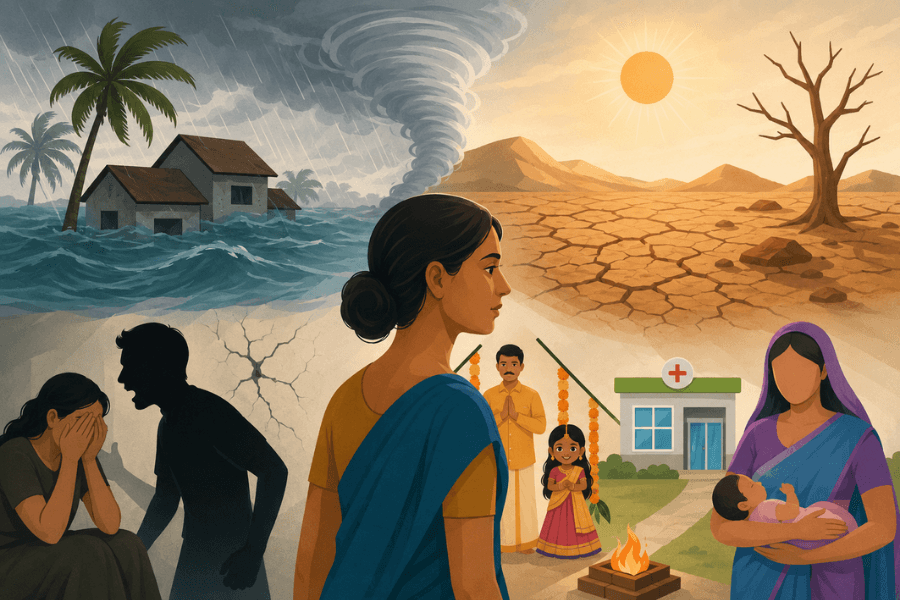
India’s climate adaptation debate is largely framed around infrastructure, agriculture and disaster response. Yet climate shocks also reshape household decisions, access to services and the distribution of care responsibilities within families. Women often bear a disproportionate share of these pressures.
The relationship between climate and gender, however, is frequently discussed as if all climate risks affect women in broadly similar ways. Evidence from across India suggests otherwise. Droughts, floods and cyclones create distinct forms of disruption, and their consequences for women’s wellbeing can differ significantly even where overall climate exposure appears similar.
Understanding these differences is critical because adaptation strategies centred primarily on exposure may overlook the pathways through which climate hazards translate into long-term social harm.
Different Hazards, Different Risks
The impact of climate change on women’s wellbeing depends not only on the level of exposure but also on the nature of the hazard itself. Around 40 percent of women live in districts exposed to climate vulnerability, while nearly 60 percent are exposed to droughts, 36 percent to floods and 26 percent to cyclones. Drawing on district-level climate vulnerability data from Council on Energy, Environment and Water (CEEW) alongside the fourth and fifth rounds of the National Family Health Survey (NFHS), a clear pattern emerges: different climate hazards are associated with different social risks.
The differences are consistent with the ways these hazards affect household life. Droughts are slow-onset events that gradually erode livelihoods through crop losses, declining incomes and water scarcity. Cyclones, by contrast, generate sudden disruptions through displacement, damaged infrastructure and interruptions to essential services. Floods often cause immediate damage but may allow faster restoration of livelihoods and public services in many affected regions. These distinct pathways shape how households cope with stress and, in turn, influence women’s wellbeing.
Women living in drought-exposed districts are 26 percent more likely to experience intimate partner violence and 38 percent more likely to discontinue the minimum recommended antenatal care during pregnancy. Cyclone exposure is associated with even stronger effects: a 27 percent higher likelihood of intimate partner violence, a 60 percent higher likelihood of dropping out of antenatal care, a 26 percent higher likelihood of miscarriage or stillbirth, and a 10 percent higher likelihood of child marriage. Flood exposure presents a markedly different picture. Its association with intimate partner violence and antenatal care dropouts is considerably smaller, at around 7 percent, while no statistically significant relationship is observed with child marriage or adverse pregnancy outcomes.
These findings suggest that climate hazards are not socially interchangeable. Similar levels of climate exposure can generate very different consequences depending on the type of shock households experience.
Where Climate and Social Vulnerability Converge
Hazard-specific risks do not operate in isolation. Their effects are amplified or moderated by the social and institutional conditions within which households respond to climate shocks.
Patterns across India illustrate how climate and social vulnerabilities frequently converge. Several districts in Bihar and Uttar Pradesh emerge as areas where climate exposure coincides with poor maternal health outcomes, including higher rates of miscarriage, stillbirth and inadequate antenatal care. In parts of Andhra Pradesh, Telangana, Maharashtra and West Bengal, climate vulnerability overlaps with higher prevalence of child marriage. Clusters associated with intimate partner violence are concentrated across parts of Karnataka, Andhra Pradesh and Tamil Nadu, alongside pockets of northern India.
These patterns suggest that climate and social vulnerabilities frequently reinforce one another, creating clusters of compounded risk that are difficult for households to escape. At the same time, parts of Kerala and Tamil Nadu illustrate that this relationship is not inevitable. Several highly exposed districts record lower prevalence of child marriage and better maternal health outcomes despite comparable climatic risks, underscoring the role that stronger institutions, accessible public services and greater social resilience can play in reducing the social costs of climate shocks.
From Exposure to Outcomes
These findings have important implications for climate adaptation. Identifying where droughts, floods and cyclones are likely to occur remains essential, but exposure alone cannot capture the risks women face. Adaptation strategies must therefore account not only for the geography of climate hazards but also for the distinct social pathways through which different hazards affect women’s lives.
As India strengthens its climate adaptation architecture, planning processes will need greater capacity to identify and respond to hazard-specific gender risks. This capacity will also be needed to assess emerging hazards such as extreme heat, whose social consequences remain less well understood. Strengthening coordination across the health, women and child development, disaster management and climate sectors will be essential if adaptation strategies are to reflect not only where climate hazards occur, but also how they affect people’s lives.
The broader lesson is that resilience cannot be measured solely by physical assets. Roads that remain functional after a cyclone and crops that survive a drought are important indicators of adaptation. Equally important are girls remaining in school, women retaining access to maternal healthcare, and households navigating periods of climatic stress without experiencing violence, forced marriage or adverse pregnancy outcomes. As climate risks intensify, these human outcomes will become just as important a measure of adaptation success as the protection of infrastructure itself.