



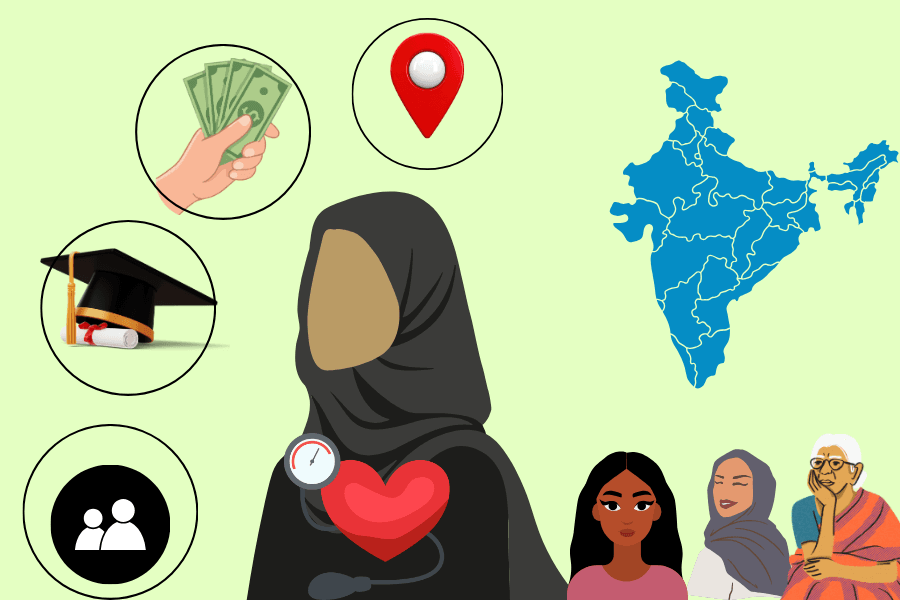
Hypertension has become one of India’s fastest-growing public health challenges, contributing to a rising burden of heart disease, stroke and kidney disorders. As India expands screening and treatment for non-communicable diseases, an equally important question is emerging: are these efforts reaching the populations where the risks are most concentrated? National averages provide only part of the answer. Beneath them lie pronounced differences in risk across age, education, wealth and geography. Muslim women offer a useful lens through which to understand how these inequalities shape the country’s evolving hypertension burden and why they matter for public health policy.
Hypertension Follows a Social Gradient
Across two rounds of the National Family Health Survey (NFHS), NFHS-4 (2015-16) and NFHS-5 (2019-21), around one in eight Muslim women aged 15-49 years had hypertension. This seemingly stable average, however, conceals substantial variation across population groups.
Age is the strongest predictor of risk. Among women aged 15-19 years, hypertension prevalence stood at just 3.4 percent in NFHS-5, rising to 28.8 percent among those aged 40-49 years. Even after accounting for socioeconomic characteristics, women in the oldest age group had more than eight times the odds of hypertension than those in their late teens.
Education reveals another clear gradient. Hypertension affected 18.4 percent of Muslim women with no formal education, compared with 7.6 percent among those with higher education. Together, these patterns indicate that hypertension increasingly reflects differences in life circumstances rather than being distributed uniformly across the population. As demographic and social conditions diverge, so too does the burden of disease.
When Prosperity Does Not Guarantee Better Health
The relationship between socioeconomic status and hypertension is, however, more complex than a simple story of disadvantage. While education appears to reduce risk, cardiovascular disease is becoming increasingly common among relatively better-off households.
Between the two NFHS rounds, Muslim women in the upper wealth quintiles were 37 to 51 percent more likely to have hypertension than those in the poorest quintile, even after accounting for other socioeconomic characteristics.
This pattern reflects an important stage in India’s epidemiological transition. Rising incomes often improve education, housing and access to healthcare, but they can also coincide with more sedentary lifestyles, dietary change, occupational stress and greater detection through expanded screening. As these forces unfold simultaneously, hypertension no longer remains concentrated only among traditionally vulnerable groups but increasingly spans wider sections of society.
The Geography of Risk
Hypertension is shaped not only by who people are but also by where they live. District-level analysis shows that hypertension clusters geographically rather than being evenly distributed, with the strength of clustering almost doubling between NFHS-4 and NFHS-5.
These spatial patterns matter because hypertension depends heavily on early diagnosis, regular monitoring and sustained treatment. Districts with similar demographic characteristics can therefore experience different health outcomes depending on the accessibility of healthcare services, local institutional capacity and the effectiveness of follow-up systems. Place itself becomes an important determinant of cardiovascular health.
Rethinking Hypertension Policy
The evidence suggests that India’s hypertension burden is becoming progressively more heterogeneous. Age, education, household wealth and geography each shape risk in different ways, making broad demographic averages an increasingly incomplete guide for policy. As India’s epidemiological transition advances, the profile of vulnerability will continue to evolve rather than remain fixed.
The next phase of hypertension policy should therefore move beyond uniformly designed interventions towards approaches informed by local epidemiology. Districts with persistent clusters require stronger screening, referral and follow-up systems, while prevention strategies should reflect differences in age, educational attainment and socioeconomic conditions. Such an approach would improve the effectiveness of existing programmes by directing attention to where risks are becoming most concentrated rather than assuming they remain unchanged over time.
Health inequalities evolve alongside demographic, economic and social change. Policies that continuously adapt to these changing patterns of risk will be better positioned to anticipate tomorrow’s disease burden rather than merely respond to today’s.