



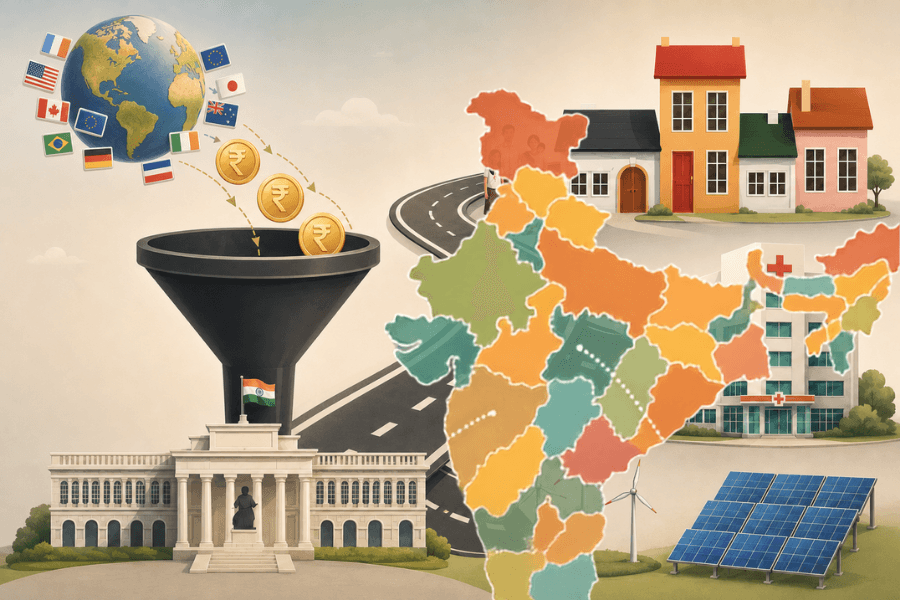
As India's investment needs continue to grow, governments are increasingly looking beyond domestic budgets to finance development. However, external finance for projects implemented by states is channelled through the Union Government, making it an integral part of the country's fiscal federal framework. Whether such financing expands public investment or simply replaces spending that governments would have undertaken anyway has therefore become an important policy question.
The question matters because states shoulder much of India's development spending despite relying on financial transfers from the Union Government, which account for nearly 45 percent of their total revenue receipts.
How External Finance Can Change Fiscal Transfers
India’s system of intergovernmental transfers combines two distinct approaches. Some transfers, such as Finance Commission tax devolution and statutory grants, are allocated through objective, rule-based criteria designed to reduce fiscal imbalances across states. Others are discretionary, allowing the Union Government greater flexibility to pursue development priorities. External development finance enters this system through Externally Aided Projects (EAPs), which account for roughly 10 percent of states’ total revenue receipts.
Although states cannot directly access international development finance, they play a central role in securing it by identifying priority sectors, preparing projects and seeking approval from the Union Government. Under India’s constitutional and fiscal arrangements, the Union Government borrows externally and channels these resources to states through Additional Central Assistance for Externally Aided Projects. While the project funds themselves remain earmarked, the Union Government retains discretion over its broader fiscal transfers to states.
This creates two possible responses. The first is aid fungibility, where the Union Government reduces discretionary transfers because external finance has already eased a state’s financing needs, allowing those resources to be deployed elsewhere. The second is resource loading, where externally aided projects attract additional discretionary transfers because they are expected to generate productive assets, strengthen future revenues and improve long-term development outcomes.
Since rule-based transfers are determined by predetermined allocation criteria, any fiscal response to externally aided projects is most likely to be reflected in discretionary transfers. The key question, therefore, is whether external finance substitutes for domestic public spending or encourages governments to invest more alongside it.
External Finance Reinforces Public Investment
Evidence from 29 states over the period 1979–2017 shows that externally aided projects are associated with an average 18 percent increase in discretionary transfers. Rather than replacing domestic spending, external finance appears to attract additional fiscal support from the Union Government.
This complementary relationship, however, is not uniform across states. It becomes considerably stronger when the governments at the Centre and in the state are politically aligned. Under the highest level of political alignment, externally aided projects are associated with an increase of around 76 percent in discretionary transfers. The finding suggests that political alignment strengthens incentives for governments to jointly support visible development projects, allowing discretionary transfers to reinforce externally financed investments.
Formula-based transfers show no comparable relationship with externally aided projects or political alignment. Their allocation continues to follow predetermined institutional rules. The contrast highlights an important feature of India’s fiscal federal system: political considerations shape transfers only where governments have discretion, while rule-based transfers remain insulated by design.
Designing the Next Phase of Development Finance
India’s development financing needs will continue to grow as states invest in infrastructure, urbanisation, climate resilience and public services. The evidence suggests that external finance can do more than fill financing gaps. When integrated effectively into India’s fiscal federal framework, it can encourage additional public investment rather than merely substitute for existing expenditure.
This finding also highlights the importance of institutional design. The contrasting behaviour of rule-based and discretionary transfers shows that transparent allocation rules continue to safeguard equity across states, while discretionary transfers provide governments with flexibility to reinforce high-priority investments. Maintaining this balance will be critical as development financing becomes more complex.
The lesson extends well beyond EAPs. As India increasingly mobilises climate finance, multilateral lending and other external sources of capital, the challenge will be to design fiscal institutions that reward states for attracting and implementing productive investments. The objective should not simply be to mobilise more external resources, but to ensure that they expand India’s overall public investment effort.