



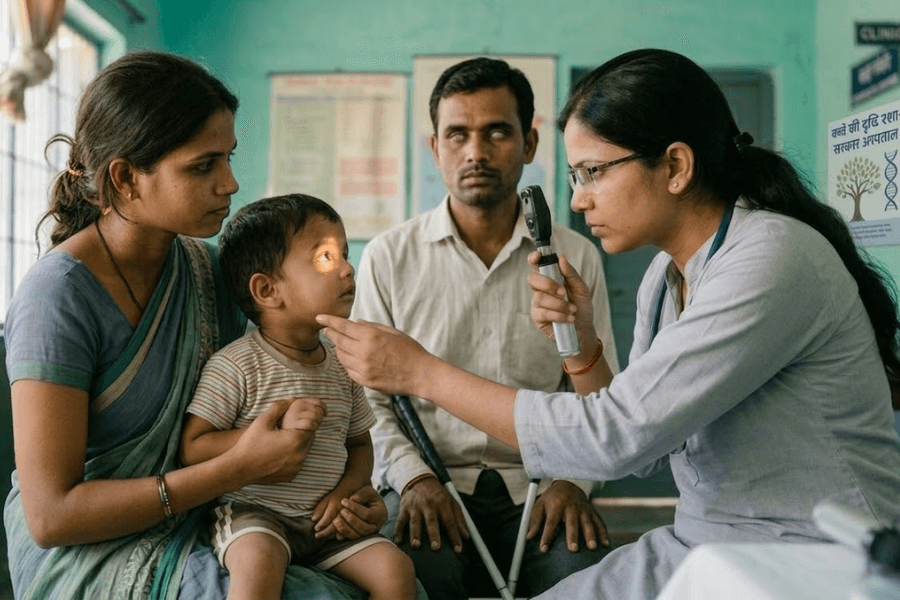
Glaucoma affects an estimated 12 million Indians and remains the country's leading cause of irreversible blindness. Because it often progresses silently and is detected only after damage has occurred, health policy has focused on diagnosing disease rather than preventing it. But within this broad and diffuse burden lies a narrower, more predictable subset: familial and juvenile forms – typically presenting in childhood / early adolescence – driven by identifiable genetic mutations. In these families, risk is concentrated, traceable, and often detectable well before structural damage becomes visible.
This distinction matters for institutional design. Public health systems struggle when risk is low-probability and population-wide, but perform far better when vulnerability is identifiable and bounded. Familial glaucoma belongs to this second category. The policy question, then, is not how to screen all Indians for glaucoma, but how to respond when risk is already known.
A System Built for Symptoms
India’s clinical governance architecture is organised around observable disease and measurable pathology. This design protects against unnecessary intervention and preserves scarce resources. But it also embeds a structural bias: action follows damage.
Genomic medicine unsettles that logic. A confirmed high-risk mutation in a child from an affected family signals elevated probability long before pressure rises or optic nerves deteriorate. The information is biologically meaningful, yet institutionally unsettled. Clinical guidelines do not clearly define when monitoring should intensify. Insurance frameworks rarely reimburse prolonged preventive surveillance, and treatment thresholds remain tied to visible impairment rather than predicted risk.
Familial glaucoma makes that gap unusually visible. It exposes a health system calibrated for reaction at a moment when science increasingly enables anticipation.
The Trade-Off Question
Any institutional redesign must recognise that not every individual carrying a high-risk mutation will experience identical disease progression. Age of onset varies, severity differs, and progression is uneven even within affected families. Surveillance and early intervention impose financial and psychological costs. Expanding genetic testing without calibrated protocols risks medicalising risk without proportionate benefit.
But in defined familial glaucoma cases, the alternative is not neutral. Late detection often means irreversible visual loss in adolescence or early adulthood. Even conservative estimates suggest that early-onset blindness carries a lifetime economic cost in the order of tens of lakhs of rupees, compounding over decades through reduced labour force participation, long-term caregiving needs and sustained disability support. The policy challenge, therefore, is calibration: determining who qualifies, how frequently monitoring occurs, when intervention thresholds are crossed, and how outcomes are evaluated so that predictive information translates into proportionate and evidence-based action.
The Window Is Open
India’s public health system is undergoing structural change. National investments in genomic research, expanding sequencing capacity in tertiary centres, and the digitisation of health records are reshaping the informational foundations of care. Yet these reforms remain largely disconnected from disease-specific preventive architecture.
Familial glaucoma presents a contained entry point. The affected population is identifiable through family history. The implicated genes are limited relative to complex polygenic disorders. Monitoring tools and therapeutic interventions already exist within ophthalmic practice. The reform required is institutional alignment rather than scientific discovery.
This is a manageable policy opportunity – bounded in scale, measurable in outcomes, and high in lifetime stakes. Integrating predictive genomics here would require connecting existing capacity to a clearly defined risk group. The question is not whether India possesses genomic capability, but whether it will embed that capability within preventive public health design.
Designing Predictive Integration
Integrating predictive genomics into glaucoma care demands clearly defined pathways.
First, hereditary glaucoma must be formally recognised within preventive child and adolescent health frameworks. Standardised family history protocols in tertiary and district hospitals can identify high-risk households early, converting recognition into systematic detection.
Second, cascade testing models must be institutionalised. When a confirmed case is identified, structured screening of first-degree relatives can proceed through predefined referral channels. This keeps expansion bounded within traceable networks rather than diffuse populations.
Third, genetic findings must trigger clear clinical algorithms. Monitoring frequency, imaging intervals, and intervention thresholds should be protocolised to reduce discretionary ambiguity. Predictive information without action pathways risks creating awareness without accountability.
This redesign should begin as a time-bound, state-level pilot across selected centres of excellence and district hospitals. Outcomes – vision preservation rates, compliance levels, and cost per disability-adjusted life year averted – must be measured transparently. Predictive genomics must enter public health through disciplined evaluation.
From Reactive to Risk-Responsive
Glaucoma is not only an eye disorder; it is a governance stress test. Familial glaucoma offers a contained and credible starting point for institutional redesign. If India can build a calibrated, evidence-based predictive pathway here, it establishes a template for integrating genomics into broader preventive policy - from other monogenic disorders to high-certainty inherited risks.
The question is no longer whether science can anticipate blindness. It is whether public institutions will adapt to act on foresight rather than aftermath.