

India’s agricultural policy landscape has evolved in recent years. The government’s 10,000 Farmer Producer Organisation (FPO) scheme has strengthened collective enterprise. Natural farming has entered public discourse. Climate resilience and sustainability are increasingly recognised priorities.
Yet, at the village level, a structural contradiction persists. While farmers are encouraged to collectivise and adopt climate-friendly practices, seed systems remain largely commercial and centralised. Fertiliser subsidies overwhelmingly support chemical inputs. Credit flows continue to favour input-intensive cultivation models. For many small and marginal farmers, this locks in a quiet dependency before the season even begins.
It shows up before sowing – in rising input costs, degraded soils, and shrinking margins that compound uncertainty. Shramik Bharti, a civil society organisation working across Uttar Pradesh and Punjab, began confronting this pattern through its field engagements.
“It began with a simple but profound question: what would it take to redesign local agricultural systems so that farmers regain control over seeds, inputs, and markets?” says Rakesh Kumar Pandey, CEO of Shramik Bharti.
The Institutional Spine: FPOs as Governance Platforms
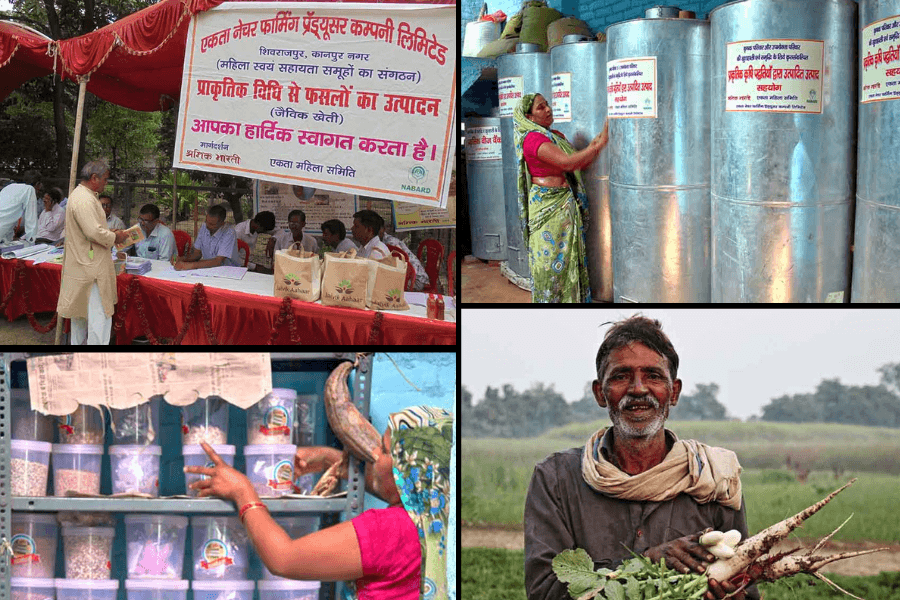
Across ten districts in Uttar Pradesh and Punjab, 29 FPOs promoted with Shramik Bharti’s facilitation now bring together over 14,500 farmers – 6,447 of them women. Members invest ₹2,000 each as shareholders, collectively governing aggregation, storage, processing, and market access. In 2024–25 alone, these FPOs generated over ₹7.6 crore in turnover and created local employment through food processing units.
These FPOs function as governance platforms – reflecting a field insight that regenerative agriculture must be institutionalised to endure. By placing farmers in governance roles, FPOs create the institutional capacity required to sustain ecological practices beyond project cycles.
“Policy has done well to promote FPOs,” Rakesh notes. “The next step is to recognise that ecological transition requires seed systems and bio-input ecosystems to be treated as infrastructure.”
Within this institutional spine, regenerative components – seed sovereignty, input autonomy, and household resilience – are integrated deliberately.
Layer 1: Embedding Seed Sovereignty within Farmer Institutions
In 2024–25, 75 seed saver farmers began conserving and multiplying indigenous Rabi crop varieties. Community seed banks were established to store and share farmer-grown wheat, mustard, chickpea, and traditional vegetable seeds cultivated under natural farming conditions.
Importantly, these seed banks are embedded within FPO structures. One of the earliest FPOs in Shivrajpur block integrates ten seed banks, five bio-input resource centres, and storage facilities within its governance architecture. Over 600 small and marginal women farmers are members.
“Seed sovereignty is not about nostalgia,” Pandey explains. “It is about community agency – what is planted, and at what cost.”
Within this arrangement, seed saver farmers multiply stock that circulates through community seed banks under FPO governance. Shareholders oversee access and replenishment, with women members participating directly in these decisions. This shifts seed management away from individual market purchase toward collective institutional control, reducing dependence on commercial seed systems.
Layer 2: Designing Input Autonomy
Seed autonomy alone does not break dependency. Across programme villages, 62 bio-resource centres now function as decentralised hubs where farmers prepare and access bio-fertilisers and pest management solutions using locally available materials such as cow dung.
For farmers accustomed to paying ₹1,300 per bag of diammonium phosphate (DAP) – a widely used, nitrogen- and phosphorus-rich fertiliser – the cost differential is immediate.
“When farmers prepare their own inputs, they are not just saving money,” Rakesh reflects. “They are reducing exposure to volatility.”
The system operates through recurring village trainings aligned with crop cycles, residential immersion programmes, exposure visits, and on-farm support. Soil samples are tested to guide crop planning. Mulching, decomposers, and zero-tillage practices convert crop residue into soil nourishment. In Punjab, stubble once burned is increasingly repurposed as mulch and compost.
The ecological gains – improved soil organic matter, moisture retention, biodiversity – accumulate gradually. The economic relief from reduced input costs is more immediate. Together, they make cultivation more predictable across seasons.
Layer 3: Building Household Resilience before Market Integration
A foundational design principle underpins the model: food sovereignty precedes market participation.
Over 300 kitchen gardens in Punjab now generate an average of 24 kilograms of fresh vegetables per household per month – nearly 20 days of nutritional security. Micro food forests, backyard poultry units supported through Azolla-based feed systems, and small livestock enterprises diversify livelihoods at the household level.
“Regeneration begins at the household,” Rakesh says. “If families are nutritionally secure, they negotiate with markets differently.”
Surplus then flows through FPO channels, where aggregation, processing, and digital market access platforms such as eNAM and ONDC expand opportunity.
Integrated Impact: Shifting the Risk Structure of Smallholder Agriculture
When seed sovereignty, input autonomy, household resilience, and collective enterprise operate together, their effects compound.
Farmers move from price-takers to informed negotiators. Women shareholders gain voice in governance structures. Local jobs emerge in processing units. Soil health improves, reducing long-term vulnerability to climate stress. Dependence on volatile input markets declines.
Over 5,000 farmers across Uttar Pradesh and Punjab are now practising forms of Aavartansheel (cyclical) natural farming within this integrated framework. Landscapes once characterised by chemical dependency are gradually transitioning into self-sustaining ecosystems.
“When farmers stop being consumers of inputs and become custodians of systems, agriculture changes,” Pandey reflects.
In effect, the model alters both economic incentives and ecological outcomes simultaneously. In an era of fiscal strain and climate volatility, reducing input dependency is not only a farmer concern – it is a macroeconomic and environmental imperative, particularly in a country where millions of smallholders remain exposed to volatile global input markets.
What Policy Can Learn from Field Practice
Field engagement surfaces design lessons rather than ideological critiques. These lessons emerge from the friction between local practice and existing policy architecture – not from abstract debate.
First, FPO policy must expand beyond aggregation. Farmers are already governing seed banks and bio-input systems within FPOs; recognising these as core institutional functions would anchor ecological practices within farmer-led structures.
Second, fiscal incentives need gradual rebalancing. Subsidy regimes remain tied to conventional inputs even as decentralised systems reduce input dependence. Aligning expenditure with lower-input practices would reduce exposure to global price shocks while strengthening soil health.
Third, seed governance frameworks can enable complementarities. Community-managed seed systems need not compete with formal systems; policy can support coexistence to strengthen biodiversity and local adaptability.
Finally, credit design must reflect altered cultivation economics. Regenerative systems lower cash requirements and diversify income streams, yet financial instruments continue to assume input-intensive models. Credit products that recognise these shifts would accelerate adoption while lowering risk.
“Ecological transition cannot be an add-on,” Rakesh argues. “It requires institutions, incentives, and infrastructure to move together.”
The lesson from the field is not that existing policy frameworks must be abandoned, but that they can be strengthened. When institutional governance, fiscal incentives, seed systems, and credit architecture align with ecological principles, regenerative agriculture becomes not merely a programme, but a durable development pathway.
From Field Practice to Policy Architecture
Designing regenerative agriculture from the ground up does not demand abandoning existing policy frameworks. It calls for strengthening them by aligning local institutions with ecological principles.
If replicated and adapted across contexts, such institution-led regeneration could help convert natural farming from a programme into a durable rural development architecture.
The question for policymakers, civil society actors, and farmer institutions alike is not simply whether regenerative agriculture works – but how institutional design can make it work at scale.