

When Raju Kendre speaks about education, he does not begin with policy. He begins with a memory of his own schooling in rural Maharashtra.
A small residential school in rural Vidarbha. A hall shared by dozens of children. For three years, that was Raju Kendre’s world – a hostel cot marking the extent of his personal space. He recalls it without sentimentality, almost matter-of-fact.
Education in his family had not travelled far before him. His mother, once a bright student, was married at seven. His father was nine. For Raju, education carried a different weight – not escape, but continuation; the possibility of extending what had been cut short.
Years later, when he arrived in Pune to prepare for the civil services, the dream collided with reality. The classroom culture, the confidence of city students, and the invisible rules of interaction – none of it had been taught. Within six months, he dropped out.
His exit was not an individual failure; it revealed a design feature of India’s higher education expansion. Over the past two decades, policy has widened access dramatically – expanding enrolments and scholarships for first-generation learners. Yet the architecture remains concentrated at the point of admission. The move from rural schooling to English-dominated campuses, from undergraduate study to competitive fellowships, from regional colleges to national institutions – these passages remain thinly supported. For many first-generation learners, it is only the beginning of a far more complex transition.
“It wasn’t that I couldn’t study,” he reflects. “It was layers: language, information, financial resources, how to even talk to people from cities.”
The setback did not end his educational journey. He later completed his master’s degree at the Tata Institute of Social Sciences, received the Chevening Scholarship to study in the United Kingdom, delivered a TEDx talk, and later earned several national and international recognitions.
Eklavya India Foundation emerged from that structural insight.
Building Transition Architecture
Eklavya was formally institutionalised in 2017, building on a series of voluntary mentoring efforts and workshops that had already begun showing measurable outcomes within two years at a college where academic progression had long stagnated. What began as informal guidance for a handful of students gradually evolved into a structured initiative addressing deeper barriers to educational mobility.
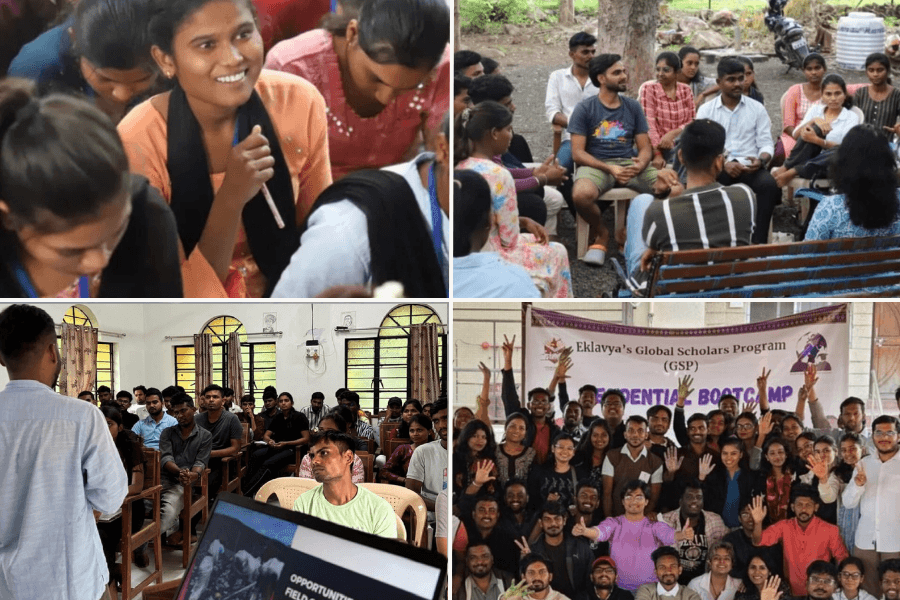
Since then, Eklavya has developed a range of interventions that go the extra mile. It has conducted around 25 structured courses ranging from two to six months, engaging more than 1,500 participants; organised 800 workshops across India for over half a million first-generation students from marginalised communities; and mentored over 7,000 students across states through nearly 100 residential bootcamps.
“Real mobility needs to break the mould through all possible pathways,” Raju clarifies. “It gives an immense sense of purpose when I see over 3,000 of our students having secured admission in 100s of universities and development fellowships, including more than 500 of them in leading universities globally.”
What first-generation learners often lack is not merit, but digital fluency, academic writing, networks, and the confidence to co-learn with more privileged students.Eklavya’s programmes focus on that transition architecture: application mentoring, and guided entry into learning ecosystems.
Embedding Mentorship Locally
Eklavya works extensively with tribal communities in Maharashtra, particularly in Melghat and the Satpura region. In these districts, the challenge is often not the absence of schemes but the absence of intermediaries who can translate them into accessible pathways. Eklavya works with Integrated Tribal Development Programmes, Eklavya Model Residential Schools (EMRS), and ashram schools, focusing on mentoring and skill-building rather than building parallel infrastructure.
The emphasis is not only upward mobility, but circular mobility. A growing network of alumni – many of whom are now professionals, researchers, and social sector leaders – has begun to play an active role in mentoring the next generation. Collectively, the initiative has delivered more than a million hours of mentorship and career guidance, creating a self-reinforcing ecosystem in which those who benefit from the programme increasingly return to support others following similar paths.
“We do not need one big institution but local sparks everywhere.” Raju says. “A local undergraduate from the Melghat–Satpura region completed his Master’s degree at TISS, Mumbai and came back to work in his home region; another from a nomadic Banjara community is currently pursuing a Master’s degree in Edinburgh and has already supported higher education pathways of 15–20 students from similar backgrounds.”
Yet the barriers remain social as well as academic. In some communities – particularly for girls - higher education requires sustained negotiation with families. Access alone is no longer the only question; the purpose of education itself is contested.
“Education has value,” Raju observes, “but what kind of education? Clerical education? Or critical education?”
For him, the distinction matters. One prepares students narrowly for routine employment; the other builds analytical capacity, confidence, and the ability to navigate complex institutions. In regions where higher education is still new, this choice shapes not just careers, but the horizon of aspiration itself.
When the State Joins
Public schemes expand seats and scholarships, but few institutions systematically build the cultural and informational capital required to access competitive fellowships, national universities, or global academic spaces. Eklavya’s approach fills this void.
Through the Adivasi Global Scholars Program, Eklavya partnered with the Maharashtra Tribal Development Department to address a persistent policy gap: several overseas scholarships earmarked for tribal students were going unfilled despite full public funding. The collaboration emerged from a shared recognition that the bottleneck was not the absence of scholarships but the absence of structured preparation and application support for eligible students.
The programme therefore combined institutional access with targeted mentoring. Eklavya organised more than 30 outreach workshops and three residential bootcamps within a few months, while mentors worked with applicants on practical aspects of the process – identifying suitable universities, preparing statements of purpose and CVs, understanding scholarship criteria, and navigating documentation and interviews. Such structured guidance is a core feature of the foundation’s Global Scholars mentorship model, which helps first-generation students navigate complex admission and scholarship systems that are otherwise difficult to access
The result illustrates how design and collaboration can improve policy delivery. With mentoring embedded alongside the department’s scholarship scheme, all 40 slots under a major state-funded international scholarship programme – collectively worth more than ₹25 crore – are expected to be utilised for the first time, addressing a long-standing pattern where such schemes remained under-subscribed because of procedural complexity and information gaps.
As Raju puts it, “If you work with the system, you can scale. But you need access.” Recognition exists, but formalised engagement remains uneven – pathways that allow grassroots mentoring to operate within, rather than alongside, public institutions. When these align, community-based mentoring becomes part of the policy ecosystem rather than a parallel effort.
Design Lessons from the Ground
Eklavya’s experience offers more than an individual story; it exposes structural design questions in India’s education architecture.
The first lesson concerns transition design. India’s expansion strategy has concentrated on widening entry – enrolment, seats, scholarships. But mobility depends on structured scaffolding across stages. The move from regional colleges to national institutions, and from vernacular schooling to English-dominated professional spaces, remains under-supported, creating predictable drop-offs at key junctures.
A second lesson lies in how skills gaps are framed. Digital fluency, professional communication, and familiarity with fellowship or civil services ecosystems are often treated as personal deficits. In practice, they reflect uneven access to institutional ecosystems. Mentoring, academic writing support, and guided exposure are not add-ons; they are institutional functions. Reframing these gaps as design questions shifts responsibility from the student to the system.
The third lesson concerns institutional linkage. Scholarships, tribal welfare schemes, and residential school infrastructure provide an essential backbone. What remains underdeveloped are connective layers: referral systems, structured data-sharing, access to physical spaces in ashram schools, and sustained academic support beyond initial placement. Without these linkages, mobility remains episodic rather than systemic.
From Recognition to Integration
As Eklavya approaches a decade of work, its ambitions for what can be done are expanding. The organisation aims to strengthen its Global Scholars Programme at a national scale while building deeper institutional partnerships and more active alumni chapters. Over the next decade, it hopes to cultivate a network of 1,000 global scholars who can mentor future cohorts and widen pathways for first-generation learners.
The vision extends beyond helping students secure admission. It includes mid-career bootcamps, sectoral leadership programmes, and professional networks that sustain mobility over time rather than treating opportunity as a one-time transition.
Yet the broader question extends beyond a single organisation. If education policy has widened the front door, the next reform frontier lies in strengthening the corridors inside. Treating grassroots mentoring institutions as structured implementation partners - with access to institutional spaces, data, and formal referral mechanisms - could help shift educational mobility from exceptional to systemic.
For first-generation learners, the gap between admission and arrival is rarely about ability. It is about architecture - whether the systems of guidance, mentorship, and opportunity extend beyond entry.