



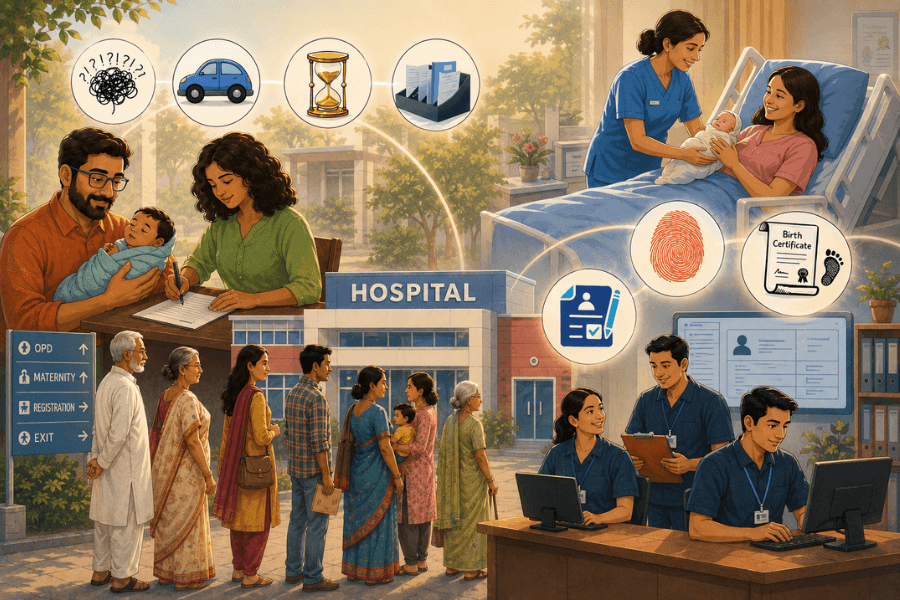
Birth registration has historically depended on household initiative, where families approach administrative offices after childbirth. That model places the burden on awareness, mobility, and time. The emerging pattern shows a different institutional arrangement. Birth registration among children under five has risen from about 80 percent in 2015–16 (NFHS-4) to nearly 89 percent in 2019–21 (NFHS-5). Over the same period, institutional births increased from roughly 79 percent to 89 percent. More recent Civil Registration System (CRS) data for 2023 indicates that birth registration has since climbed to nearly 98 percent, suggesting that the trend observed in NFHS data has continued and deepened.
These shifts have altered how legal identity is produced. When childbirth takes place within formal health systems, registration increasingly begins alongside service delivery rather than through separate administrative action by households. Identity is generated within the system rather than pursued outside it. This is the logic of suo moto registration; the principle that the state, not the household, bears the obligation to record a birth at the point and moment of its occurrence.
The Registration of Births and Deaths Act already makes registration free, compulsory, and universal. State rules under the Act, in the majority of states, designate government health facilities as Registrars – not merely informants but legally empowered recording authorities. Reflecting this, the Office of the Registrar General of India has since mandated that all institutional births be accompanied by a birth certificate issued before discharge. The data examined here shows what becomes possible when that legal framework is actually operationalised: registration ceases to be a burden placed on citizens and becomes a duty discharged by the state.
The Equity Effect of Institutional Births
The expansion of institutional births has begun to reduce long-standing inequalities in registration. The poorest households have seen the largest gains. Birth registration among the poorest increased by about 25 percentage points between 2015–16 and 2019–21. Over the same period, the gap between the poorest and richest households declined from 28.6 percentage points to 14.4 percentage points.
This shift has weakened the influence of socio-economic barriers that historically shaped registration outcomes. Earlier, wealth and education strongly affected whether families completed registration procedures. The expansion of institutional delivery systems has narrowed this dependence by reducing the administrative burden placed on households.
A similar pattern is visible across caste and religious groups, where gaps in registration have also narrowed. Access to institutional care is beginning to offset some structural disadvantages that previously shaped documentation outcomes.
Grassroots Facilities as Registration Hubs
The transformation is most visible at the level of primary health infrastructure. Primary Health Centres and Community Health Centres are emerging not only as delivery points but also as local administrative gateways. The share of institutional births occurring in these facilities increased from 30.5 percent to 34.7 percent between 2015–16 and 2019–21. Registration among births in these facilities rose from 80.8 percent to 90.2 percent, which is the largest improvement across delivery settings.
The organisational role of these facilities is significant. Public health centres operate within administrative channels that are more directly connected to civil registration authorities than most private facilities. This allows documentation to move through routine institutional channels rather than requiring separate follow-up by families. The costs that families would otherwise bear, including travel to registrar offices, repeated visits, lost wages, documentation fees, and reliance on intermediaries, are absorbed within the facility’s own institutional workflow.
The importance of decentralised infrastructure is visible in states where these facilities have been designated as Registrars or formal reporting points. Delhi (40.5 percent relative change), Rajasthan (35.9 percent relative change), and Uttar Pradesh (22.2 percent relative change) have recorded some of the sharpest improvements in registration under such arrangements.
How Policy Alignment Drove Change
This transformation reflects layered policy design rather than a single intervention. Investments in public health infrastructure expanded access to institutional care, particularly in rural areas. The National Health Mission strengthened the supply side, while schemes such as the Janani Suraksha Yojana altered household incentives through conditional support for institutional deliveries.
These policies reinforced one another. Health policy expanded access to facilities, while administrative design ensured that each interaction produced a record. The result was a model in which health systems and civil registration processes became increasingly interconnected.
The scale of change also reflects coordination across levels of governance. National programmes expanded infrastructure and incentives, while state governments adapted registration arrangements through local reforms.
Where Gaps Still Persist
Despite these gains, important gaps remain across regions. NFHS-5 data reveals that in states such as Bihar, Jharkhand, Nagaland, and Uttar Pradesh, more than one quarter of births remain unregistered. In some of these states, even the richest households report registration rates below 90 percent.
These patterns point to uneven institutional capacity rather than only differences in household awareness. Since civil registration is a Concurrent List subject, administrative systems remain inconsistently integrated across states, limiting how reliably births move from health systems into civil registration records. In some areas, health infrastructure has expanded faster than registration linkages. In others, migration, remoteness, and fragmented local coverage continue to interrupt documentation processes.
The persistence of gaps, even among wealthier households in certain states, suggests that the remaining challenge increasingly lies in uneven state capacity and implementation design.
Designing the Next Phase of Integration
The next phase of reform will depend on strengthening coordination between health systems and civil registration databases. Digital integration can reduce reporting delays and improve continuity across records. Expanding the formal role of primary and community health centres as registrars can deepen decentralised coverage, while community health workers can help identify births occurring outside institutional settings.
The organising principle for this next phase must be automatic registration at the point of birth: every institutional birth should initiate a registration record, completed before discharge, without requiring a separate act by the household. The RBD Act already provides this legal basis. What remains is implementation. Institutions operating on this principle will not only reduce the economic burden on families but also build trust in government, as citizens see the state acting proactively and responsively. Issuing birth certificates closer to the point of discharge can accelerate recognition of identity, while standardised protocols across states can reduce procedural variation.
The broader lesson extends beyond birth registration itself. Public service systems increasingly shape how legal recognition is delivered, particularly when welfare and administrative processes function together rather than separately. India’s recent gains reflect the institutional potential of that approach. The next step is to extend it more evenly across states and to anchor it in a clear restatement of what the law already implies: registration is the state’s duty, not the citizen’s burden.