

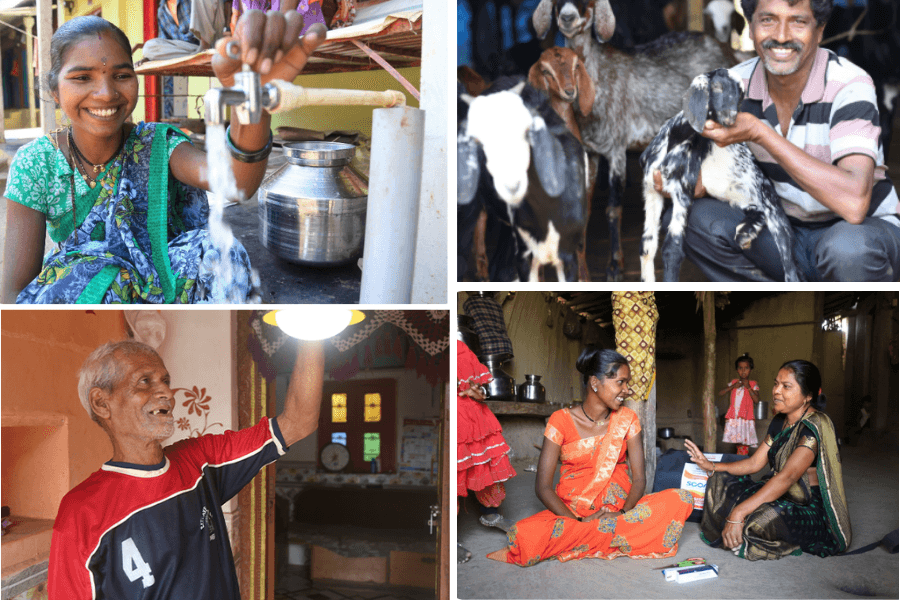
For Mangesh Wange, the real question in rural development is one of agency: who decides, who adapts, and who remains accountable when others step back? Trained as an agricultural engineer and later at IIM Ahmedabad, he spent several decades in corporate leadership roles before turning to rural development. A pivotal conversation with Ronnie Screwvala sharpened that question, reframing change not as something delivered to communities but as something that must be designed and sustained where people live.
“That conversation forced a simple question,” Mangesh recalls. “If communities don’t own decisions, what exactly are we building?”
At Swades Foundation, which works across water, sanitation, health, education, and livelihoods in rural Maharashtra, this shift translated into a different operating logic. Rather than sequencing projects, the organisation focused on how village institutions function – how priorities are set, responsibilities assumed, and systems sustained once external actors step back. Mangesh joined Swades first as Chief Operating Officer and later as CEO and Board Member, bringing systems discipline to the design of grassroots institutions.
“You cannot expect people to change outcomes if they are never trusted to shape them”, he says.
Reframing Poverty as a Decision Constraint
That trust, for Mangesh, begins with recognising what he calls mental poverty – a narrowing of expectations shaped by repeated exclusion from choice and control. Programmes can deliver assets, but if people remain peripheral to how priorities are set and maintained, outcomes rarely endure.
At Swades, the response is structural. Village Development Committees – known locally as Gram Vikas Samiti – serve as the primary site of local governance. Women constitute at least half the membership, younger residents handle execution and coordination, and elders act as margdarshak, mediating conflict and sustaining norms. These bodies set priorities, sequence interventions, and address breakdowns as they arise.
“When you clarify authority and embed responsibility in a village, outcomes begin to shift,” Mangesh says.
Why Interventions Run Together
Village life rarely conforms to neat sequencing. Water access influences schooling; health shapes livelihoods; sanitation affects time use.
“Lives are not organised that way, and neither are decisions. Treating these as separate problems,” he says, “often displaced constraints rather than resolving them.”
Swades therefore works across water, sanitation, health, education and livelihoods simultaneously – not for comprehensiveness, but for coherence. Progress in one area is designed to reinforce another, preventing gains from stalling.
Sustaining that coherence requires constant local coordination and collaboration. Swades Mitras (trained community health volunteers) alongside other vital ecosystem players working in education, sanitation, and livelihoods, operate within village systems – translating committee priorities into action and ensuring that agreed standards hold.
“The point is not to do things for the village,” Mangesh says. “It is to make sure the village’s decisions actually get done.”
The 4E Rules That Make It Happen
Over time, the choices and practices at Swades have consolidated into consistent operating design – discipline, shaping how decisions are made, acted upon, and sustained after external facilitation eases. What matters is – whether engagement produces mutual trust, empowerment produces capability, execution produces reliability, and exit leaves behind institutions that continue to decide.
Engage begins with who participates and on what terms. Engagement is anchored in Village Development Committees, who help build understanding and mutual trust with Swades and within the communities.
Empower focuses on building the capacity to act on those decisions. Over 11,000 community volunteers – many of them women – anchor this effort, with empowerment understood as sustained decision capacity rather than episodic training or task delegation.
Execute is where intent meets everyday constraint. Execution is assessed not by installation or completion, but by whether systems continue to function months later and whether communities respond when they do not.
Exit comes into play once committees demonstrate the ability to manage assets, mobilise contributions and make course corrections on their own. External actors step back while communities retain authority over decisions, oversight, and correction.
“These four principles operate as a single system. Engagement without empowerment stalls. Execution without exit recentralises control,” Mangesh says. “What holds them together is consistency: applying the same decision rules across villages, year after year, until institutions outlast projects.”
From Funded Delivery to Shared Contribution
Early interventions at Swades were largely fully funded, prioritising speed and coverage. Assets were installed quickly, uptake was high, and outputs were visible. But over time, a constraint surfaced: where communities had little stake in mobilising resources, responsibility for upkeep remained external.
“We could see the systems working,” Mangesh says. “But we could also see where ownership stopped.”
Since then Swades ensured a community contribution of up to 25 percent across several interventions. The contribution could take the form of cash, labour, or locally arranged inputs, but its intent was consistent: communities were required to invest materially in the decisions they made.
In 2017, Swades introduced the Village Development Committees – a shift from the ‘push’ to ‘pull’ approach. This shift changed the texture of implementation facilitating unity and shared ownership Committees debated priorities more carefully, households weighed trade-offs, and maintenance responsibilities became explicit.
“When people own the decision together, they stay with it,” Mangesh says.
Communities demonstrated the ability to mobilise resources, manage vendors, and resolve breakdowns independently – allowing external actors to step back without recentralising control.
As communities begin to own self-development (Swa Se Bane Des) how progress is tracked also changes. Village Development Committees track a small set of indicators tied directly to assets and services they manage. The emphasis is on regularity rather than sophistication.
“What matters is whether the information changes the next decision,” Mangesh says.
Dream Villages and Compounding Value
Over time, these layers of decision-making – ownership, unity and feedback – begin to settle into a different village equilibrium. At Swades, this condition is described as a Dream Village – one where institutions function without external prompting. Assets continue to exist, but responsibility for them no longer rests outside. Decisions are taken locally, revised locally, and enforced locally.
“A Dream Village is one where the system doesn’t wait for us,” Mangesh says. “It responds on its own.”
Across these villages – now over 250 – the compounding effect of aligned decisions becomes visible. Time once spent managing scarcity is redirected towards livelihoods. Household investments become more predictable. Collective action – whether to maintain an asset or negotiate with external agencies – draws on institutions that already exist. What matters is that these gains continue to accrue after programmes recede.
Working With the State, Not Around it
These experiences shape how Mangesh thinks about policy – not as intent set at a distance, but as something tested at the point of delivery. From his perspective, most policies do not fail because of flawed objectives. What matters is that these gains continue to accrue after programmes recede.
What stands out is the importance of timing and sequence. Delays in fund release, misalignment between departments, or rigid procurement rules often weaken local momentum. When implementation lags, community institutions lose rhythm; when inputs arrive out of sequence, decision-making authority recentralises by default. These are not peripheral issues – they determine whether policy translates into action or stalls midway.
Where committees track functionality, mobilise contributions and resolve breakdowns themselves, policy intent is more likely to endure. Where such checks are absent, even well-funded programmes struggle to sustain outcomes.
“We see ourselves as implementation partners,” Mangesh says. “Our role is to show what it takes for a policy to actually work on the ground.”
The implication is practical rather than ideological. Durable change depends on designing implementation around clear authority, shared contribution, local monitoring, and timely exit. Where those conditions are met, institutions persist – and policy finds traction beyond the life of a programme.