

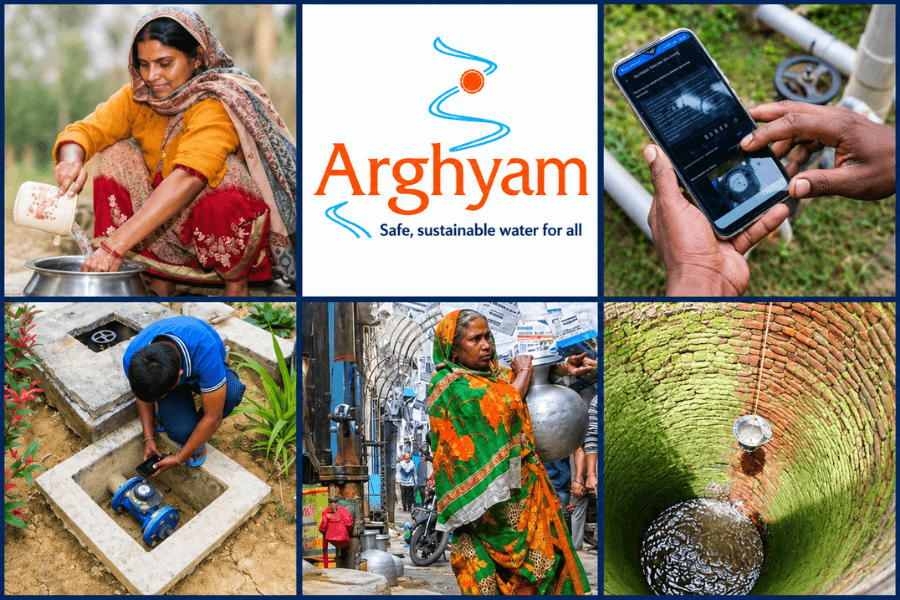
India's expansion of rural piped water infrastructure under the Jal Jeevan Mission has brought the challenge of sustaining water services into sharper focus. Installing household connections creates the means to deliver water, but ensuring regular and safe supply requires functioning equipment, timely repairs and institutions capable of managing these systems over time.
For Arghyam, a philanthropic organisation founded by Rohini Nilekani in 2001 and working towards safe and sustainable water for all, this has meant reconsidering how it engages with government programmes and local institutions. Its Chief Operating Officer, Manu Srivastava, brings over two decades of experience in developing technology solutions for large-scale social impact, including as part of the founding team of the eGovernments Foundation. Arghyam reports reaching 11.7 million people through 231 projects across 28 states.
From Grassroots Initiatives to Sustaining Water Systems
Arghyam began concentrating on water around 2005, supporting civil society organisations working on water quality, groundwater management, sanitation and water-related conflicts. It also promoted participatory approaches to water management and strengthened networks and institutions that generated knowledge to inform policies and programmes on water quality and groundwater management.
Government programmes subsequently influenced where Arghyam directed its efforts. The Swachh Bharat Mission led it to withdraw from much of its sanitation work as government investment expanded. When the Jal Jeevan Mission began in 2019, however, Arghyam approached the government with a different proposition.
"When the Jal Jeevan Mission began, we recognised that building infrastructure was only part of the challenge. Maintaining these systems and sustaining water supply would be considerably more difficult. We offered to partner with the government to support this transition from infrastructure creation to service delivery," Manu recalls.
Arghyam's earlier experience had also demonstrated the importance of adapting interventions to local conditions. In participatory groundwater management, it worked with organisations in Uttarakhand, Gujarat, Maharashtra and Andhra Pradesh. While the objective of community-led groundwater management was shared, arrangements differed across locations.
In one location, community members agreed not to drill additional borewells. Such an agreement depended on local groundwater conditions and community relationships. Different resource conditions in Kutch or the spring-dependent areas of Uttarakhand called for other approaches.
This understanding of local variation became particularly important as Arghyam explored how to enable communities and local institutions to take ownership of and manage water supply infrastructure across thousands of villages.
Why Monitoring Rural Water Supply Is Difficult
In Assam, officials overseeing approximately over 19,0000 water supply schemes faced a basic operational problem. While households knew whether water had reached them, officials managing hundreds of schemes lacked a reliable way to determine which schemes had supplied water on a particular day.
"We explored whether existing infrastructure could address this gap,” Manu explains. “Most schemes already had bulk flow meters, so the basic infrastructure for collecting the information was in place. The challenge was to capture the readings reliably and make actionable information readily available to officials."
Arghyam developed JalSoochak, a WhatsApp- and mobile-based system that uses photographs of existing bulk flow meters and artificial intelligence to extract readings. According to Arghyam, more than 16,500 Jal Mitras have used the system, recording 2.2 million readings. This has enabled operational monitoring across water supply schemes and helped identify those requiring attention, although meter readings alone cannot establish whether households receive adequate, safe and regular water.
Arghyam subsequently explored extending the solution to other states, revealing an assumption in its original design.
"We initially thought that a solution working in Assam could be replicated elsewhere. But when we went to Punjab, we found that the schemes did not have bulk flow meters," Manu reflects.
Arghyam therefore began exploring electricity consumption as another indicator of scheme operations. However, interpreting such data requires information about pump characteristics, energy use and local operating conditions. Neither method, by itself, provides a complete picture of service delivery.
The Assam experience reinforced Arghyam's broader thinking on digital public infrastructure (DPI) for water: rather than requiring identical technologies across states, a common digital framework could allow different systems to generate and exchange operational information.
Making Water Data Work for Local Institutions
Making different monitoring technologies interoperable is only one part of building this framework. It also requires understanding whose information needs it must serve and how the data will be used.
Arghyam identifies three groups whose requirements deserve particular attention: frontline workers operating water schemes, gram panchayats and Village Water and Sanitation Committees (VWSCs), and engineers responsible for technical support.
Their operational needs differ. A pump operator may need information about equipment performance, while an engineer may require readings and maintenance records to investigate a failure. Village institutions may need to understand recurring interruptions, arrange repairs and manage expenditure.
"The primary purpose is not reporting, but enabling these three sets of stakeholders to solve local water problems. If the data serves only higher-level reporting requirements and cannot help those responsible for supplying water, we are missing its real purpose," Manu explains.
While state-level monitoring may rely on aggregated information across thousands of schemes, those operating individual schemes need detailed and timely data to respond to problems. Translating this information into action also requires strengthening local processes and building local capacity beyond the digital system itself.
Building the Capacity to Sustain Water Services
Rural water supply schemes involve government departments, contractors, gram panchayats and village committees. Large programmes place substantial demands on these institutions, often before they have developed the personnel, systems and coordination arrangements required to deliver at scale.
Manu describes the need for an initial period of institutional preparation as phase zero:
"The capacity of government, the private sector and civil society to undertake something of this scale cannot develop overnight. We call it phase zero: investing time in building the systems, processes and capabilities before implementation accelerates. If you want to move quickly, you must first invest in building those muscles."
The consequences of inadequate preparation become particularly evident after construction, when responsibility for operating a scheme passes to village institutions.
"We have built the infrastructure, and now we expect gram panchayats and VWSCs to maintain it. But many of them were not consulted when these systems were being developed. They need time, financial resources and institutional support to manage these utilities. Otherwise, we risk creating another graveyard of failed water supply schemes," Manu cautions.
Arghyam's work in Bihar illustrates how some of these requirements can be addressed through support for local operations and maintenance. During 2024–25, an initiative with Aga Khan Rural Support Programme (AKRSP-I) and Water For People reached more than 70,000 households across 621 wards in five districts. It combined community forums, frontline support and digital tools for tracking maintenance and managing billing, with tariff collections totalling ₹1.94 crore. These activities demonstrate efforts to strengthen the operational and financial processes needed for local water management.
Such responsibilities require adequate financial resources, technical assistance and clearly defined maintenance arrangements. Assigning ownership to village institutions is not the same as equipping them to manage water services independently.
Arghyam's experience points to a challenge extending beyond infrastructure creation: building the institutional capacity to identify problems, mobilise resources and sustain water services. For rural households, the ultimate measure of progress is not simply a tap connection, but whether safe water continues to flow through it.