



Cost–benefit assessments decide which metro lines get built, which are delayed, and which are judged too expensive to justify. When assessments focus narrowly on immediate commuter time savings, they can materially understate the welfare impact of urban transit. Evidence from Mumbai suggests that measurement choices alone can change the apparent scale, distribution, and even the viability of metro investment.
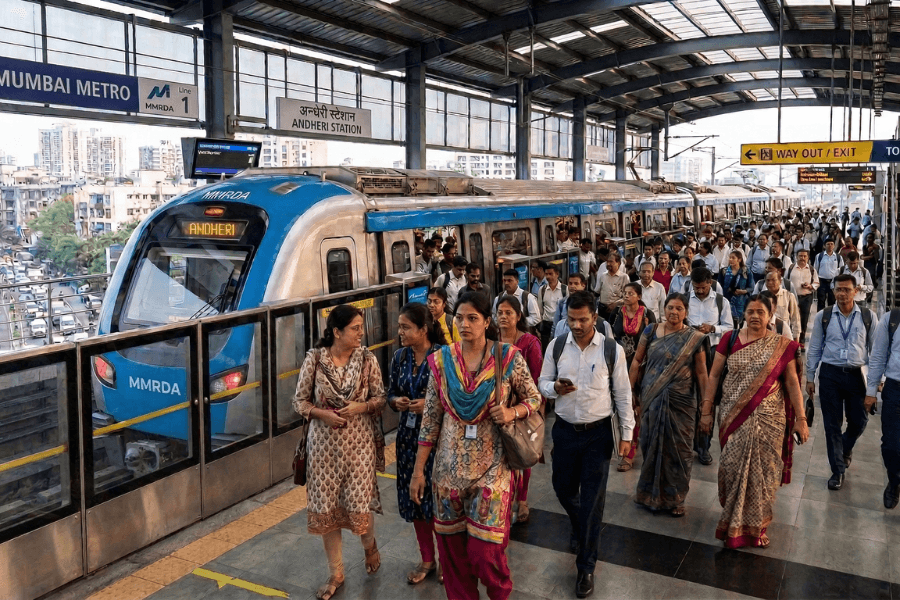
Mumbai’s first metro line, an 11.4 km east–west corridor, generates about $51 million a year in measurable commuter benefits under standard evaluation methods. Against a construction cost of roughly $2 billion, this appears modest. But households adjust where they live in response to improved connectivity. Accounting for this adjustment, annual welfare rises more than tenfold – to roughly $591 million.
How Standard Appraisal Measures Benefits
Most transport appraisals focus on the short run. They estimate how many minutes commuters save, assign those minutes a monetary value, and aggregate across users. Applied to Mumbai, this approach shows that about one-quarter of commuters benefit directly from the first metro line. Conditional on benefiting, the average gain is around Rs. 77 per month, roughly 12 percent of commuting costs.
These estimates draw on a representative 2019 World Bank survey of more than 3,000 Mumbai households, combined with detailed travel-time and housing data. Within this framework, benefits arise only through route switching and reduced travel time, holding residential locations fixed. The resulting welfare gains are internally consistent – but bounded by design.
How Metro Access Reshapes Work and Housing
The same data allow a second exercise: not only how commuters change routes, but how households relocate once a new metro corridor alters access to jobs across the city.
Under this longer horizon, benefits expand sharply. Workers who previously faced constrained residential choices can move to neighborhoods better connected to their workplaces. Welfare gains then reflect changes in the spatial match between jobs and housing, not just faster commutes.
The logic extends to Mumbai’s larger 92 km expansion of Lines 2, 3, and 7. Short-run gains of about $170 million per year rise to roughly $1.55 billion once relocation responses are incorporated.
The difference reflects the horizon of measurement: whether appraisal captures only immediate time savings or also the gradual reorganisation of residence.
Who Gains, and When: Distribution Over Time
The horizon of evaluation also shapes how metro benefits appear to be distributed.
In the short run, higher-income commuters experience about 40 percent larger gains than those below the median income. College-educated workers gain between 50 and 90 percent more than those without degrees, conditional on using the metro. Women also show greater willingness to pay for time savings. Viewed through this lens, metro expansion appears to advantage relatively better-off groups.
Once housing adjustment is allowed, the picture changes. More than 90 percent of households experience positive welfare gains over the longer horizon. Lower-income households, those with less education, and households without private vehicles gain more than their better-off counterparts. Improved metro access relaxes residential constraints that previously limited access to stable and better-matched employment.
Short-run and long-run evaluations therefore deliver sharply different distributional conclusions.
How Financing Assumptions Shape Outcomes
Measurement choices also interact with financing conditions.
Line 1’s construction cost of roughly $2.03 billion translates into annualised capital costs of about $200–300 million, depending on the discount rate assumed – the rate used to convert future value into today’s value. Under a short-run view, benefits fall well below these costs. Under the longer-run view, annual welfare gains exceed capital costs under many discount-rate assumptions.
For the larger expansion – costing around $22 billion, with annualised capital costs between $1.9 and $3 billion – the assessment is more sensitive. Long-run benefits of roughly $1.55 billion per year approach or exceed capital costs only under lower discount rates.
Discount rates determine how heavily future gains are weighted relative to upfront expenditure. Infrastructure that delivers benefits gradually through changes in residential and labor-market patterns will appear more or less viable depending on how the future is valued. In contexts where borrowing costs are high, projects with substantial long-run gains may look weaker than underlying welfare impact warrants.
Why Appraisal Choices Matter Today
Indian cities are committing large sums to metro expansion amid tight state budgets and heterogeneous financing structures across projects. Appraisal frameworks influence which corridors move forward. When evaluation emphasises only immediate commuter time savings, projects that primarily expand longer-run access to jobs and housing may appear less attractive than their broader impact warrants.
The Mumbai evidence does not imply that every metro project will pass a broader test. It suggests that restricting evaluation to the short run can materially understate welfare effects and reverse conclusions about who benefits. Decisions taken on that basis will reflect the limits of the measurement, not necessarily the limits of the investment.
In growing cities, how we measure the future may shape the future we get.