



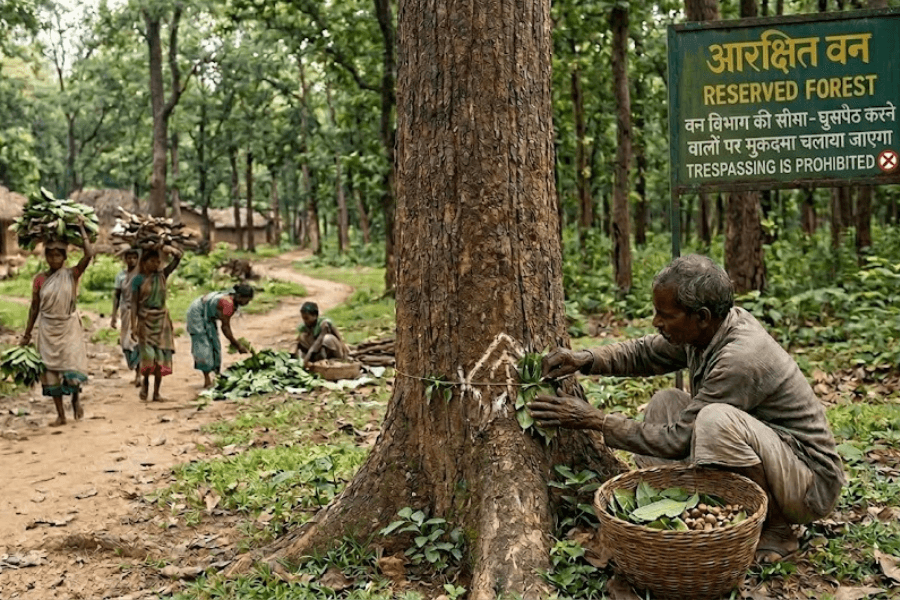
India’s forest laws address land, conservation, and community participation at length. They recognize “forest rights,” empower Gram Sabhas, and mandate the development of work plans aligned with sustainability commitments. Yet they remain curiously silent on a basic question that shapes both livelihoods and conservation outcomes, i.e. who owns the trees standing on public forestlands?
This omission matters because control over trees fundamentally shapes how forests are used, protected, or extracted. In large parts of Jharkhand and across many tribal and forested districts, trees are not simply state assets or undifferentiated commons. They are customarily owned, inherited, distributed, and managed in accordance with long-standing community rules. When formal administrative systems intervene without acknowledging these arrangements, they often end up overriding them. This result is a structural blind spot in India’s forest policy architecture.
Customary Rules: Governance Without Paperwork
Customary tree ownership rights are not recorded in revenue documents, yet they are socially enforced and widely accepted. These rights typically include claims over access, use of wild flowers or timber, and the authority to exclude others. In effect, control over individual trees is privately or jointly governed, even if the land remains publicly classified. This separation between land and tree rights departs from conventional state and community binaries, but it also reflects how rights and responsibilities are organised on the ground. Tree-level claims operate at a finer scale than land parcels, shaping household income, local cooperation, and protection incentives.
The distribution of trees within families is not arbitrary. It takes into account species value, tree size, and productivity over time. Larger, older mahua trees that yield more flowers may be distributed differently from younger ones. In practice, three ownership forms commonly coexist: individual ownership, where one household holds exclusive rights over specific trees; joint ownership, usually among brothers or close relatives; and collective ownership, where an entire village or a specific tribal group shares access. Forests thus operate as layered governance systems, with differentiated and overlapping claims coexisting and operating within the same landscape.
Crucially, these arrangements produce distinct ecological outcomes. In villages where asan trees are central to tasar cultivation, households have a direct incentive to prevent forest fires, restrict lopping, and deter illegal felling. Community patrols, fines, and social sanctions are not externally imposed; they emerge as routine practices. Where rules are respected and leadership is stable, tree-level governance aligns livelihood interests with forest protection.
When Formal Systems Override Customary Claims
When policy frameworks assume a simple binary between state and community control, they risk overlooking these embedded tenure arrangements, and the incentives they generate for investment, monitoring, and exclusion.
In one instance, a household that had protected and harvested flowers from fifteen mahua trees for years lost those rights after a land settlement officer measured the plot and determined that the trees stood on another household’s titled land. Customary tree demarcations and community recognition were superseded by cadastral records.
Such tensions are systemic rather than exceptional in regions with long histories of land acquisition and administrative ambiguity. Between 1951 and 1995, approximately 600,000 hectares of land in Jharkhand, including forest, common, and private land, were acquired for development projects, displacing around 1.5 million people. In these contexts, land administration processes routinely prioritise cadastral boundaries while remaining silent on tree-level claims. As a result, customary arrangements are typically overridden, in many cases not by design but by omission. The consequences extend beyond symbolic recognition: they reconfigure income streams, disrupt household planning, and weaken incentives to invest in tree protection.
Market Capture and Organized Extraction
When customary governance weakens, market incentives also begin to operate without the counterweight of local monitoring and exclusion. Informal networks involving traders and intermediaries expand, facilitate large-scale timber extraction. Villagers report periods when more than fourteen wood mills operated in nearby areas and over twenty wood-loaded carts pass daily through certain villages. This scale indicates sustained commercial activity rather than isolated subsistence use.
Under these conditions, the returns from timber extraction come to dominate the incentives for long-term stewardship. What emerges is not merely individual rule-breaking, but a shift in the incentive structure governing the forest landscape. Extraction becomes organised, predictable, and economically rational once governance constraints weaken.
Forest degradation thus reflects institutional imbalance, not cultural attitudes toward conservation. The same landscape that supported regeneration under aligned institutions becomes vulnerable to extraction when monitoring weakens, and incentives are reorganised. Forest outcomes depend less on statutory intent and more on the strength and coherence of governance systems on the ground that align rights, incentives, and monitoring on the ground.
Integrating Tree-Level Tenure into Forest Governance
Integrating customary tree ownership into formal governance does not require a parallel legal regime. It begins with acknowledging that tree-level claims (individual, joint, or collective) structure decisions around monitoring, exclusion, and investment within forest landscapes. Working plan preparation and Gram Sabha processes can incorporate basic documentation of such arrangements, particularly where livelihood systems such as tasar cultivation depend on specific tree species located on publicly classified forested land.
Land settlement and compensation processes can also be designed to reconcile cadastral records with customary tree demarcations, reducing the risk that formal measurement overrides established stewardship claims. Where displacement or development projects alter local tenure arrangements, explicit recognition of tree-based livelihoods becomes critical to sustaining incentives for protection in surrounding forests.
Toward Institutional Alignment
India’s forest policy framework has evolved significantly. The Forest Rights Act recognizes individual and community rights over forest resources. Working plan codes emphasise sustainable management. Agroforestry policies promote integration of trees with farming systems. Yet these frameworks largely operate at the level of land parcels or community boundaries, without explicitly incorporating tree-level tenure arrangements that structure incentives, monitoring, and protection on the ground.
For a country committed to improving forest cover and sustaining rural livelihoods, overlooking functioning tree-level governance systems is costly. Recognizing who owns the trees – how those rights are created, inherited, and managed – may not prevent all tree removal or solve every forest challenge. But without integrating this layer into formal policy processes, India’s forest governance will continue to operate with a structural blind spot.
Ecology determines where forests can grow; institutions determine whether they endure. A more credible policy framework would begin by acknowledging that reality.