



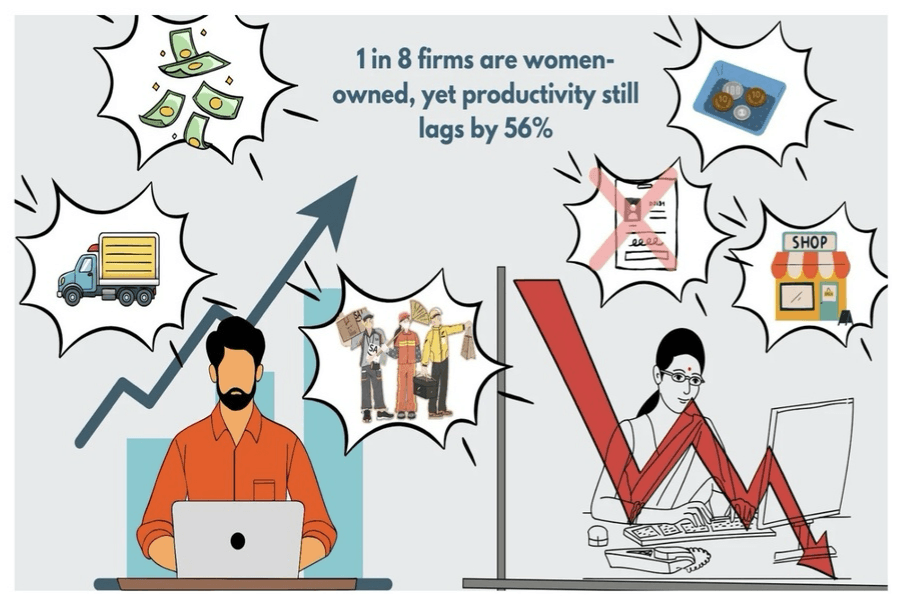
India’s informal sector, which employs the majority of the workforce, exhibits a sharp gender divide in entrepreneurship. Only about one in eight firms is owned by a woman, and these firms are, on average, roughly 56 percent less productive than those owned by men.
At first glance, the explanation appears straightforward. Women-owned firms are typically smaller, less capital-intensive, and more likely to operate from within households. They are also less likely to be formally registered or to maintain accounts. These characteristics are closely associated with lower productivity.
But this account is only partial. It explains what resources firms have, not how effectively those resources translate into output.
A Gap That Resources Alone Cannot Explain
An analysis of multiple rounds of NSSO survey data on unincorporated enterprises, covering over 5.8 lakh firms, shows how women participate in the informal economy. Many operate from home-based setups, rely less on hired labour, and are concentrated in activities such as personal care and retailing with lower entry barriers. These firms are also less likely to access formal credit, operate from fixed business premises, or invest in productive capital, which limits their ability to scale and generate higher output. These differences account for around 39 percent of the gender productivity gap.
The remaining 61 percent arises from a different source. Even when firms are similar in terms of capital, labour, and scale, the output they generate differs systematically across ownership groups. In other words, comparable resources do not translate into comparable outcomes.
The magnitude of this difference is substantial. If women-owned firms were to receive the same returns to their characteristics as male-owned firms, their productivity could increase by roughly two-thirds. Even after accounting for both resource differences and variation in returns, a residual gap persists, pointing to influences that are not directly captured in observable firm attributes.
Reported Constraints Tell a Misleading Story
One way to understand how these differences operate is to examine how firms experience and report operational constraints. Women-owned firms report fewer constraints, such as falling demand, credit constraints, power outages, or labour shortages, than male-owned firms.
This pattern appears counterintuitive. Firms facing greater disadvantages would typically be expected to report more constraints.
The explanation lies in how constraints are perceived and encountered. Entrepreneurs interpret business challenges through the lens of experience, expectations, and risk tolerance. Structural barriers may be internalised or may not appear as discrete, reportable problems. At the same time, the nature of enterprises matters: smaller, home-based firms operating in local markets are less exposed to formal sector frictions, and therefore report fewer of them.
Reported constraints, therefore, provide only a partial view of the underlying disadvantage.
Structural Factors Sustain Residual Differences
The more consequential drivers lie beyond what firms can easily report. Access to informal business networks, credibility in market transactions, and the ability to expand beyond household-based operations shape how firms grow and compete. Social norms and household responsibilities shape both the types of enterprises women run and the time and risk they can allocate to them.
These forces do not operate as isolated constraints. They influence how opportunities are accessed, how decisions are made, and how returns are realised. The resulting disadvantage is structural in nature and remains difficult to capture in standard datasets, even though it is evident in firm outcomes.
Policy Must Address How Outcomes are Generated
Interventions that expand access to inputs, such as credit, training, or infrastructure, address only part of the problem. Policies built solely on reported constraints risk misdiagnosing the sources of disadvantage.
The central issue lies in how markets and institutions assign value to similar economic activity. Addressing this requires strengthening access to business networks, improving market linkages, and addressing biases in financial and commercial interactions. It also requires enabling women-owned firms to move beyond low-scale, household-based activities into more productive segments.
The objective is to expand access to resources and ensure that comparable effort and capability are rewarded on equal terms. Closing the gender productivity gap ultimately depends on how effectively the economy converts participation into productivity.