



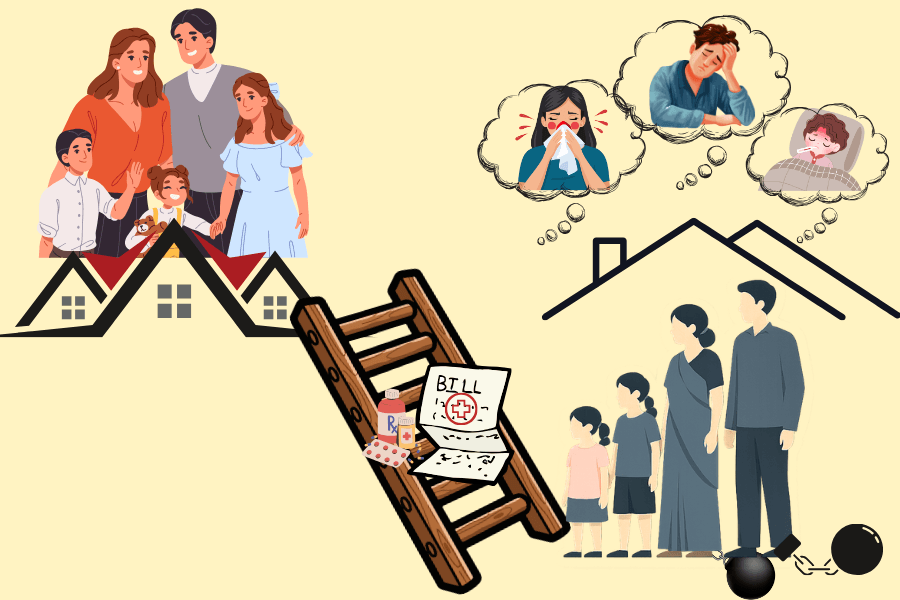
India’s poverty story is being quietly reshaped by healthcare costs. When illness strikes, the financial consequences often extend far beyond treatment; they can shift a household’s position on the poverty ladder.
Estimates from the National Sample Survey (NSS) data show that once healthcare expenditure is accounted for, the national poverty rate rises from 12.26 percent to 13.51 percent, pushing 3.1 million additional households into poverty.
This reflects a systemic feature of how healthcare is financed in India, where a large share of expenses is paid directly by households than pooled at the system level.
How Health Spending Translates into Poverty
The mechanism is simple but consequential. Poverty depends not only on what households earn, but also on what they must spend. Healthcare stands apart from most expenses because it is unpredictable and difficult to defer. When such costs are financed through out-of-pocket payments, they reduce disposable resources at precisely the moment of vulnerability.
The effect is not limited to how many households fall into poverty, but how far they fall. After adjusting for healthcare spending, the poverty gap widens significantly, affecting millions of households already below the poverty line. For many families, a health shock does more than change their poverty status; it pushes them into more severe and persistent deprivation.
Who Bears the Cost of Healthcare
The burden of healthcare spending is unevenly distributed, with the greatest pressure falling on households with the least financial resilience.
As incomes fall, households spend a larger share of their consumption on healthcare. The poorest rural households spend around 23.4 percent of their total consumption on healthcare, compared to about 17.4 percent among the richest. For these households, even routine medical needs can disrupt essential spending on food, education, and housing.
Geography compounds this vulnerability. Rural households experience a larger increase in poverty, from 17.71 percent to 19.05 percent. In comparison, urban areas see a rise from 6.80 percent to 7.97 percent, indicating a similar but slightly less pronounced effect. Differences in access to public healthcare and reliance on private providers shape this divergence.
In some cases, reported medical spending exceeds total consumption, indicating borrowing or asset sales and the onset of debt-driven healthcare financing. Among the poorest rural households in Bihar, medical expenses can account for as much as 86 percent of total consumption, leaving little room for other necessities.
How the System Amplifies Risk
The unequal burden of healthcare costs is rooted in how the health system allocates and absorbs financial risk.
A significant part of this risk arises from how care is priced and accessed. In many regions, where public healthcare is uneven in availability or quality, households turn to private providers as the default option. This reliance comes at a cost: private care is typically more expensive and less regulated. As a result, households that depend on private healthcare are over 5 percentage points more likely to fall into poverty after medical spending.
Financial protection mechanisms do not adequately offset this exposure. Only about 21 percent of households report any insurance coverage, and reimbursement levels remain low at around 1.9 percent in rural areas and 6.85 percent in urban areas. While insurance reduces the likelihood of falling into poverty by about 3.78 percentage points, its overall effect remains modest in the context of widespread out-of-pocket expenditure.
The burden is further shaped by the nature of health risks within households. Longer hospital stays, chronic illness, and the presence of elderly members all increase the likelihood of financial strain. These risks are predictable across the population, yet they remain only partially pooled. Their effects are also mediated by existing social inequalities, with historically disadvantaged groups facing a higher probability of impoverishment after healthcare spending. Scheduled Tribe and Scheduled Caste households show a 7.3 and 4.2 percentage point higher likelihood, respectively.
Together, these features create a system where financial risk is concentrated at the household level rather than absorbed collectively.
From Health Costs to Economic Risk
Public spending on health in India remains at around 2 percent of GDP, limiting the system’s ability to absorb financial risk at scale.
The consequences extend beyond the health sector. When households finance medical care through savings, borrowing, or asset sales, the effects spill over into broader economic outcomes. Income instability rises, consumption patterns shift, and the capacity to invest in education, nutrition, or livelihoods weakens.
At the aggregate level, repeated exposure to health shocks affects productivity and the quality of growth. Interruptions in work, uneven access to care, and financial distress combine to slow and fragment economic progress.
What appears as a health expenditure problem is, in effect, a system of risk distribution. When financial protection is weak, the burden of managing health shocks shifts to households, with long-term consequences for both poverty and growth.
Reducing this risk requires more than expanding access to care. It demands lowering out-of-pocket payments at the point of service, strengthening the reliability of public healthcare, and pooling predictable risks such as chronic illness, ageing, and low incomes before they translate into financial distress.
A useful test of progress is whether health systems reduce the share of household spending devoted to medical care. As long as healthcare costs remain a source of economic instability, efforts to reduce poverty will remain incomplete.