


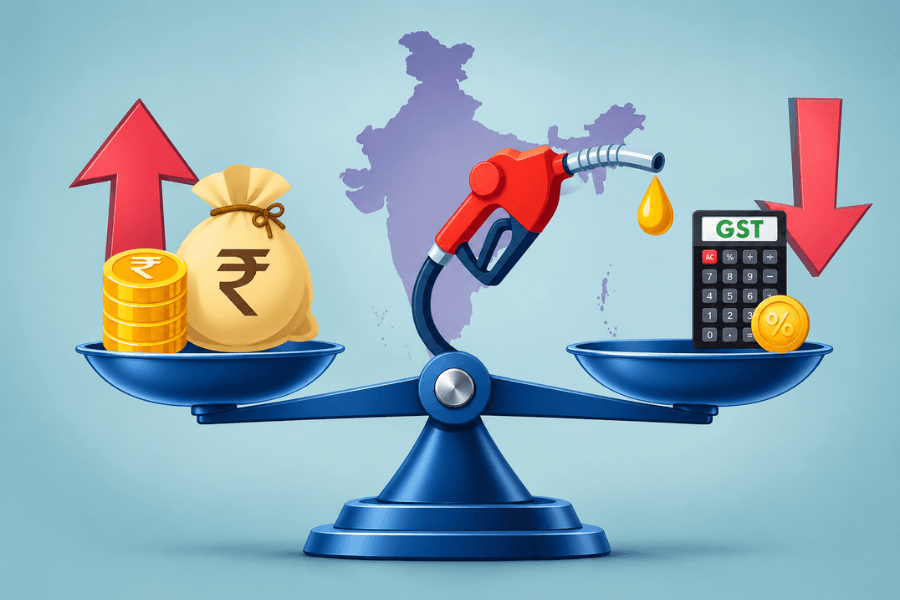
Five petroleum products remain outside India's Goods and Services Tax (GST) regime: petroleum crude, high-speed diesel, motor spirit (petrol), natural gas and aviation turbine fuel. The Union and State governments tax these products through separate customs, excise and value-added tax (VAT) or sales-tax arrangements. Their exclusion from GST also means that taxes levied under the existing regime generally cannot be claimed as GST input tax credits by businesses using these products as inputs. This can leave taxes embedded in the costs of transport, fertiliser production and other economic activities.
Article 279A(5) of the Constitution provides for the GST Council to recommend the date from which GST should be levied on these products. Bringing them into the GST framework could reduce tax cascading, but would require decisions on tax rates, the protection of Union and State revenues, and the management of fuel-price volatility. The policy question is what tax design and fiscal arrangements would make their inclusion feasible while balancing these competing considerations.
The Fiscal Stakes of Petroleum Taxation
Customs duties apply to imports of crude oil and petroleum products and can include specific levies, charged per unit, and ad valorem levies, calculated as a proportion of value. Central excise duties are largely specific taxes. Cesses also form part of the Union's petroleum tax structure; unlike shareable tax revenue, these are not devolved to the States. States levy sales tax on petroleum products, either ad valorem, on a value inclusive of customs and excise duties, or through a combination of specific and ad valorem taxes.
In 2024–25, tax and duty receipts associated with the petroleum sector were ₹3.41 lakh crore for the Union government and ₹3.21 lakh crore for State governments excluding royalties, according to the Petroleum Planning and Analysis Cell (PPAC). These aggregates include receipts that would not necessarily be replaced by bringing the five petroleum products under GST. State-level sales tax and VAT collections also varied considerably: ₹4,690 crore in Delhi, ₹37,244 crore in Maharashtra, ₹12,979 crore in West Bengal and ₹24,880 crore in Tamil Nadu. These differences reflect variation in both State tax rates and petroleum-product consumption.
The Revenue-Neutrality Challenge
What GST rate, that is, Revenue Neutral Rate (RNR) would preserve existing Union and State petroleum-tax revenues?
The RNR would depend on the tax base, the treatment of existing levies and the input tax credits available under the new regime. Even if aggregate revenues could be maintained, individual states could face revenue shortfalls because their current petroleum tax collections differ. These differences may require a fiscal adjustment mechanism.
Consider the following illustration: excise duty and sales tax or VAT component in petrol retail price varies from around 27 percent in Delhi to 34 percent in Kolkata. Considering a non-VAT tax component of 30 percent and assuming three or four steps in the value chain would translate into the RNR of 50 percent and 66 percent, respectively.
A GST rate substantially above the rates applicable to many downstream products could create an inverted tax structure if the tax rate on petroleum inputs exceeds the rate on downstream outputs and the resulting input tax credits cannot be fully utilised or refunded.
The Trade-Offs in Petroleum Tax Reform
The choice between specific and ad valorem taxation affects how changes in international oil prices and exchange rates influence fuel taxes and retail prices. A specific tax levied as a fixed amount per unit does not automatically rise when the underlying price increases. By contrast, an ad valorem tax, calculated as a proportion of the taxable value, changes with that value. Replacing specific duties with a predominantly value-based GST would therefore change the responsiveness of tax collections to petroleum-price movements.
The extent to which changes in international prices and exchange rates are transmitted to consumers also depends on the overall tax structure and how changes in costs are reflected in retail prices. GST inclusion does not, by itself, determine the degree of price pass-through.
If the GST rate is set below the revenue-neutral rate, government receipts could fall, depending on the levies withdrawn and the input tax credits permitted. If businesses pass on some of the resulting tax savings through lower prices, consumption and economic activity could increase, potentially offsetting part of the initial revenue loss.
The Limits of Alternative Transition Models
The persistence of tax cascading strengthens the case for bringing petroleum products under GST. Businesses could claim input tax credits for eligible GST paid, but the State-level cess would remain outside the GST credit chain. The cess could therefore continue to be embedded in downstream costs, leaving some tax cascading unresolved. The arrangement's revenue implications would depend on the GST base, the cess design and the input tax credits permitted, while maintaining two levies could add administrative complexity.
The feasibility of this hybrid model depends on the legal basis for the State-level cess. Two possible routes merit examination. One is a cess modelled on the Kerala Flood Cess, which was time-limited and subject to a specific rate. The other is a separate state levy on intra-State sales under Entry 54 of List II of the Constitution. However, the legal feasibility of either route for petroleum products after their inclusion in GST would need to be established. The Kerala precedent does not, by itself, establish that the same mechanism could be applied to petroleum products, while the continued applicability of Entry 54 in this context remains an issue requiring constitutional and legislative examination.
A second proposal is to phase in GST over five to ten years, starting with crude oil and natural gas. This could allow governments to assess fiscal and administrative effects before extending GST to the remaining products. However, it would prolong the coexistence of different tax regimes and preserve the associated breaks in the input tax credit chain for products not yet included.
Making GST Inclusion Feasible
The transition to GST should be guided by a fiscal plan that quantifies potential revenue losses and identifies credible ways to manage them.
The first step is to assess the size and growth potential of the petroleum tax base. Product-wise consumption projections, price and demand elasticities, and tax buoyancy estimates should be used to compare revenue trajectories under the existing regime and alternative GST scenarios. This would help distinguish temporary transition losses from persistent revenue shortfalls and establish how much collections depend on economic growth, consumption and discretionary tax changes.
Second, each State's capacity to mobilise alternative revenues should be assessed before petroleum taxes are subsumed into GST. State-wise estimates should examine the scope to improve collections from stamp duty and registration fees, motor vehicle taxes and electricity duties, alongside property-related revenues where States or local governments have the relevant authority. The objective should be to quantify realistic revenue potential, accounting for administrative constraints and differences in States' tax bases, rather than assume that petroleum-tax losses can be readily offset. These assessments should also inform the design of any time-bound fiscal adjustment arrangements, including their funding, eligibility criteria and phase-out conditions.
Finally, before implementation, alternative tax designs and transition sequences should be stress-tested against different oil-price, exchange-rate and consumption scenarios. The GST Council should publish estimates of their implications for government revenues, retail prices and input tax credits, and establish thresholds for reviewing the transition if outcomes diverge materially from projections. This would provide a basis for comparing simultaneous and phased inclusion and for adjusting the implementation plan in light of observed outcomes.
These steps would give the GST Council a basis for determining when inclusion is feasible, what fiscal adjustments are necessary and which tax design best balances revenue protection, lower cascading and price stability.