


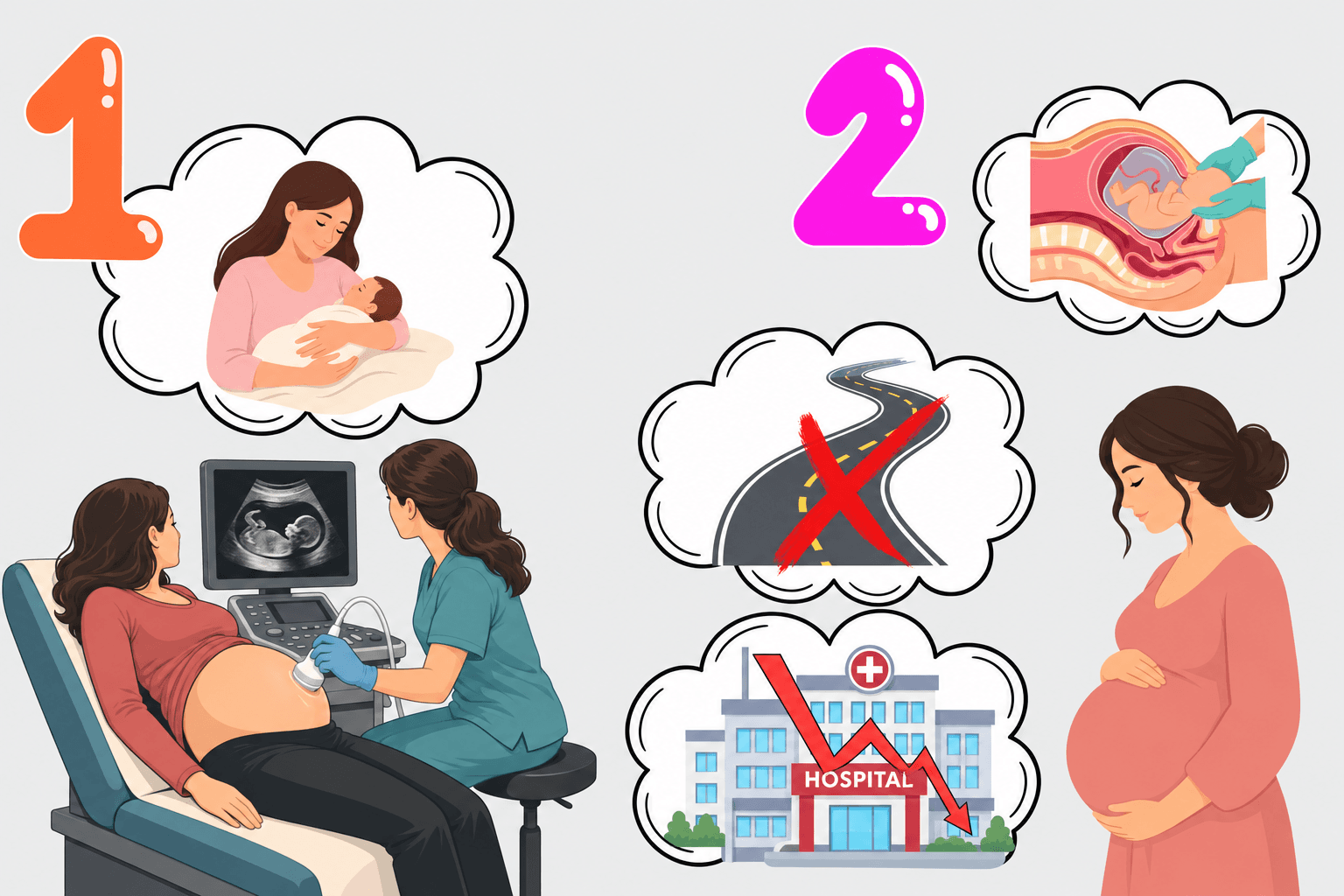
India’s maternal healthcare use conceal a gap that national averages do not reveal. Institutional delivery rose from around 82 percent in 2010–11 to 92 percent in 2020–21. Yet within families, the use of formal maternal care declines as women move from their first birth to subsequent births.
An institutional first delivery may indicate successful entry into the formal health system, but it does not ensure sustained engagement across subsequent pregnancies. Maternal-health progress should therefore be judged by both the reach of formal care and the continuity of appropriate engagement across pregnancies.
The National Gain Hides a Birth-Order Gap
Evidence from the fourth and fifth rounds of the National Family Health Survey (NFHS), covering more than 111,000 births to 52,853 mothers, reveals a consistent within-family birth-order pattern.
Relative to the first birth, the probability of institutional delivery falls by 5.1 percentage points for the second birth and 4.9 percentage points for the third. The change is also visible in who provides care: professional assistance falls by 3.8 percentage points for the second birth and 3.5 percentage points for the third, while assistance from non-health professionals rises by about 4.1 percentage points for both.
Lower Risk Does Not Explain the Whole Gap
Differences in clinical risk across birth orders may explain part of the pattern. However, a previous uncomplicated delivery does not establish that a subsequent pregnancy requires less care.
While clinical studies show that first births are physiologically more complex and riskier than subsequent births, the evidence, however, suggests that differences in delivery risk cannot fully explain the birth-order pattern. Antenatal engagement also falls with each successive birth. The probability of a first antenatal care visit within 12 weeks falls by 2.3 percentage points for the second birth, 4.2 points for the third, and as much as 8.2 points for the fifth birth and beyond.
The decline extends beyond delivery care to antenatal engagement. This suggests that the birth-order gap involves decisions made during pregnancy as well as at childbirth, although the antenatal pattern alone cannot establish why care use falls.
Information May Influence Care-Seeking
When a first birth is followed by neonatal death, the usual decline in institutional delivery and professional assistance for subsequent births is substantially reduced and is no longer statistically distinguishable from zero. The pattern is consistent with an adverse first experience changing how a mother assesses the risks of a subsequent pregnancy. An uncomplicated first delivery may similarly lower perceived risk in a subsequent pregnancy.
Antenatal care is also an information channel through which women learn about pregnancy-related complications and reassess the risks of childbirth. Among mothers who report receiving information about pregnancy complications, the birth-order gap in institutional delivery is smaller. This is consistent with an informational role for antenatal care, although the comparison does not by itself establish that counselling caused the difference. The birth-order gap is around 2.6 percentage points smaller for second and third births and roughly 4.4–4.8 percentage points smaller at higher birth orders.
Access Deepens the Birth-Order Care Gap
Care-seeking is also shaped by whether formal care is practically accessible. The birth-order decline is sharper among mothers who report distance to a facility, lack of transport or difficulty travelling without accompaniment as major problems. Such constraints can become more consequential as families grow, when reaching a health facility requires time, transport and accompaniment.
Infrastructure can therefore shape maternal healthcare behaviour in ways that conventional health-sector measures may miss. New all-weather road connections established between a mother’s births narrow the birth-order gap in institutional delivery by about two percentage points. Greater access to rural bank branches also narrows the gap by roughly 1.7–2.8 percentage points.
Maternal Policy Must Follow Women Across Pregnancies
The evidence has three practical implications for maternal-health policy.
First, monitoring should distinguish first births from subsequent births, with birth order-specific indicators for antenatal care and institutional delivery. Such monitoring would show whether improvements in aggregate coverage are being sustained across birth orders.
Second, programme design should examine how maternity support reaches women across birth orders. Pradhan Mantri Matru Vandana Yojana originally covered the first living child; PMMVY 2.0 extended benefits to a second living child when that child is a girl. The birth-order decline predates PMMVY and should not be presented as an effect of the programme. Nevertheless, its eligibility rules raise a wider policy question: how adequately does maternity support address the costs of subsequent pregnancies?
Third, antenatal outreach should renew counselling and assess practical barriers in every pregnancy. Follow-up for women with previous births should address the assumption that an uncomplicated earlier delivery makes formal care less necessary, while identifying difficulties with transport, accompaniment and the costs of reaching care.
India’s institutional-delivery gains remain a major achievement. The next stage of maternal-health policy, however, requires a more demanding measure of progress. A health system that succeeds once should also be designed to remain relevant the next time.