



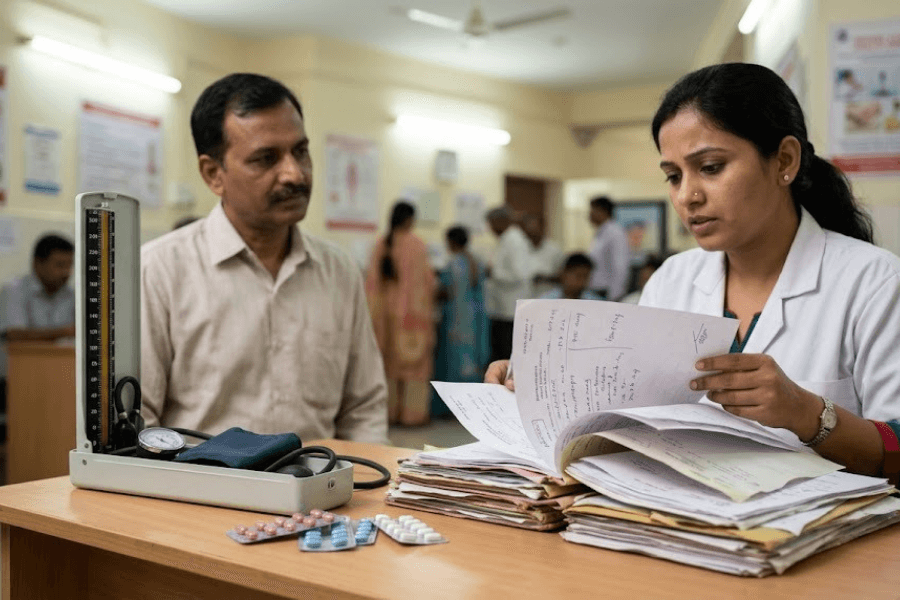
Hypertension, or high Blood Pressure, is India’s largest and most important public health challenge. An estimated 300 million adults live with high blood pressure, yet only a small proportion are treated to control targets. This gap persists despite the widespread availability of effective and inexpensive medicines. The consequences are visible in rising rates of heart attacks, strokes and kidney disease – conditions that account for a large share of preventable deaths in the country.
India’s hypertension challenge is less about discovering new medicines than about how treatment is organised across the health system. In the absence of clear, standardised treatment pathways, care often depends on individual prescribing decisions rather than consistent clinical protocols. As a result, effective therapy is frequently delayed or applied unevenly across different levels of care.
In a country where hundreds of millions live with hypertension, treatment strategies must be designed for large public health programmes – where simplicity often determines whether effective care reaches patients consistently.
Why Current Treatment Pathways Delay Control
Conventionally, treatment for hypertension usually begins cautiously. Many patients start with a single medicine and move to additional drugs only if blood pressure remains high. While this stepwise approach may appear sensible, it often leaves patients with uncontrolled blood pressure for extended periods – increasing the risk of heart attacks, strokes and other cardiovascular complications. Further, maximum dosing of single agents is associated with significant adverse effects.
Clinicians have increasingly recognised the benefits of starting treatment with two complementary medicines rather than one. Indeed, many contemporary guidelines from multiple societies reflect this thinking. This strategy, known as dual therapy, can lower blood pressure more quickly by combining medicines that act in different ways. When two medicines are combined into a single tablet – a single-pill combination – treatment also becomes easier for patients to follow because it reduces the number of pills they must take each day. Further, they act synergistically with better blood pressure control and lower incidence of side effects
Much of the clinical debate has focused on identifying the most effective drug pairings. Yet from a public health perspective, a more important question is whether several combinations can deliver similar benefits. Recent research provides a useful answer to that question.
What Recent Evidence Reveals
A large multicentre trial called Treatment Optimisation for blood Pressure with Single-Pill combinations in INdia (TOPSPIN), conducted in 32 sites in India, comparing three commonly used dual-drug therapies, produced a strikingly consistent result. It compared a single-pill combination of two different drugs: a calcium channel blocker with a thiazide-like diuretic, a calcium channel blocker with an Angiotensin-Converting Enzyme (ACE) inhibitor, and an ACE inhibitor with a thiazide-like diuretic.
All three combinations lowered blood pressure substantially over six months. Roughly 70 percent of participants achieved recommended blood pressure control levels during this period. The treatments were also similarly well tolerated, with only a small proportion of patients discontinuing therapy due to side effects.
The implication for health systems is significant. If multiple therapies achieve similar outcomes, the central challenge becomes less about identifying the single best drug combination and more about ensuring that effective treatment reaches patients early and consistently.
The Policy Opportunity: Simpler Treatment Protocols
Evidence that several dual-drug therapies work similarly well creates an opportunity to simplify hypertension treatment protocols across India. Instead of maintaining complex decision trees about which medicines should be combined in each case, treatment programmes could standardise a small number of proven options. This would allow clinicians to initiate effective therapy quickly while maintaining flexibility for individual patients.
Single-pill combinations could play an important role in this approach. By reducing the number of pills patients must take each day, they improve adherence and simplify prescribing in busy primary care settings.
At the health-system level, focusing on a limited set of medicines can make procurement more predictable, training for health workers easier and monitoring systems more straightforward. Further, given that fixed-dose combinations of simple drugs are part of the Essential Drugs List of the WHO, there is also a need to consider the inclusion of Single-Pill Combinations (SPCs) and Fixed Dose Combinations (FDCs) in the National List of Essential Medicines (NLEM) of India.
These advantages are particularly relevant to India’s expanding primary healthcare infrastructure, including health and wellness centres that are increasingly managing chronic conditions such as hypertension and diabetes.
Designing Hypertension Care for Large Health Systems
Hypertension illustrates a broader challenge in managing chronic disease. When large populations require long-term treatment, the effectiveness of care depends not only on medical advances but on how reliably treatment reaches patients across the health system.
Even modest improvements in treatment coverage and adherence could translate into substantial reductions in cardiovascular disease.
In many cases, the most powerful innovation in medicine is not a new drug, but a simpler way to use the ones we already have.