



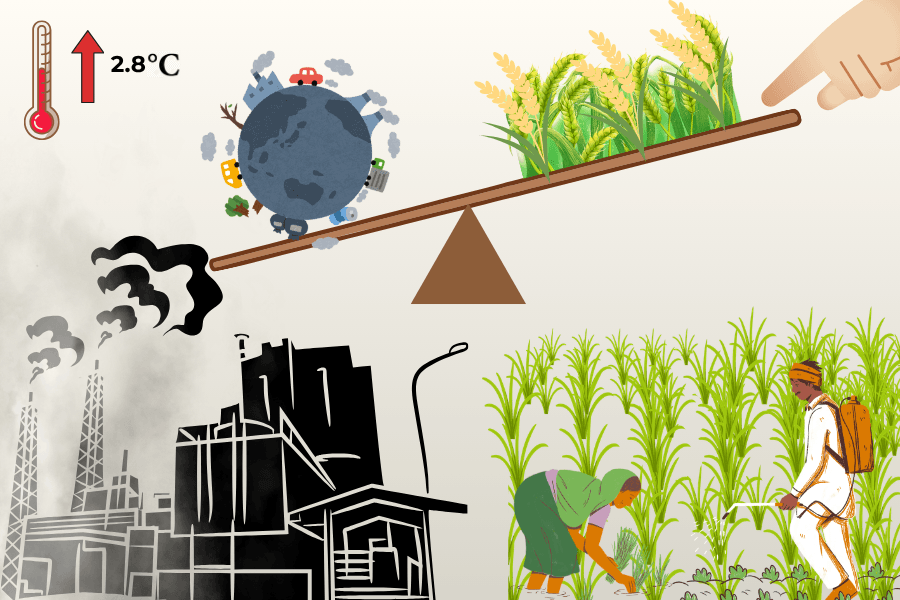
Global greenhouse gas emissions remain far above the trajectory required to meet the Paris Agreement targets. Under current policies, the world is headed toward a temperature increase of around 2.8°C above pre-industrial levels. As emissions rise, the policy challenge is not only how to reduce them, but where reductions can be achieved at the lowest cost.
India sits at the centre of this question. While its per capita emissions remain low, it is among the world’s largest emitters in absolute terms and recorded one of the highest increases in emissions in 2024. Identifying sectors where mitigation is both feasible and efficient is therefore critical.
Recent developments, including Amazon’s $30 million carbon credit deal with Bayer’s The Good Rice Alliance, reflect growing recognition that agricultural systems can generate tradable mitigation outcomes. The deeper opportunity lies before the carbon market stage: correcting the incentives that shape production.
Agricultural Emissions Reflect Misaligned Incentives
Agriculture’s role in India’s emissions profile reflects both its scale and the nature of its emissions. Methane and nitrous oxide, both dominant in agricultural systems, have a significantly higher heat-trapping effect than carbon dioxide, with methane warming the atmosphere about 120 times more over the near term and 27.8 times over a century. India’s agricultural emissions, estimated at 407 MtCO₂e in 2020, are about 14 percent higher than in 2000, though more slowly than output, suggesting partial decoupling.
The sector also offers substantial mitigation potential. Existing practices, such as improved fertiliser management, zero tillage, and better water control in rice, could together reduce emissions by 85.5 MtCO₂e annually. These are not frontier technologies but address inefficiencies already embedded in production systems.
India has often framed agricultural emissions as “survival emissions” and excluded the sector from formal mitigation targets. While politically salient, this framing conflates production necessity with input use. Food production is essential, but the way it is produced is shaped by incentives, prices, and institutional design.
This distinction reframes the mitigation question. Where emissions arise from inefficient use of fertiliser, water, or land, reducing them does not require lowering output. It requires changing the conditions under which production decisions are made, while bringing policy incentives into focus.
Subsidies Encourage Input Overuse
Agricultural emissions in India reflect the structure of its policy incentives. Around 73 percent of public expenditure in agriculture continues to be directed toward subsidies and welfare schemes, while investment in research, development, and extension remains comparatively low at about 0.43 percent of agricultural GDP, despite significantly higher returns. This allocation pattern prioritises input intensity over efficiency.
Fertiliser use shows this clearly. The persistent underpricing of urea has led to a sustained increase in nitrogen application, with usage per hectare nearly doubling from 64.2 kg/ha in 2000 to 121 kg/ha in 2020. This has not translated into proportional productivity gains. Instead, nearly two-thirds of applied nitrogen is lost to the environment, contributing to emissions and environmental degradation. Nitrogen use efficiency has also declined, from about 48 percent in the 1960s to 35 percent in 2018.
Water use follows the same pattern. Power subsidies and irrigation infrastructure have encouraged water-intensive cultivation, particularly in paddy. Continuous flooding, a major source of methane emissions, persists not because alternatives are unavailable but because incentives for change remain weak. Techniques such as controlled irrigation can reduce methane emissions by 30 to 50 percent, yet remain under-adopted.
These patterns point to a system in which input use expands without corresponding efficiency gains: shifting the policy question from diagnosis to correction.
Mitigation Requires Incentive Reform
Because inefficiency is embedded in the incentives, mitigation must operate through policy design rather than output reduction. The aim should be to preserve food security while reducing the resource intensity of production.
Fertiliser reform is a natural starting point. Rationalising urea prices, combined with direct income support, can reduce overuse while protecting farmer incomes. Policies must also promote balanced nutrient application based on soil conditions. Evidence suggests that halving urea consumption over the next two decades is feasible without compromising food production, underscoring the scale of efficiency gains available.
Water management in rice cultivation presents a second lever. Practices such as alternate wetting and drying can significantly reduce methane emissions while conserving water. Scaling these practices, however, requires more than technical advice. It depends on irrigation scheduling, extension systems, local governance, and farmer confidence that yield risks will be managed.
Reallocating public spending is equally important. Increasing investment in agricultural R&D and extension can generate sustained gains in productivity and emissions reduction. Evidence on returns is well established, estimated at up to 14 times, while the constraint lies in prioritisation.
These reforms are interdependent. Price corrections without income support risk resistance. Technical solutions without incentive alignment fail to scale. The transition must therefore be sequenced: protect incomes, correct price distortions, and strengthen extension systems—before market-based mechanisms can operate effectively.
Carbon Markets Depend on Policy Reform
As efficiency gains materialise, they create opportunities in carbon markets. With agriculture included in India’s Carbon Credit Trading Scheme and over 50 agricultural carbon credit projects covering 16.5 million hectares, the sector is emerging as a source of tradable mitigation outcomes.
Carbon markets, however, cannot substitute for policy reform. They can monetise emissions reductions only where such reductions are real, measurable, and verifiable. In a system dominated by smallholder production, high transaction costs, and uneven institutional capacity, their effectiveness depends on aggregation, monitoring, and credible benefit-sharing.
Distributional risks also matter. Without safeguards, benefits may accrue unevenly, especially where land rights are unclear or participation is mediated through intermediaries. Transparency, informed consent, and equitable access are therefore central to whether agricultural carbon markets reinforce or distort incentives.
Markets can amplify well-designed reforms, but they cannot correct underlying distortions. If fertiliser, water, and power incentives continue to reward overuse, carbon credits will remain layered over an inefficient production system.
Delaying Reform Risks Long Term Lock-In
India’s agricultural system has delivered food security, but it has also embedded input-intensive practices that now carry rising environmental and fiscal costs. These patterns are not fixed. They are the result of policy choices, and they can be changed through better-designed incentives.
The cost of delay lies in lock-in. Subsidies, cropping patterns, procurement systems, irrigation habits, and farmer expectations reinforce one another over time. The longer inefficient production systems persist, the harder and more expensive they become to reform.
Agriculture should therefore be treated as a core domain of climate policy and one of its most actionable areas. The central policy choice is whether India continues to subsidise inefficiency, or begins rewarding the practices that can protect food security while lowering emissions. Delaying that shift will raise both the economic and environmental cost of transition.