



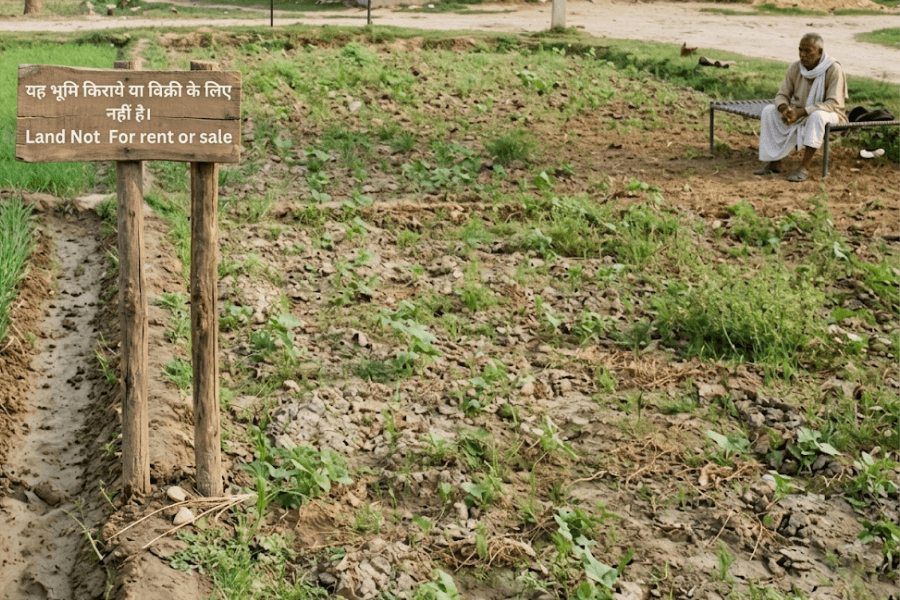
For decades, India’s agricultural debate has revolved around fragmentation, small holdings, and land scarcity. Yet the deeper constraint is not how much land farmers own, but whether land can move to those who can use it more productively. Across states, large differences in land rental laws and market participation shape who cultivates how much land – and with what productivity.
The result is systematic misallocation: farmers with higher productivity are often unable to expand their operated land, while less productive farmers continue to operate inherited plots.
If land within each state could be reallocated efficiently, without changing total land area or technology, agricultural productivity could rise by roughly 65 percent nationally, and by more than 100 percent in some states.
This is not a marginal adjustment. It suggests that a substantial part of India’s agricultural productivity gap is institutional in origin – not a consequence of land scarcity or technological limits.
The Institutional Slant
Data from two rounds of the India Human Development Survey (IHDS, 2004-05, 2011-12) with over 8,000 farm households across 15 major states, and complemented by Agricultural Census data and state-level institutional records, show that agricultural outcomes differ sharply across states. Agricultural productivity varies by more than thirteen-fold across major states. Average operational farm sizes range from below one hectare in parts of eastern and southern states to nearly three hectares in Punjab. Rental market participation also differs sharply: in some states, over one-fifth of cultivated land is leased, while in others participation remains in the low single digits.
Such variation is difficult to attribute solely to agro-climatic conditions. Instead, it reflects differences in land institutions – particularly tenancy laws, land ceiling regulations, and the quality of land records and dispute resolution mechanisms.
After Independence, states were granted authority over land policy. These reforms addressed genuine historical vulnerabilities and remain foundational. In several states, however, restrictions on leasing – ranging from outright prohibitions to tightly regulated arrangements such as mandatory sharecropping – discouraged formal rental activity. Combined with weak land records and slow contract enforcement, these rules increased the perceived risk of renting out land.
The result is a pattern of secure ownership combined with constrained mobility.
How Rental Barriers Misallocate Land
In a well-functioning rental market, more productive farmers – those who generate higher output per acre – would rent in additional land. Less productive farmers would rent out land, earning income while allowing more efficient cultivation. Over time, land would flow toward higher-productivity use.
In practice, restrictions and risk in rental markets deter farmers on both sides from entering rental arrangements. As a result, a substantial share of farmers operate only their inherited land endowment, neither renting in nor renting out.
This pattern is visible in the data. In several states, 80 to 90 percent of farms do not participate in land rental markets. When large numbers of farmers remain outside the rental market, land cannot adjust to differences in productivity. The relationship between farm productivity and operated land weakens sharply. In some states – such as Tamil Nadu – the correlation between the two is close to zero. This is not merely a distortion at the margin; it is a participation failure.
The constraint is therefore not only how much land farmers operate, but who operates it.
Distortions That Constrain the Productive
Crucially, this misallocation is not random.
In several states – including Kerala, Tamil Nadu, and parts of western India – the effective constraints in land rental markets rise systematically with farm productivity. Farmers who could generate higher output per acre face stronger barriers to expanding their operated land. By contrast, in Punjab the relationship is much weaker, and land is more closely aligned with productivity. This productivity-dependent pattern of constraints magnifies aggregate losses: the farmers best positioned to raise output are precisely those prevented from doing so.
Importantly, more than half of the potential gains identified earlier stem from state-level rental barriers that discourages participation. In states of Tamil Nadu, Kerala, and Rajasthan the effective cost of participation is equivalent to an implicit tax exceeding 90 percent on rental transactions.
The implications are significant. Where the barriers are strongest, productivity losses are largest. These potential gains, locked hitherto, can arise not from new technology, irrigation expansion, or subsidy redesign, but from reallocating existing land across existing farmers.
Productivity, Not Concentration
Land sales in India remain rare; most agricultural land is inherited, and purchase transactions are limited. As a result, rental markets are the primary – and often the only – channel through which land can adjust to differences in productivity. Enabling secure, voluntary rental contracts need not undermine ownership rights. On the contrary, clear rules that protect ownership while permitting leasing can strengthen tenure security while improving allocative efficiency.
The first generation of land reforms addressed historical inequities and tenant vulnerability. That achievement was essential and remains foundational. The present challenge is different. When regulatory restrictions intended to prevent exploitation also deter voluntary, mutually beneficial rental arrangements, the result is not greater equity, but persistently lower productivity.
From Ownership Security to Mobility Security
As demographic pressures, climate variability, and structural change reshape rural economies, the ability of land to move toward higher-productivity use becomes increasingly consequential. Institutions that secured ownership in the mid-twentieth century successfully addressed historical vulnerabilities, but must now also facilitate land mobility in the twenty-first.
The choice facing states is not between reform and reversal. It is between static protection and dynamic efficiency. Tenancy frameworks can evolve to allow secure leasing without jeopardising ownership. Improvements in land records and dispute resolution can reduce uncertainty, while clear and enforceable rental contracts can lower the implicit tax on participation that currently keeps large numbers of farmers outside the market.
Protecting ownership was a critical milestone; enabling efficient use is the next institutional frontier. India’s agricultural future will depend less on how much land it has, and more on whether its institutions allow land to move.