



India’s nutrition policy has long been approached as a consumption problem, focused on improving access to food through transfers and supplementation. But this framing misses a deeper question: can nutrition policy also change how efficiently food is produced? Nutrition policy, when designed differently, can also function as a productivity policy.
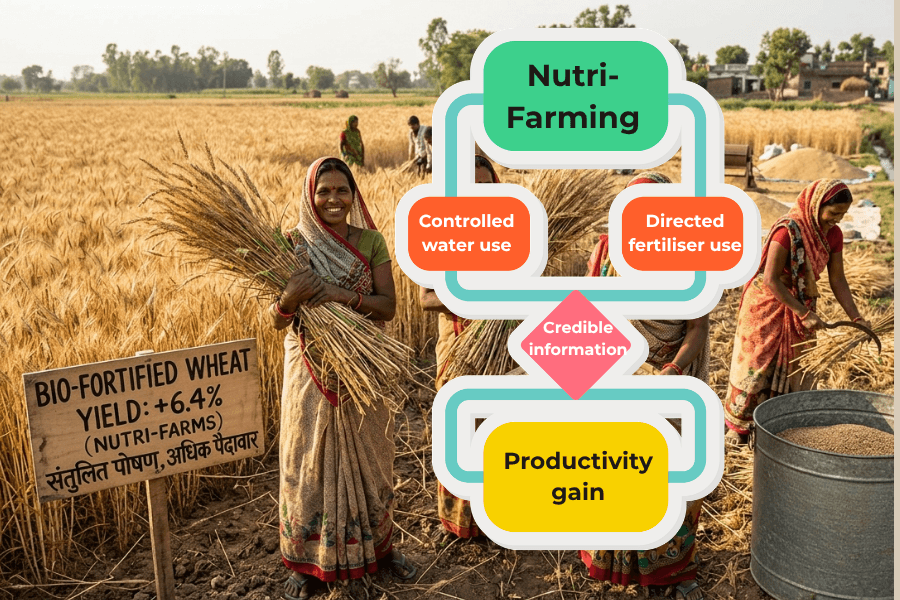
Introduced in the 2013–14 Union Budget, the Nutri-Farms approach was implemented across 100 districts in nine high-malnutrition states, including Bihar, Uttar Pradesh, Madhya Pradesh, and Rajasthan, and targeted staple crops such as wheat, rice, and millets. The programme marked a shift from distributing nutrients to producing them through a combination of bio-fortified varieties, improved farming practices, on-field demonstrations, and supply-chain development.
The key question, then, is whether this shift translated into measurable outcomes for farm productivity.
Raising Yields Without Expanding Land
The most striking outcome is a measurable improvement in productivity. In districts where the programme was implemented, wheat yields increased by about 6.4 percent in the years following its rollout (2015–2017), compared to similar districts without the intervention. For a sector where gains are typically incremental, this is a meaningful shift.
These gains were not driven by expansion in cultivated areas; they reflect more efficient use of existing land. As agriculture still employs nearly 45 percent of India’s workforce, this gain holds considerable economic significance for raising rural incomes and reducing malnutrition.
But the more important question is how these gains occurred.
Changing How Farmers Use Inputs
The gains are driven partly by changes in how farmers use inputs. Programme districts saw an increase in irrigated land under wheat cultivation, indicating a shift away from dependence on erratic rainfall towards more controlled and reliable water use. This helps stabilise yields and reduce risk.
A second channel is fertiliser composition. While total fertiliser use did not increase significantly, farmers altered the mix of nutrients they applied. In particular, there was a shift towards greater use of potassium, which improves disease resistance and supports higher yields.
Rethinking Policy Design and Returns
These patterns challenge three assumptions that often underpin policy design.
First, they highlight the role of information and demonstration. Farmers are often assumed to be constrained primarily by resources. But knowledge about seeds, nutrients, and practices can be equally decisive. When credible, localised information is available, farmers respond.
Second, they underscore the importance of supply chains. By strengthening procurement, processing, and market linkages, the programme reduced uncertainty about selling produce. Productivity depends not just on inputs at the farm level, but on confidence in markets beyond it.
Third, they link nutrition with agriculture policy. The two are typically treated as separate domains but are deeply interconnected. Policies aimed at improving nutrition can influence production decisions, just as agricultural policies shape nutritional outcomes.
The implications extend beyond farm practices to fiscal returns. The increase in wheat yields translates into an estimated additional production of about 24,000 tonnes annually. At prevailing prices, this corresponds to roughly INR 261 million in additional revenue, with profits estimated at around INR 43 million.
Relative to the programme’s total cost, these gains suggest that around 2 percent of expenditures could be recovered annually through productivity spillovers alone. These are not the programme’s primary objectives, but they materially alter how its returns can be assessed. When welfare programmes generate production and income spillovers, their true economic returns are larger than headline numbers suggest.
This shifts how nutrition policy itself needs to be understood.
Redesigning India’s Nutrition Strategy
India’s current nutrition architecture relies heavily on recurring fiscal commitments: subsidised food distribution, supplementation, and direct transfers. These remain essential, but do little to alter the production systems that determine long-term availability and prices.
A production-linked approach offers a complementary pathway. By investing in interventions that improve both nutritional outcomes and farm productivity, the state can pursue multiple objectives simultaneously. Bio-fortification, extension services, and market integration become tools not just of agriculture policy, but also of nutrition policy.
This does not imply replacing existing programmes. Rather, it suggests rebalancing towards approaches that treat farmers as central to the nutrition challenge, not peripheral to it.
The policy question is no longer whether to support consumption or production, but how to align the two. India’s nutrition challenge will be solved as much in fields as in feeding programmes.