



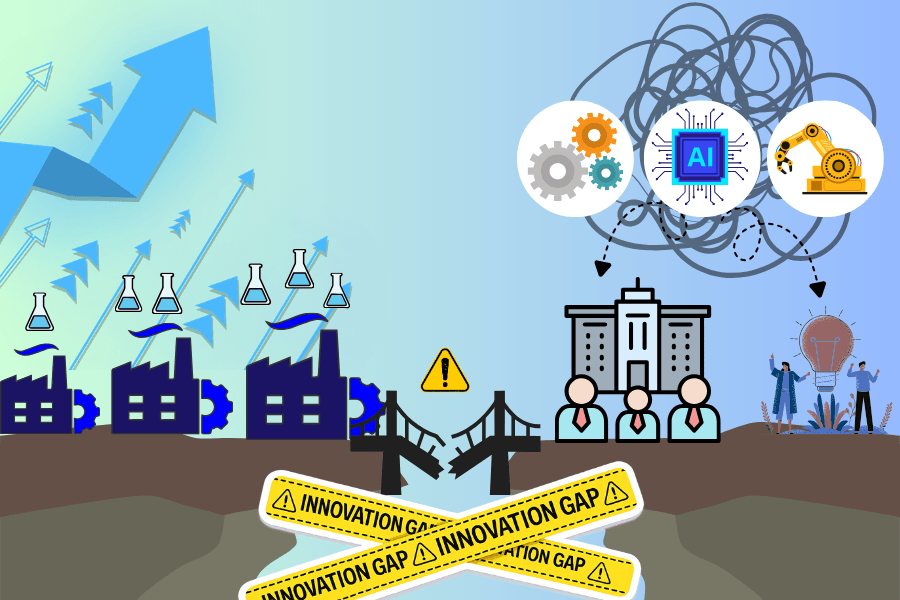
India’s active R&D units have increased steadily over the past decade. More firms are formally reporting innovation activity, and policy support for industrial research has expanded significantly. Yet beneath this apparent progress lies an uncomfortable reality. Manufacturing R&D intensity, measured as expenditure relative to output, has remained persistently weak even as participation in the innovation ecosystem has widened.
India, in effect, may be building an administratively thicker innovation ecosystem without building a technologically deeper one. That distinction matters because the next phase of global manufacturing competition, shaped by industrial AI, strategic technologies, supply-chain realignment, and green industrial systems, will increasingly reward countries capable of sustaining long-term technological capability within their industrial base rather than intermittently accessing external technologies.
A Wider but Shallow Innovation Ecosystem
India’s innovation debate has long focused on gross domestic expenditure on research and development (GERD), which has remained below 1 percent of GDP for decades and well behind countries such as China and South Korea. But aggregate national spending figures reveal little about how innovation capacity is evolving within Indian industry itself.
Factory-level evidence from organised manufacturing points to a more complicated transition. Between 2015-16 and 2023-24, the number of active R&D units increased from about 3,500 to 4,000, suggesting that more firms are formally entering the innovation ecosystem. Yet R&D expenditure as a share of gross value added remained weak throughout the period, fluctuating between 0.38 percent and 0.57 percent without any sustained upward movement.
The divergence suggests that broader institutional participation alone does not automatically produce sustained technological accumulation within manufacturing firms.
Why Formalisation Does Not Equal Capability
The composition of India’s R&D ecosystem helps explain why wider participation does not necessarily indicate deeper technological capability.
Factories with active R&D units registered under the Department of Science and Technology (DST) or Department of Biotechnology (DBT) spend substantially more on research, on average, than firms registered under other categories or firms reporting R&D expenditure without any formally registered unit. This suggests that institutions linked to dedicated scientific and technological ecosystems continue to account for a disproportionate share of meaningful research activity.
Yet the composition of participation is also changing. Active DST/DBT-linked R&D units have gradually declined as a share of the ecosystem, while registrations under “other” agencies have expanded rapidly. At the same time, firms reporting R&D expenditure without registered units have declined. On the surface, this points to growing formalisation of innovation activity. But it remains unclear whether this formalisation reflects deeper technological investment or simply wider administrative classification.
A particularly revealing feature is the persistence of inactive registered R&D units: firms that continue to hold R&D registrations despite reporting no R&D expenditure. This suggests that parts of India’s innovation ecosystem may increasingly be measuring participation in administrative categories rather than sustained technological effort itself. Registration growth, therefore, does not necessarily indicate the development of durable research capability within manufacturing firms.
The Structural Logic of Adaptation-Led Industrialisation
The pattern reflects the structure of India’s industrial upgrading model itself.
Large segments of Indian manufacturing have historically relied on imported technologies, foreign collaborations, multinational subsidiary structures, and technology-transfer agreements to improve productivity and scale. Rather than developing frontier technologies internally, firms have often specialised in integrating and adapting externally developed systems into domestic production processes.
The auto-component sector illustrates this pattern clearly. Many firms operating within global automotive supply chains specialise in adapting designs, production systems, and engineering standards developed by multinational original equipment manufacturers. This model has delivered important gains by accelerating technology diffusion, improving manufacturing capability, and helping firms integrate into global value chains without bearing the full costs of frontier innovation.
But adaptation-led industrialisation also shapes the structure of firm incentives. If competitiveness depends primarily on acquiring, integrating, or incrementally modifying external technologies, firms may prefer intermittent or project-linked research expenditure over building large, continuous research ecosystems internally.
In such systems, technological learning often remains incremental and externally anchored rather than internally cumulative. As a result, firms may continue to depend on adaptation-led upgrading without developing the internal research ecosystems required for sustained indigenous innovation.
Why Existing Incentives May Not Deepen R&D
Recent policy interventions reflect growing recognition of this challenge. Over the past two decades, India has expanded R&D tax incentives, strengthened intellectual property protections, widened CSR-linked support for scientific research, and launched the ₹1 lakh crore Research Development and Innovation (RDI) Scheme aimed at supporting private-sector-led technological development.
Yet current policy frameworks appear more effective at widening firms’ engagement with innovation systems than at altering long-term research behaviour.
Part of the reason lies in the political economy of industrial innovation itself. Long-horizon R&D remains expensive, risky, and institutionally demanding. Firms often face stronger incentives to prioritise production expansion, export competitiveness, and short-term operational efficiency over uncertain research investments whose returns may materialise only over extended periods.
Financial structures reinforce this tendency. Credit systems and investor expectations tend to reward scale expansion and predictable returns more reliably than experimentation-intensive technological development. At the same time, fragmented innovation support systems and weak academia-industry research linkages limit the emergence of stable collaborative research ecosystems capable of sustaining long-duration innovation cycles.
In this environment, firms may rationally engage with innovation systems at the level necessary to access incentives, maintain registrations, or undertake project-specific research without substantially increasing sustained R&D intensity. The result is a manufacturing ecosystem where participation expands faster than technological depth.
From Innovation Participation to Technological Capability
For much of the past three decades, India’s manufacturing strategy focused on expanding production capacity, integrating into global value chains, and accelerating industrial scale. Those objectives remain important. But the next phase of industrial competition will increasingly depend on whether firms can move from adaptation-led upgrading toward sustained technological capability creation in strategic and technology-intensive sectors.
The central challenge, therefore, is no longer only about expanding formal measures of innovation activity. It is about whether India’s industrial ecosystem is generating durable research ecosystems capable of continuous experimentation, technological learning, and endogenous innovation over time.
The real test of India’s innovation transition is not how many firms participate in R&D, but how many develop the capacity to advance technology continuously, both within their own R&D setups and through academia-industry linkages, rather than import it intermittently.