



India’s Green Revolution is often remembered as a turning point that helped the nation secure self-sufficiency in food. Yields of rice and wheat rose sharply, and dependence on food aid declined. Yet this success also created new challenges. Traditional grains such as millet - known for being healthy, nutritious, and climate resilient - once staple across much of the country, were gradually abandoned. Procurement and subsidies favoured rice and wheat, consumer tastes shifted, and millets were dismissed as “the poor man’s food.”
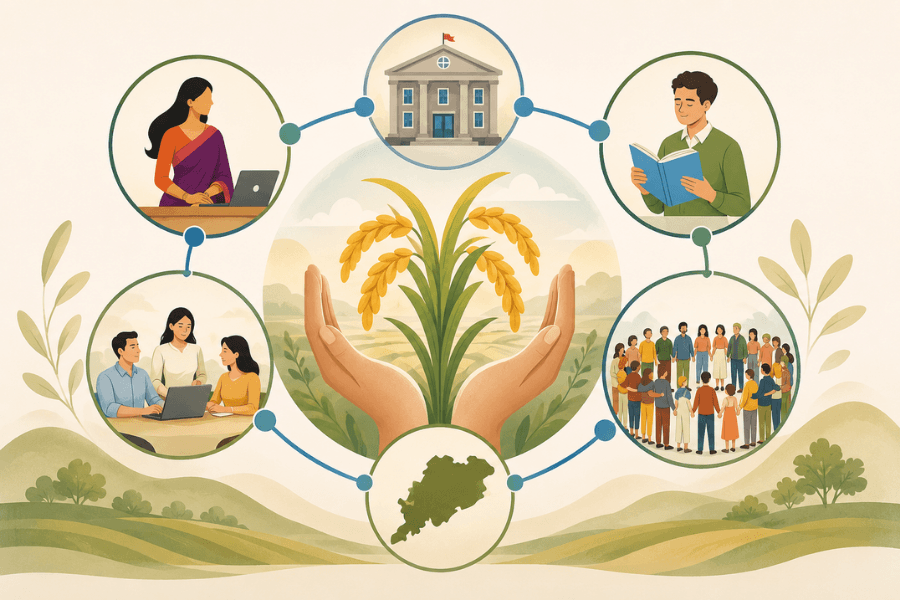
In 2017, Odisha took steps toward a course correction. The state government launched the Odisha Millets Mission (OMM, renamed to Shree Anna Abhiyan in 2024), in collaboration with academia and civil society. It was initially rolled out in just 30 blocks across seven districts, with the explicit aim of reviving millet cultivation and consumption. By 2018–19, it had expanded to 55 blocks, and today it covers 177 blocks across all 30 districts of the state. What makes OMM remarkable is not simply that it has put forgotten grains back on the agenda. It has broken with India’s command-and-control style of policymaking, showing how multistakeholder policymaking with co-production, phased learning, and pro-farmer and pro-women approach can produce more resilient and inclusive outcomes.
Breaking with Tradition
The need for innovation in Odisha was urgent. Poverty levels in the state stood at 33 percent, much higher than the national average of 22 percent. Among Odisha’s rural tribal population, 63.5 percent were poor, compared with 45.3 percent nationally. Malnutrition indicators were stark: 29.7 percent of under-five children were underweight, 31 percent were stunted, and 56 percent of pregnant women were anaemic. These figures highlighted the failure of rice-centred policies.
The OMM set out to reverse this pattern, with success judged not by yields alone but also by improvements in nutrition, livelihoods, and resilience. The state backed this ambition with resources: its commitment to the mission grew from ₹581 crore in the first five years to ₹2,808 crore in the next five, signalling seriousness and continuity.
One of the unique elements of the mission was that it brought in diverse partners, civil society organisations, academic researchers, and farmer producer groups, through formal memoranda of understanding and contracts. Roles were defined and accountability built in. This was co-production by design: structured collaboration that embedded non-state actors into delivery.
Phased Expansion and Embedded Learning
Another departure of the OMM lay in its approach to scale. Programmes in India are often launched with ambitious targets, sacrificing flexibility for uniformity. The OMM instead grew step by step. Starting small, it expanded in seven phases, each round incorporating lessons from earlier ones. This incremental approach reduced the risks of failure. Procurement rules that excluded small farmers were modified. Processing technologies were refined. Incentives were recalibrated. Mistakes were treated as opportunities to learn before scaling further.
Supporting this adaptability was the active role of academia. Their involvement throughout produced studies on nutrition, seed diversity, and gender impacts that directly informed policy. The collaboration with the civil society brought in their rich field-based knowledge and experience to every stage of the policymaking. Alongside formal meetings, feedback through WhatsApp groups connected facilitators, officials, and community groups for real-time information. Monitoring thus became a process of collective learning rather than a bureaucratic checklist.
Building Local Enterprise
Reviving millets required viable markets and ways for communities to capture value. The OMM invested in farmer producer organisations, women’s self-help groups, and micro-entrepreneurs to handle processing, storage, and marketing. Community-managed seed centres and machinery hubs were also created.
Women’s collectives were central. Under the “Millet Shakti” initiative, self-help groups ran tiffin centres and processing units supplying local markets and school kitchens. With them, farmers gained market access, and women became visible actors in local economies. Without such enterprises, millet farming would have remained dependent on government procurement.
The OMM was also the first state programme to introduce direct benefit transfers for agronomic practices such as systematic millet intensification, and to set minimum support prices for little and foxtail millets. These measures gave farmers confidence that millet cultivation could be profitable and sustainable.
Integration Across Schemes
The mission embedded itself in other state programmes. Mission Shakti gave women’s groups formal roles in processing and marketing. The Midday Meal Scheme and Integrated Child Development Services introduced millet dishes into schools and Anganwadis, creating steady demand and reshaping diets. Tribal development funds and District Mineral Funds were channelled into millet promotion in Adivasi districts.
By working across programmes, OMM secured both resources and legitimacy. It was not a vulnerable standalone project but a cross-cutting initiative woven into Odisha’s development agenda.
The GAME Framework
The OMM’s design can be understood through the GAME framework: Goals, Actors, Measures, and Ends. Goals went beyond yield or acreage, with nutrition, diversification, and resilience placed alongside productivity. Actors included government, civil society, and academia, each with formal responsibilities. Measures combined incentives, seed banks, procurement, and decentralised processing, creating an ecosystem rather than isolated schemes. Ends were tracked inclusively, with weight given not only to acreage but also to women’s entrepreneurship, tribal participation, and the revival of food heritage.
The framework shows that effective policy requires attention not only to objectives but also to who is involved, how progress is measured, and whether the outcomes reflect the needs of those often excluded – such as women and marginal farmers.
Equity and Historical Justice
For tribal farmers and women, the OMM is more than a source of new income. It has restored dignity to crops long dismissed as inferior, and to the knowledge systems that sustained them. Women once invisible in official statistics have emerged as entrepreneurs and leaders of local enterprises. Indigenous cultivation and cooking practices have been reclaimed as assets rather than liabilities.
This transformation was not incidental but intentional. From the outset, the mission mobilised primarily small and marginal farmers, with particular emphasis on Scheduled Tribes and Scheduled Castes. Procurement was decentralised to favour smallholders, women’s groups were prioritised in entrepreneurship, and local governance institutions were given space to decide strategies. By embedding equity into design, OMM did not merely promote millets; it reversed a decades-long pattern of exclusion.
Challenges and Political Risks
Yet no policy is without challenges. As the OMM expands, the quality of facilitation and monitoring is becoming harder to maintain. There is also the risk of elite capture, as larger players enter millet processing and edge out the women’s groups who were central at the start. Political pressures within the state can also distort priorities, with headline numbers sometimes valued over sustained grassroots ownership.
Transferability Beyond Odisha
Other states have shown interest in adopting the OMM, and the Government of India has even set up a task force to study it. But replication often involves dilution or rebranding. Without safeguards, inclusive design can give way to tokenism, and the collaborative spirit that underpins the Mission may erode.
The OMM is often described as a model, but its real strength lies in being a process that adapts continuously to context and feedback. Odisha had enabling conditions: a government willing to experiment, civil society organisations with strong local roots, farmers ready to adapt, and academia willing to contribute with research. Without such alignment, replication is likely to fail.
Still, the broader lessons travel well. Policies should set goals beyond narrow outputs, formalise roles for diverse actors, adopt measures that support entire value chains, and judge success by inclusive outcomes while building adaptability into design. These principles are relevant not only to agriculture but to any sector facing complex challenges.
The Policy Slant
The OMM is not just about reviving a forgotten grain; it is about reimagining how policy is made. Its lesson is that effective policies succeed not by imposing uniform solutions, but by sharing ownership, adapting to context, and amplifying voices at the margins. As India confronts the intertwined challenges of poverty, inequality, and climate stress, it will need more such experiments. The real question is not whether other states adopt millets, but whether they embrace the spirit of OMM: – collaborative and responsive. That, more than any acreage restored, is its enduring contribution to governance.