


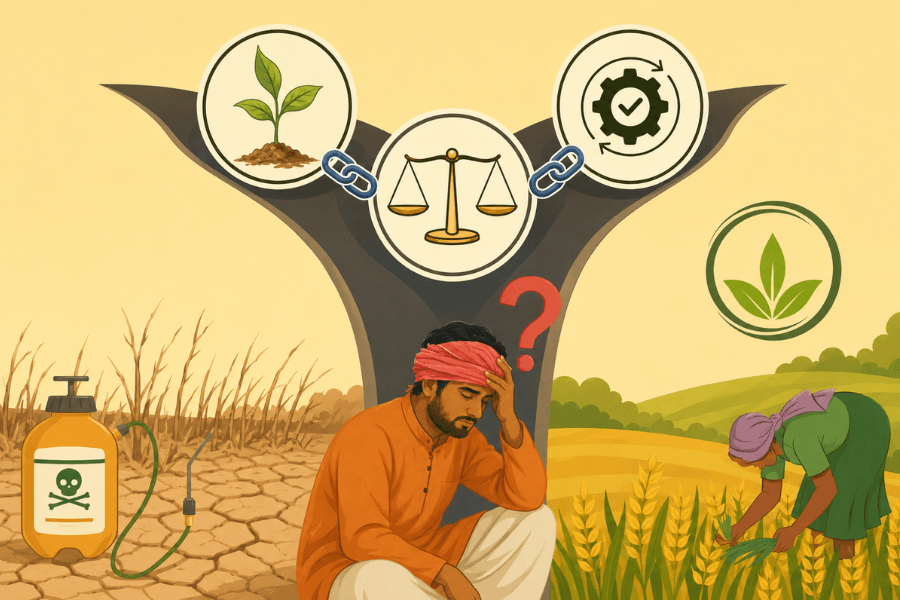
The Government of India's draft notification proposing a nationwide prohibition on the import, manufacture, sale, transport, distribution and use of Paraquat Dichloride marks one of the most significant pesticide regulatory decisions in recent years. Based on the recommendations of an Expert Committee and the Registration Committee, the proposal cites repeated poisoning incidents with high fatality rates, the absence of a specific antidote and evidence that paraquat has already been banned or severely restricted in more than 70 countries. Protecting human health and the environment must remain the foremost objective of pesticide regulation.
Yet the significance of the paraquat decision extends beyond a single herbicide. It should prompt a broader shift in pesticide regulation – from episodic approvals and prohibitions towards continuous risk assessment and post-registration surveillance – while also forcing agricultural policy to confront a related question: how should farmers transition when an important crop-management tool is withdrawn?
Beyond a Single Herbicide
Paraquat is a herbicide, but the regulatory question it raises is broader. Pesticide regulation must distinguish between hazard – the inherent capacity of a substance to cause harm – and risk, which depends on actual exposure. Dosage, application practices, protective equipment and farming conditions therefore matter alongside toxicological evidence. The same chemical can consequently face different regulatory treatment across agricultural systems.
Scientific knowledge also changes. New toxicological research, epidemiological evidence and environmental monitoring can alter what is known about a pesticide long after its initial registration. Approval should therefore not mark the end of regulatory scrutiny. Registered pesticides require periodic reassessment as evidence on their benefits, exposure patterns and risks evolves.
Where evidence shows that a pesticide poses risks that cannot be reduced to acceptable levels under realistic conditions of use, restriction or prohibition is warranted. But once a widely used herbicide is withdrawn, a second policy challenge begins: enabling farmers to manage weeds safely, effectively and affordably without it.
When a Herbicide Leaves the Field
Weed management remains one of the most important yet often overlooked challenges in Indian agriculture. According to the ICAR–Directorate of Weed Research, weeds account for annual crop losses estimated at nearly ₹92,000 crore and can reduce yields by 20–30 percent if left uncontrolled. Labour shortages, rising wages and the expansion of conservation agriculture have further increased the importance of timely and efficient weed control.
Paraquat and other non-selective herbicides have been used in orchards, plantations, stale seedbed preparation and minimum-tillage systems. Their adoption reflects, in part, the realities of labour scarcity and tight agricultural operating windows.
Manual weed control, while effective, typically requires 30–40 labour-days per hectare and can cost ₹12,000–16,000 per hectare. Herbicide-based weed management generally costs ₹2,500–4,000 per hectare. Removing a widely used herbicide can therefore change the economics of weed management, not merely the chemistry of it.
As a matter of precaution, the government and regulatory authorities should also consider the full range of alternatives available to farmers – not only other herbicides, but also mechanical and manual methods of weed control. The assessment should consider their effectiveness, affordability, labour requirements, implications for crop yields and farmers’ incomes, as well as potential environmental and health risks. Such a holistic assessment can help ensure that the transition to safer alternatives is practical, affordable and sustainable for farmers.
These costs are not an argument for tolerating unacceptable health risks. They demonstrate why prohibition is a regulatory decision, while replacing a herbicide's agricultural function is a farming transition. The two require different policy responses.
The Cost of Getting the Transition Wrong
The immediate question after withdrawal is not simply which chemical replaces paraquat, but what will replace the weed-management function it currently performs.
The answer need not be another herbicide. Depending on the crop and farming system, substitution could involve other herbicide molecules, mechanical weeding, biological approaches, cover crops, mulching or integrated weed-management systems. Precision spraying and robotic weed-control technologies may widen those choices over time.
These options, however, are not interchangeable. They differ in efficacy, labour requirements, cost, equipment needs and suitability across crops and agro-climatic regions. Replacing one herbicide with another may require relatively limited changes in farm practice but introduces a different chemical risk profile. Moving towards mechanical or integrated approaches can reduce chemical dependence more fundamentally, but may require new equipment, extension support and changes in cultivation practices.
The availability of alternatives should not determine whether an unacceptable pesticide risk is tolerated. It should, however, shape how the transition is implemented. A prohibition imposed without adequate access to effective substitutes risks increasing cultivation costs, encouraging inappropriate chemical substitution or weakening weed control. A managed transition can instead use regulation to accelerate the adoption of safer and more sustainable practices.
This requires agricultural research and extension policy to move alongside pesticide regulation. Research on biological weed management, precision agriculture, artificial intelligence-enabled spraying, robotic weed control and integrated weed management can expand the range of viable alternatives. Extension systems must then help farmers identify which options work under their particular crop, labour and agro-climatic conditions.
From Individual Bans to Pesticide Governance
The wider lesson from paraquat is that pesticide governance cannot begin with registration and end with prohibition. A modern regulatory system needs the capacity to assess risk under actual conditions of use, monitor what happens after registration, reassess approvals as evidence changes and act when risks can no longer be adequately controlled.
For pesticides whose risks can be managed, tools such as restricted-use classifications, certified applicator systems, protective-equipment requirements, calibrated spraying equipment, safer packaging and traceability can reduce exposure. Better surveillance of poisoning incidents and environmental effects can also provide regulators with evidence on how products perform outside controlled trials.
Where such safeguards cannot reduce risks to acceptable levels under realistic conditions of use, withdrawal must remain available. Such decisions should, however, trigger a parallel agricultural response: assessment of the function the product performs, identification of viable alternatives and support for farmers making the transition.
Paraquat should ultimately be judged on the evidence specific to paraquat. But its wider significance lies in what follows such decisions: a pesticide-governance system capable of reassessing and acting on risk, and an agricultural system capable of adapting when a crop-management tool is withdrawn.