



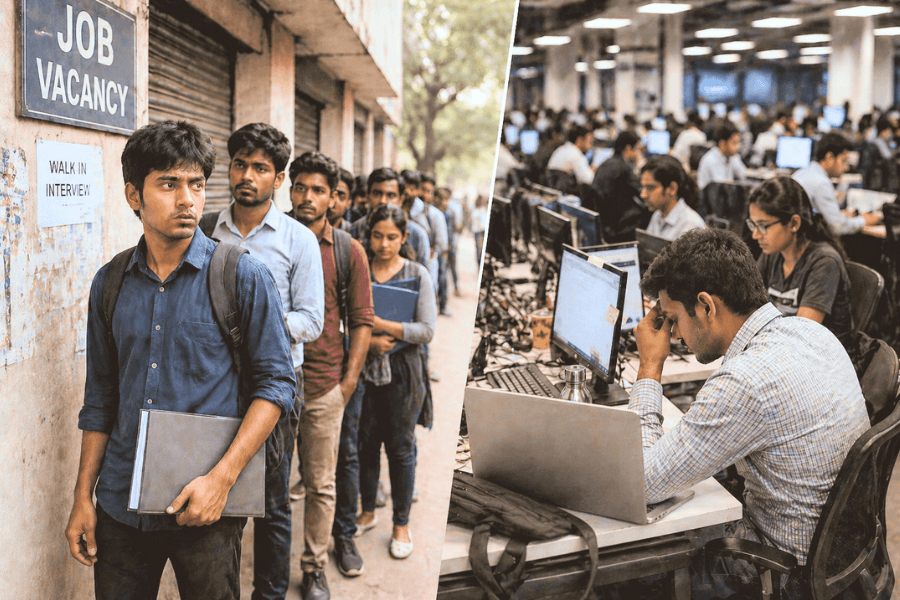
India’s youth labour market presents a puzzling picture. Fewer than half of young adults aged 20–29 are employed. Yet among those who are employed, long workdays are common, often extending well beyond a standard eight hours once commuting is included.
This contrast is not easy to reconcile. If jobs are scarce, why are many workers overburdened? And if work is available, why do so many remain outside the labour market?
The answer lies in how work is distributed across people, types of jobs, and places.
Who Gets Access to Work and Who Is Left Out
The unevenness is most visible in who gets access to work. The estimates based on data from India’s Time Use Survey 2024 reveals that nearly 79 percent of young men are in paid employment, compared to just about 18 percent of young women. In several large states such as Bihar and Uttar Pradesh, fewer than one in ten young women are employed.
This gap largely explains why overall participation remains low and varies sharply across states. Where more women work, employment rates rise; where they do not, the demographic dividend remains unrealised.
In effect, India’s employment challenge is as much about expanding access across the nation as it is about creating jobs.
Where Work Is Created and Why It Remains Fragmented
Even among those who do find work, it remains unevenly distributed across the type of employers. Informal (household) enterprises remain the default entry point into work – even for those with higher education. Only about 9.5 percent of young adults are employed in formal enterprises – corporate sector, government and NGOs – compared to roughly 37 percent in household enterprises. In rural India, this imbalance is even more pronounced.
The consequence is not just lower job quality, but uneven labour utilisation. Employment in household enterprises are often fragmented, limiting both the number of hours people can work and the consistency of that work. This reflects the small scale of such enterprises and unstable demand.
Even when jobs exist, they do not absorb labour evenly – leaving many underemployed while others remain excluded from work altogether.
Work Is Not Shared Evenly
This unevenness is clearest in the number of hours young people work.
On average, employed young adults spend about 6 hours and 55 minutes a day at work. This appears close to a standard workday. But the average conceals a sharply divided reality. At one end, about one-quarter of young workers put in more than 8 hours a day. At the other end, one-third of workers in informal enterprises work less than 6 hours.
Long hours reflect strong demand and inefficient job design, while short hours indicate underemployment – people working less than they would prefer because adequate work is unavailable. The result is a labour market that overuses some workers while leaving many others underutilised.
The Clock Reveals What Employment Data Misses
Looking only at paid work captures only part of the picture; how people spend a full day offers a fuller view of how labour – paid or unpaid – is actually used.
Young men work significantly longer hours in paid employment – about 7 hours a day compared to roughly 5 hours for young women. Yet once unpaid household and care work is included, the pattern reverses: young women, on average, work about 9.5 hours a day, compared to roughly 8 hours for young men.
This issue is not how many people work, but how work is distributed across activities. It shows that the issue is not only insufficient employment, but how time is allocated – often in ways that limit participation in paid employment.
Where You Live Shapes How Long You Work
Even for those in work, where people live shapes how they experience work. When commuting time is included, the length of the workday changes sharply. The share of young workers in formal employment spending more than 8 hours a day on work-related activities rises from about one-quarter to over 60 percent. More than one in three spends over 9 hours.
This reflects a deeper spatial mismatch between jobs and housing. Employment opportunities are often concentrated in specific urban locations, while affordable housing is located far from them. The result is a longer effective workday – driven not by work, but by getting to work.
Labour market outcomes are shaped as much by urban design as by employment policy.
India Is Not One Labour Market
These patterns are not uniform across the country. Some states absorb a majority of their young workforce, while others struggle across both rural and urban areas. For instance, employment participation among young adults ranges from about 58 percent in Gujarat to around 37 percent in Bihar – a gap of over 20 percentage points.
This variation goes beyond participation. States differ not just in how many young people work, but in how work is organised – across formal and household enterprises, across hours worked, and across distances travelled. In more urbanised and economically advanced states, gender gaps in work intensity tend to be narrower, and labour markets are better able to match workers to jobs.
These differences suggest that labour market outcomes are shaped less by national constraints alone and more by state-level institutions, infrastructure, and economic structures. India’s labour market is not one system, but many operating under different constraints.
Fixing Allocation, Not Just Supply
If work is unevenly allocated, expanding employment alone will not resolve the imbalance.
First, access constraints shape who can enter the labour market. A large part of the challenge lies in improving access to work, particularly for women, by addressing mobility, safety, and the transition barriers such as care work burden. Without this, even expanding labour demand will leave a significant share of the workforce underutilised.
Second, the structure of firms determines how labour is absorbed. A labour market dominated by informal enterprises limits the effectiveness with which workers can be absorbed. Moving more workers into formal enterprises is not only about job quality; it also increases the intensity and stability of work, allowing labour to be used more productively.
Third, spatial organisation affects the efficiency of work. When jobs and housing are poorly aligned, commuting time expands the effective workday without increasing productive work. Improving transport systems and aligning affordable housing with employment centres can reduce this distortion and improve both productivity and well-being.
Finally, labour policy must account for how time is allocated beyond paid work. Unpaid care responsibilities continue to shape who can participate in employment and how much they can work. Expanding access to childcare and related support systems is therefore not only a social objective, but an economic one.
From Population to Utilisation
India’s demographic dividend is often understood in terms of numbers – a large and growing working-age population. But numbers alone do not generate growth. What matters is how effectively that population is utilised.
The challenge, therefore, is not only to bring more people into work, but to ensure that work is distributed and organised to use time and effort more fully. India’s demographic dividend will be realised not through more jobs alone, but through better use of work – across people, places, and time.