


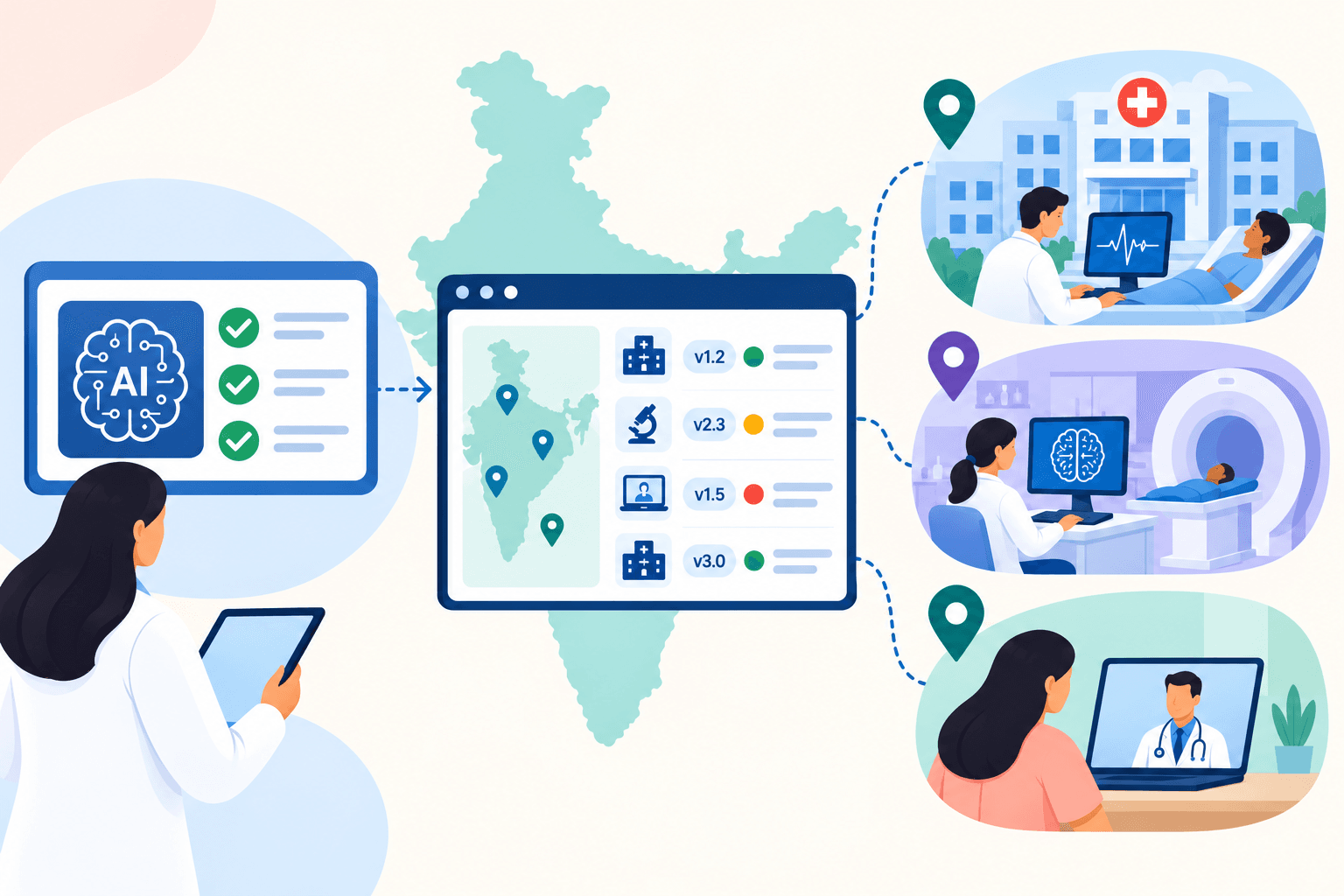
India is building systems to evaluate whether artificial intelligence (AI) is safe and reliable for use in healthcare. Yet the country lacks a unified public record showing where AI systems are deployed, what decisions they support and which model version is in use. As AI enters telemedicine, screening and clinical decision-making, this lack of traceability creates a patient-safety risk. An error detected in one hospital may go unrecognised at other facilities using the same system. India should therefore create a searchable national register of healthcare AI deployments.
In February 2026, the Ministry of Health and Family Welfare launched the Strategy for Artificial Intelligence in Healthcare for India (SAHI) and the Benchmarking Open Data Platform for Health AI (BODH), strengthening India’s emerging framework for healthcare AI evaluation and governance. A public register would complement these systems by making deployments traceable once AI enters healthcare practice.
From Evaluation to Everyday Care
By December 2025, AI-enabled clinical decision support had been integrated into eSanjeevani, the Ministry of Health and Family Welfare reported. MadhuNetrAI had analysed 14,000 retinal images across 38 facilities in 11 states, while Cough Against TB had screened more than 1.62 lakh people since March 2023. These figures show the scale of deployment, but they do not provide an ongoing record of which facilities use each system or model version. Such a record would help authorities trace affected deployments when safety concerns arise and help hospitals assess the evidence supporting systems they are considering.
Public access serves a further purpose: allowing patients to identify AI systems used by their healthcare providers and understand their intended role and oversight arrangements. It also enables hospitals to inspect validation evidence before procurement and researchers to examine patterns of adoption and gaps in coverage.
The register should cover AI systems that materially influence clinical decisions, access to care, triage, documentation or resource allocation. This includes diagnostic models, clinical decision-support systems, appointment-prioritisation tools and AI-generated clinical documentation. Ordinary administrative software with no material effect on patient care falls outside the proposed scope. Evidence and reporting requirements should be proportionate to the risk posed by each system.
Building a Register Around Existing Systems
A national register should build on the regulatory and evaluation mechanisms that already govern parts of healthcare AI in India. In March 2026, the Ministry clarified in a Rajya Sabha response that AI-enabled products qualifying as medical devices fall within the Central Drugs Standard Control Organisation’s (CDSCO) regulatory pathway under the Medical Devices Rules, 2017. BODH provides a mechanism for evaluating models against diverse, anonymised health data.
The proposed register serves as a common index, identifying each AI system and its deployments while linking to licensing, benchmarking and safety information held by the relevant authorities. The National Health Authority (NHA) should administer it, connecting deployment records to facility identifiers within the Ayushman Bharat Digital Mission (ABDM). CDSCO retains its existing responsibility for regulating AI-enabled medical devices.
The proposed design has two linked records. The product-level record identifies the developer, intended use, regulatory status, validation evidence, available versions and known limitations. The deployment-level record identifies each facility using the system, the model version deployed, its local purpose, date of introduction, patient population and human-review arrangements. This separation allows facilities to report local use without reproducing technical information already held at the product level.
Making Deployment Data Verifiable
Developers and suppliers should maintain product-level records and report changes in software versions, intended use, validation evidence and known risks. Healthcare facilities should report local deployment, oversight arrangements, serious incidents and discontinuation. Verification of deployments within Union and state health programmes should rest with the authorities administering them.
The NHA’s role as platform administrator is to assign identifiers and check that required information is complete. CDSCO should verify licensing information for regulated devices, with entries linking to relevant BODH benchmarking results. Each entry needs to show its source, verification status and date of last review. Regulatory status must be recorded separately from evaluation status, making clear that inclusion in the register does not constitute government approval.
Facilities should confirm their records annually and report material changes within 30 days, including a new clinical purpose, expansion to another patient population or a major software update. Serious safety concerns require prompt reporting through applicable incident-reporting channels and corresponding updates to the register, rather than waiting for the routine update deadline. For regulated devices, entries should link to the Materiovigilance Programme of India. A version log can capture minor technical updates.
A small NHA secretariat should coordinate verification, audit samples of entries and support smaller providers. Vendor-prepopulated product information would leave facilities responsible for reporting local deployment details. Public entries need plain-language summaries, with commercially sensitive and cybersecurity information restricted to authorised regulators.
A National Register Must Reach Private Healthcare
Centrally funded programmes offer a manageable first phase, but national coverage ultimately requires private-sector participation. No single mechanism will reach every private healthcare provider.
For regulated AI-enabled medical devices, product-record requirements should be incorporated into manufacturers’ and importers’ licensing and post-market obligations. Private facilities can then link these records to their Health Facility Registry identifiers when reporting deployment. For providers receiving public reimbursement, registration could become a condition of empanelment or renewal under Ayushman Bharat–Pradhan Mantri Jan Arogya Yojana (AB-PMJAY). This would extend reporting to participating private institutions through an existing administrative relationship.
State governments could incorporate deployment reporting into clinical-establishment licensing and renewal, where the applicable legal framework permits. Accreditation offers another route: standards could require organisations to maintain current entries for AI systems that influence care. Government procurement contracts should require vendors and purchasing facilities to complete their respective records.
These routes would initially produce partial coverage because state laws, ABDM participation and accreditation remain uneven. The Ministry of Health and Family Welfare should establish a common reporting standard under SAHI, with states and other responsible authorities incorporating it into their oversight systems. A shared standard allows reporting obligations to expand without creating incompatible registers.
Turning Visibility into Accountability
A public register would not, by itself, make healthcare AI safe. Its value lies in making safety concerns actionable by linking each system and model version to the facilities using it. As India strengthens evaluation, it should establish a common deployment-reporting standard and connect it to existing regulatory, procurement and reimbursement systems. The objective is to ensure that an error detected in one facility can trigger a timely response wherever the same system is used.