



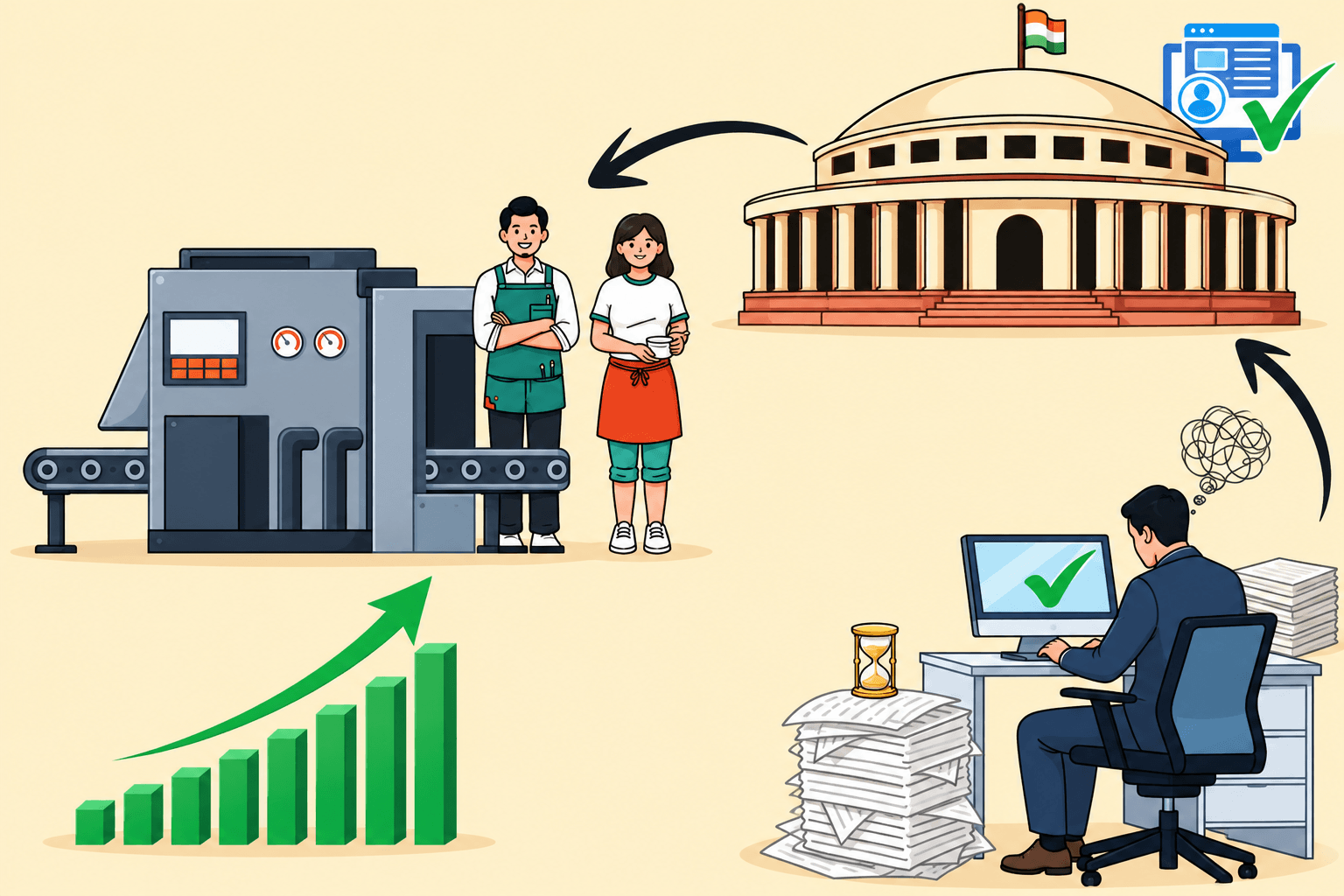
India’s digital government push is usually measured by access: can a business file, apply, pay or track a transaction online? But the fact that a service is available online does not tell us whether dealing with the state has become any less costly for the firm.
That distinction matters most for small businesses. A large company can assign a compliance officer, consultant or legal team to a bureaucratic requirement. For a microenterprise, the same requirement can consume a large part of the owner’s time through paperwork, delays and repeated interactions with government offices. Administrative friction can therefore become a production constraint.
If the state-business interface shapes how firms use scarce time, capital and labour, digital government is not merely an administrative reform. It is productivity policy.
The Hidden Productivity Cost
Administrative friction accumulates across tax payments, permits, inspections, labour and environmental compliance, commercial disputes and multi-agency approvals. For small firms, these are largely fixed costs: the same form, visit or delay absorbs a far larger share of their limited managerial capacity.
The scale of India’s unorganised enterprise economy makes these costs particularly consequential. More than 90 percent of enterprises in the unorganised sector are microenterprises, many of them operating with little organisational capacity to absorb administrative requirements.
Digitalisation can reduce these costs by limiting physical interactions, standardising procedures, improving traceability and connecting fragmented processes. But the economic gains may extend beyond the time saved. If administrative constraints affect how firms deploy capital and labour, reducing them should also affect productivity.
When the State Changes How Firms Do Business
In December 2014, the Chief Secretaries of states agreed on a 98-point Action Plan on Ease of Doing Business under the Make in India initiative. The Action Plan covered six areas of the state-business interface: tax filing and payments, construction permits, environment and labour standards, inspections, commercial dispute resolution and single-window systems.
Many of these reforms relied on digital tools, including online filing, payments, applications, tracking and approvals, although the reform programme itself was broader than digitalisation.
By 2015, states had implemented varying numbers of the six reform categories. This variation provides a natural way to examine whether firms in states that undertook more comprehensive reform subsequently performed differently from firms in states that undertook less.
The Productivity Dividend
Data from the 67th (2010–11) and 73rd (2015–16) rounds of the National Sample Survey (NSS), covering more than 285,000 non-agricultural, non-financial unincorporated enterprises, suggest that firms in states that undertook more comprehensive business-environment reforms subsequently recorded higher revenue-based total factor productivity (TFPR).
TFPR measures how effectively a firm turns capital and labour into revenue, while also reflecting the prices at which it sells its output.
This relationship becomes more consistent as the difference in reform intensity between states increases, with a similar pattern visible in manufacturing. Firms in Gujarat, Madhya Pradesh and Rajasthan — the three states that had implemented all six reform categories — recorded higher TFPR than firms in almost all other states, both overall and in manufacturing.
But the more revealing finding concerns the distribution of productivity. Firms in more comprehensively reformed environments were not only more productive on average; the dispersion of productivity across firms was also narrower.
That matters because administrative friction does not fall evenly. Firms with fewer resources to absorb compliance costs bear more of it. The evidence therefore points to a broader possibility: reform may matter not simply because productive firms become still more productive, but because fewer firms are held back by the state-business interface.
Digitising Bureaucracy Is Not the Same as Removing It
The lesson is not that putting more government services online automatically raises productivity. Digitalisation creates economic value when it removes administrative friction rather than merely digitising it.
A paper form converted into an online form may improve access while leaving the underlying burden intact. Firms still lose productive time if they must submit the same information repeatedly, navigate multiple portals, reconcile inconsistent requirements or wait without knowing when an approval will arrive.
The benchmark should be the smallest firm, not the company with a dedicated compliance team. The relevant questions are practical: How many times must the same information be submitted? How many agencies must a firm interact with? How many physical visits remain necessary? Can an application be tracked? Is the time to approval predictable?
For a small firm, interoperability matters because it determines whether digital government actually reduces the number of interactions with the state. If information already submitted to one agency can be reused by another, digitalisation removes compliance work rather than merely relocating it online. Interoperability is, in that sense, a productivity tool.
India has already invested heavily in making the state accessible online. The next test of digital government is a harder one: how much of a small firm’s scarce time, capital and managerial attention does dealing with the state still consume?
When digital reform reduces that burden, it does more than make government convenient. It gives firms back resources they can use to produce, invest and grow.