


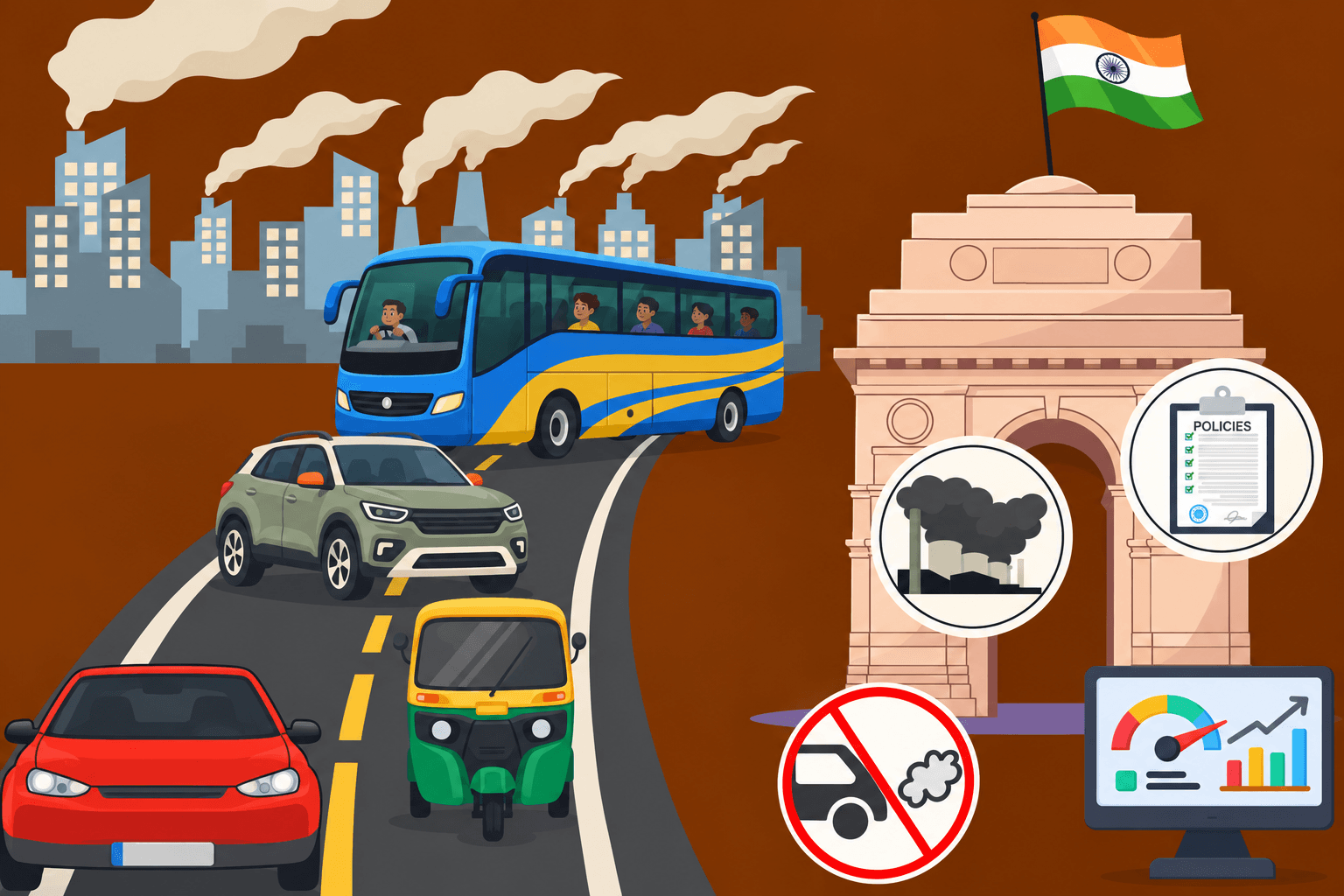
Every winter, Delhi’s air-pollution debate follows a familiar cycle. Pollution levels rise, attention turns to likely sources, governments announce restrictions and enforcement measures, and debate centres on whether the latest intervention will bring concentrations down. The harder policy question receives less attention: how do we know whether a particular intervention actually worked?
That question is important because a change in observed air quality does not necessarily reflect a change in emissions. Delhi’s pollution reflects several sources operating simultaneously, including combustion, road and construction dust, open burning and regional transport. Atmospheric chemistry can transform gaseous pollutants into particulate matter, while low wind speeds, temperature inversions and shallow boundary layers can turn relatively steady emissions into prolonged episodes of high pollution.
The Missing Question in Delhi’s Pollution Debate
Measurement quality is central to how pollution policy is diagnosed and evaluated. If measurements across locations or periods are not sufficiently comparable, policymakers may struggle to distinguish a genuine change in emissions from meteorological variation, atmospheric processes or measurement uncertainty. Delhi has developed an extensive air-quality monitoring network over the past two decades. Yet differences in measurement principles, calibration and maintenance can limit the comparability of observations across locations and over time.
The issue is how confidently those measurements can be compared and interpreted.
When Measurement Shapes the Diagnosis
PM2.5 is not a single pollutant with a single source. Its concentration reflects direct emissions as well as chemical transformations in the atmosphere. During severe winter episodes, secondary inorganic and organic aerosols can account for more than half of PM2.5 mass. These particles form through reactions involving precursors such as nitrogen oxides, sulphur dioxide, ammonia and volatile organic compounds. Particulate mass measurements alone cannot reveal these formation pathways. Concurrent measurements of precursor gases and particle composition are needed to diagnose them and assess whether controls on precursor emissions are working.
Dust presents a different challenge. Mechanically generated and re-suspended particles can contribute substantially to PM10 and, in some locations, PM2.5, particularly around traffic corridors and construction sites. Their contribution can rival or exceed exhaust emissions under certain dry conditions. Because dust emissions can be brief and highly localised, evaluating dust controls requires measurements that capture particle size, location and short-duration peaks.
Severe pollution episodes also extend across the National Capital Region and adjoining states. Measurements within Delhi alone cannot always establish where the pollution originated. Comparable observations across jurisdictions, alongside source analysis, are needed to assess the contribution of regional transport.
From Monitoring to Policy Evaluation
Measurement should be part of policy design. Every major intervention should begin with a credible baseline, specify what change it is intended to produce and establish how that change will be assessed. A fall in PM2.5 after an intervention does not, by itself, show that the intervention caused it: weather, regional transport, atmospheric chemistry and other measures introduced at the same time may also affect concentrations.
This calls for a measurement–diagnosis–mitigation loop. Reliable measurements establish the baseline; source characterisation helps identify the appropriate intervention; and comparable measurements help evaluate the outcome. That evaluation must account for measurement uncertainty as well as the other factors that could explain an observed change. A sustained improvement attributable to the measure provides a basis for strengthening it. An inconclusive result calls for further investigation or redesign.
India has an institutional basis for improving the reliability of these measurements. The India Certification Scheme for Environmental Monitoring Instruments (NPLI-CS), established by CSIR–National Physical Laboratory, is designed to bring traceability and performance verification into environmental monitoring. Its certification framework covers calibration against reference standards, laboratory assessment of instrument performance, evaluation of measurement uncertainty and long-duration field verification. It applies to continuous emissions monitoring systems (CEMS), which measure emissions at sources, and continuous ambient monitoring systems (CAMS), which measure pollution in the surrounding environment.
Reliable source and ambient measurements provide a stronger foundation for examining the relationship between what is emitted and what people breathe. Establishing that relationship still requires source characterisation and analysis of atmospheric conditions. Certification makes those assessments more dependable; it does not replace them.
The measurement system should then be designed around the intervention. Combustion controls require evidence of changes in emissions and ambient concentrations. Dust and construction controls need measurements that capture short-lived changes close to affected roads or sites. Regional measures require comparable data across jurisdictions. Strategies targeting secondary aerosols need measurements of precursor gases alongside particle composition. In each case, the policy question determines what must be measured.
From Emergency Response to Policy Learning
Delhi’s worst pollution cannot be managed as an isolated emergency that begins and ends with a particular restriction. Severe episodes build over days or weeks, recur each winter and reflect interactions among emissions, regional transport, atmospheric chemistry and weather. Managing them requires preparedness and sustained exposure reduction alongside emergency response.
Clean-air policy must also establish whether longer-term changes are reducing emissions and exposure. Electrification of transport, reduced dependence on diesel generators, cleaner industrial energy and better construction practices may alter the relationship between economic activity and pollution. Their effects should be assessed over time and across differing weather conditions, using measures suited to each intervention.
The question for every major clean-air measure is therefore: what evidence would convince us that it worked? Asking it before implementation would make evaluation part of policy design – and give Delhi a firmer basis for deciding which measures to retain, scale or redesign.