



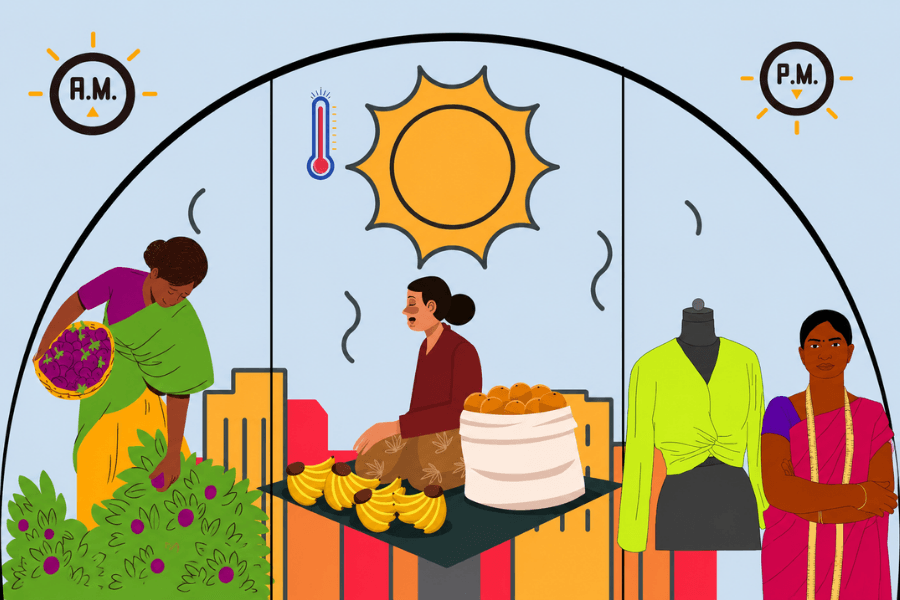
India now routinely faces temperatures above 40°C, with peaks exceeding 45°C in several regions. At these levels, the economic concern is immediate: higher heat should reduce people’s ability to work, lowering productivity and incomes. Yet the evidence points to a more nuanced reality. Across a nationally representative sample of over 186,000 working-age individuals, daily work hours remain broadly unchanged even on very hot days.
This creates a paradox. If heat exposure is rising sharply, why is labour supply not falling?
The answer lies in how work is distributed across the day. Heat is not eliminating work; it is reorganising it.
Shifting the Workday
On average, Indians engaged in paid employment work about 7.5 hours on a given day. As temperatures rise, workers adjust the timing of their effort. Work declines sharply during the hottest window between 12 p.m. and 3 p.m., when exposure is most intense. In response, activity shifts to cooler periods: mornings between 6:30 a.m. and 10 a.m., and evenings from around 5:30 p.m. to 8:30 p.m.
The adjustment is temporal shift rather than an absolute decline in time spent on paid work. Work is preserved by redistributing it across cooler hours.
But the ability to shift work across the day is not evenly distributed. It depends on how much control workers have over their schedules.
Flexibility Defines Adaptation
Self-employed individuals, casual workers, and those in agriculture display the strongest adjustments. Their work is tied to outdoor conditions but allows discretion in timing. These workers reduce activity during peak heat and compensate during cooler hours.
Salaried workers face a different constraint. Fixed schedules limit their ability to reallocate work. When temperatures rise, activity falls during peak heat, with limited scope to recover lost time later in the day.
Sectoral patterns reinforce this divide. Intraday shifts are pronounced in agriculture and other outdoor work, while manufacturing and services show far weaker adjustments. Adaptation is strongest where time flexibility exists, and weakest where institutional schedules are rigid.
Heat exposure, therefore, does not affect all workers uniformly. It is mediated by the degree of control individuals have over their time.
The Hidden Health Trade-Off
These adjustments are not costless. The preservation of work time is achieved by compressing recovery.
As temperatures rise above the 25-30°C range, nighttime sleep declines steadily. Workers compensate through longer daytime naps, which increase significantly at higher temperatures. This redistribution of rest indicates that recovery is being fragmented rather than maintained.
Other activities also adjust. Households prioritise income-generating activities: time spent on unpaid work declines, and leisure contracts as heat rises. Over time, this pattern can translate into fatigue, health risks, and reduced efficiency that are not immediately visible in labour supply data.
Designing Flexible Work Systems
India’s policy response to heat has begun to recognise the need for adaptation, including proposals to reschedule work hours and strengthen workplace protections. The emerging evidence points to a broader design challenge.
Workers are already adjusting by redistributing effort across cooler hours. The constraint lies in whether institutions can accommodate this shift.
In agriculture and informal sectors, flexibility exists but operates without support systems such as shaded rest areas or reliable water access. In formal sectors, the constraint is structural, embedded in fixed schedules and coordination requirements.
A differentiated approach is therefore required. Outdoor work demands protections that reduce exposure. Formal sectors require organisational redesign that allows work to move across time without undermining coordination.
The policy challenge is not to introduce flexibility, but to align institutional structures with behavioural adaptation already underway.
Time as an Economic Constraint
As temperatures continue to rise, the central question is how effectively economies can reorganise time. Workers have already begun adjusting at the margin, redistributing effort across cooler hours. The next step lies in whether institutions can support this transition at scale.