



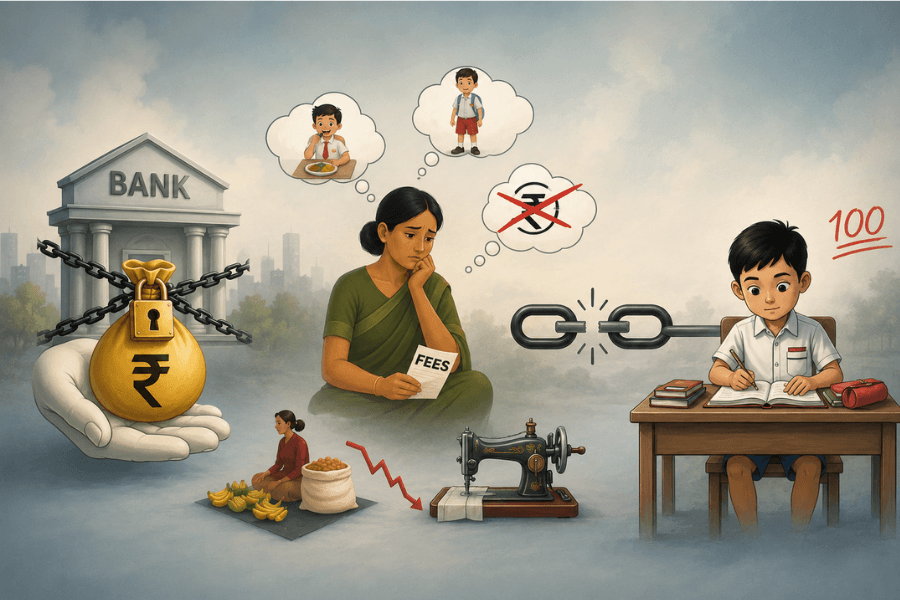
A child’s learning is shaped by more than what happens inside the classroom. Families invest continuously in education through school fees, books, transport, nutrition and other everyday decisions that support children’s development. The ability to sustain these investments during periods of economic uncertainty plays an important role in shaping learning outcomes.
For millions of low-income families, affordable credit helps sustain these investments by providing a buffer during periods of financial stress. India’s experience following the Andhra Pradesh microfinance regulation of 2010 illustrates how quickly that buffer can disappear. That episode raises a broader policy question: What happens to children’s learning when financial shocks weaken household resilience?
Credit Is Part of the Education Story
The Andhra Pradesh microfinance regulation of 2010 was introduced in response to concerns over high-interest lending and coercive recovery practices in the state’s microfinance sector. Although the regulation applied only in Andhra Pradesh, its effects extended far beyond the state. Because banks provided much of the funding to microfinance institutions, they sharply reduced fresh lending across the country. Between 2010 and 2011, the sector’s gross loan portfolio contracted by nearly 20 percent, equivalent to more than US$1 billion.
Districts that experienced greater exposure to this contraction subsequently recorded weaker learning outcomes among school-going children. Mathematics scores declined by around 0.08 standard deviations and reading scores by about 0.05 standard deviations relative to less exposed districts – learning losses comparable to the gains achieved by many large educational interventions. Importantly, these effects persisted even after credit conditions gradually improved.
The significance of these findings extends beyond one episode in India’s microfinance sector. They suggest that household access to finance can influence educational outcomes in ways that education policy does not usually recognise.
Households Adjusted Around Schooling, but Learning Suffered
The persistence of these learning losses suggests that reduced access to credit affected far more than household cash flow. Rather than making one large adjustment, families appear to have spread the burden across many everyday decisions while trying to keep children in school.
One of the earliest adjustments was school choice. Children in more affected districts became about 2.3 percentage points less likely to attend private schools and correspondingly more likely to enrol in government schools, where education is largely free. Overall school enrolment remained broadly stable, suggesting that households prioritised keeping children in school even as financial constraints reshaped the type of education they could afford.
Financial pressures also reduced investment in education. Monthly expenditure on education declined by around ₹39, representing nearly 13 percent of average spending. Much of this reflected lower spending on school fees, although tighter budgets also left less room for books, learning materials, transport and other educational expenses that support children’s progress throughout the school year.
The adjustments extended beyond education. Monthly household food expenditure fell by around ₹71 in the more exposed districts, with noticeable reductions in cereals, vegetables, fruits and nuts. At the same time, mothers’ employment declined by around 2 percentage points as tighter access to microfinance constrained income-generating activities. Both changes weakened the household environment that supports children’s development.
Individually, each adjustment appears modest. Together, they reveal how financial shocks can gradually hollow out the ecosystem that sustains learning. Educational setbacks emerged not because children left school, but because the conditions that support learning steadily weakened.
Financial Shocks Deepen Existing Educational Inequalities
The average decline in learning also masked important differences across households.
Girls experienced larger declines than boys, with mathematics scores falling by an additional 0.012 standard deviations and reading scores by 0.01 standard deviations. They were also 2 percentage points more likely to shift from private to government schools, suggesting that financial stress can reinforce existing gender inequalities even when overall enrolment remains stable.
Younger children experienced larger learning losses than older students. The strongest effects were concentrated among children aged 6 to 10 years, when foundational literacy and numeracy skills are formed. Setbacks during these years are more difficult to recover, increasing the likelihood that temporary financial shocks produce lasting educational consequences.
Financial resilience therefore matters not only for improving average learning outcomes but also for preventing existing educational inequalities from widening.
Household Financial Resilience Is an Educational Input
The Andhra Pradesh experience highlights an important blind spot in policymaking. Financial regulation is usually evaluated through indicators such as consumer protection, institutional stability and financial sector performance. Yet its effects can extend into entirely different sectors through the decisions households make when their financial resilience is weakened.
Education policy has traditionally focused on improving schools, teachers and learning resources. These remain essential. But the evidence suggests that children’s educational progress also depends on whether households can sustain spending on nutrition, educational materials and income-generating activities during periods of financial stress.
Education and financial policy are often discussed separately, yet households connect the two through their everyday decisions. Household financial resilience deserves greater recognition as a foundation for educational outcomes. Recognising that connection would help ensure that measures designed to strengthen the economy also safeguard the human capital on which future growth depends.