



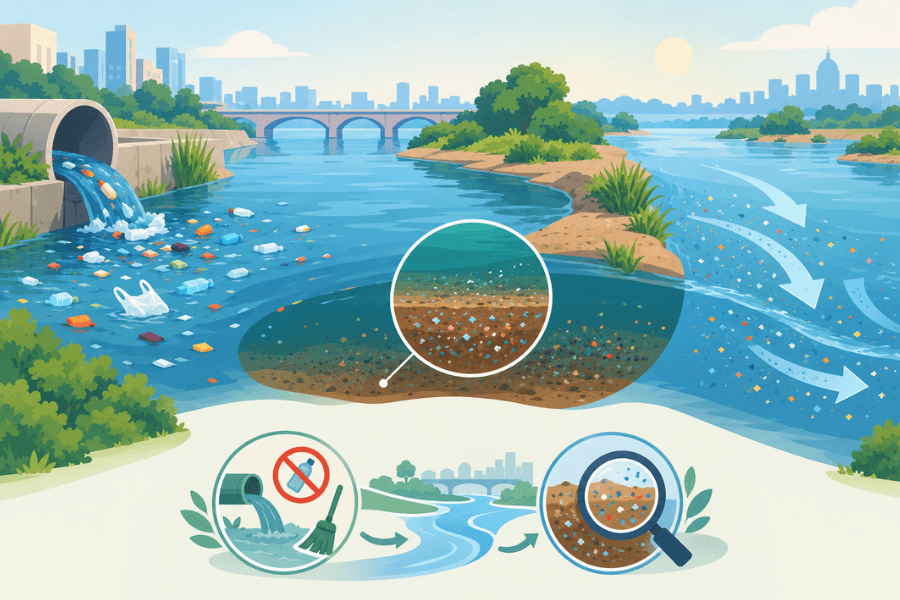
Plastic pollution in rivers is usually understood as a problem of what enters the water. But rivers do not always carry pollution downstream; their flow, sediment and floodplain determine where plastic is deposited and retained.
That distinction is clearly visible along the Yamuna floodplain. Microplastic concentrations range from 54 particles per 100 grams of sediment at Panchyara, a reference site, to 809 particles at Okhla Barrage. The contrast raises a more consequential question than how much plastic reaches the river: what happens to it once it gets there? For Yamuna management, that distinction matters because reducing new plastic inputs does not address the pollution already accumulated within the river system.
Understanding that pattern begins with the pathways through which plastic enters the river.
Urban Systems Shape Plastic Inputs
Delhi generates more than 11,000 tonnes of municipal solid waste every day, while plastic waste generation is estimated at 53.6 grams per person per day, or roughly 1,060 tonnes a day. The scale of this waste stream creates multiple opportunities for plastic to leak into the river system.
Plastic reaches the Yamuna through multiple pathways, including domestic wastewater, industrial activity, urban waste and runoff. Drains are a critical part of this network, with Najafgarh and Barapullah among the major channels carrying wastewater and urban runoff towards the river. Plastic discarded along riverbanks and floodplains adds another pathway, particularly when it is washed into the river.
These pathways are potential points of intervention. But controlling plastic at entry points addresses only one part of the problem: it does not account for where plastic accumulates once inside the river system.
Accumulation Follows River Dynamics
At Wazirabad, concentrations reach 224 particles per 100 grams of sediment; this rises to 809 at Okhla Barrage and stands at 528 at Jaitpur.
River hydraulics help explain this uneven distribution. Reduced flow velocities and areas of active sediment deposition provide conditions for microplastics to accumulate, while higher-flow conditions can promote downstream transport. At Wazirabad Barrage, reduced flow favours retention.
But hydraulics do not act alone. Higher concentrations can also emerge from the interaction of river processes with local sources and infrastructure. Okhla, near the Shahdara drain confluence and Okhla Barrage, combines concentrated anthropogenic inputs with conditions that favour deposition.
A pollution hotspot, then, need not correspond to a single pollution source. It may reflect local inputs, accumulated upstream pollution, depositional conditions, or some combination of the three.
The question then shifts from how the river moves plastic to how the sediment retains it.
Sediment Creates a Pollution Stock
Across the sediment fractions, fine sand records the highest aggregate microplastic abundance, at 171, compared with 29 in clay.
This pattern reflects the role of sediment texture: grain size influences where microplastics settle and how readily they remain in place. Sediments can thus act as a storage compartment for plastic pollution, particularly in depositional areas and floodplains.
The Yamuna has both a continuing flow of new plastic pollution and a stock already accumulated in its sediments. Seasonal variations in flow and future floods could remobilise this accumulated stock and carry it further downstream.
Reducing new inputs, therefore, does not remove the stock already accumulated in the river system.
What a Flow-and-Stock Approach Changes
The flow-and-stock distinction points to three changes in Yamuna management.
First, routine pollution monitoring should include riverbed and floodplain sediments alongside water, particularly at locations where microplastics are likely to accumulate.
Second, pollution control should move upstream to the drainage network. Drains should become intervention points for reducing plastic pollution before it enters the river.
Third, pollution management should account for how barrages, depositional zones and floodplain dynamics affect microplastic accumulation and remobilisation. River restoration plans should identify sediment hotspots and assess where floods or changing flows could redistribute accumulated plastic.
Together, these measures would extend Yamuna management beyond water quality to the wider processes that determine where plastic enters, accumulates and moves.
Beyond Water Quality
The Yamuna's plastic problem requires river management to look beyond the water column. Reducing new plastic inputs remains essential, but so does accounting for pollution already stored in sediments and the conditions that can redistribute it.
The next phase of Yamuna restoration must address what enters the river, what accumulates within it, and where changing flows may carry that pollution next.