



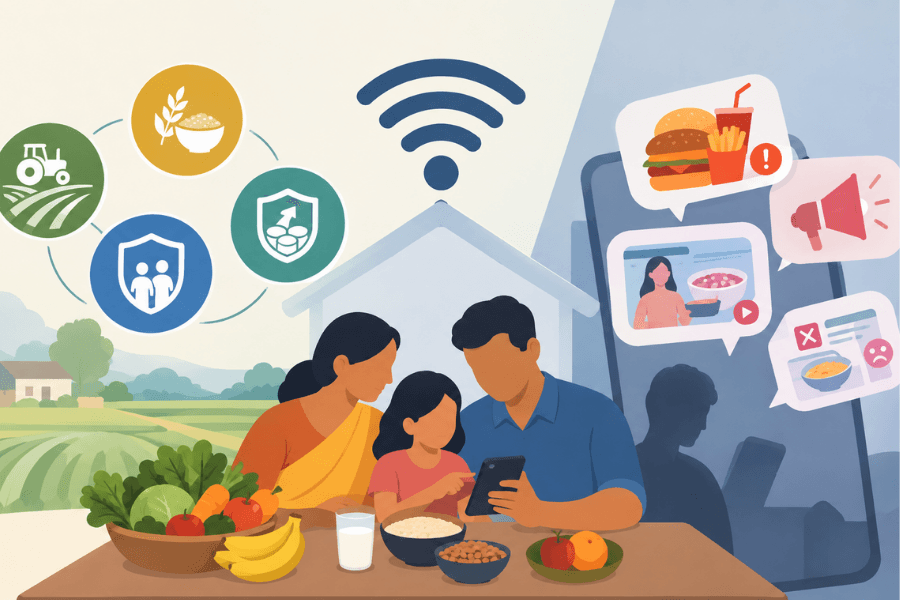
Household consumption has long been at the centre of public policy. Governments have sought to improve outcomes through interventions spanning agriculture, food security, social protection and income support. Yet another force is increasingly influencing how households make consumption decisions: internet connectivity.
By changing how households discover information, compare alternatives, access markets and complete transactions, connectivity can expand their choices. Is connectivity improving household consumption and nutrition – and under what conditions might it instead expose households to misleading information, unhealthy choices and aggressive digital marketing? More fundamentally, should internet connectivity now be viewed as part of the policy architecture shaping household consumption outcomes?
How Connectivity Changes Household Decisions
Digital connectivity affects household decisions through two interconnected pathways.
The information pathway allows households to compare prices, discover products and access health and nutrition information. The market access pathway, through e-commerce platforms, digital marketplaces and online services, expands the range of goods and services available to them. Digital payments and online banking reinforce both pathways by reducing the cost and friction of transactions.
Connectivity, however, does not automatically produce better outcomes. Education influences whether households can assess the reliability of information. Income determines whether newly available products and services are affordable. Digital capability affects whether households can navigate platforms effectively and protect themselves from misleading practices. The gains from connectivity are therefore likely to be uneven.
What the Evidence Reveals
Nationally representative data from the Household Consumption Expenditure Survey (HCES) 2022–23, covering more than 261,000 households, reveal a strong association between internet access and household consumption patterns.
After accounting for observable household and socioeconomic characteristics, internet-connected households report 26.2 percent higher total expenditure, 14.2 percent higher food expenditure, 40.8 percent higher expenditure on consumables and 21.2 percent higher expenditure on durable goods. The pattern extends across essential and discretionary spending, suggesting that connectivity is associated with broader market participation rather than changes limited to specific categories.
The association also extends to dietary outcomes. Internet-connected households report approximately 8–9 percent higher intake of calories, proteins, carbohydrates and fats, along with greater dietary diversity.
These findings suggest that connectivity is associated not only with how much households spend, but also with the composition of their consumption. At the same time, higher expenditure or nutrient intake alone cannot be treated as evidence of improved welfare. Greater dietary diversity provides a stronger indication that connectivity may be expanding the range of available consumption options.
The relationship is stronger in rural than in urban areas. This may reflect larger information gaps, longer distances from markets and fewer locally available choices. In such settings, digital access may help reduce some of the constraints created by limited physical infrastructure.
The evidence points to a broader shift in household decision-making. Connectivity is becoming part of the environment in which households evaluate options and make everyday economic choices.
Rethinking Digital Inclusion Through Welfare Outcomes
The policy implications extend beyond telecommunications.
As connectivity influences how households access information, markets and services, digital inclusion needs to be assessed through outcomes as well as access. Subscriber numbers, data consumption and digital transactions remain important indicators, but they do not reveal whether households are making better-informed choices or benefiting more effectively from public services and markets.
Existing initiatives in digital literacy, financial inclusion, consumer protection and accessible public services provide an important foundation. The priority is to strengthen their implementation and coordination as connectivity assumes a larger role in household decision-making.
Three priorities follow.
First, digital policy needs stronger links with sectoral outcomes. Connectivity affects areas beyond telecommunications, including nutrition, agriculture, financial inclusion, consumer protection and access to public services.
Second, digital capability must become central to inclusion. Expanding access without strengthening people’s ability to evaluate information and navigate online markets risks leaving households exposed to the same vulnerabilities in a new environment.
Third, the quality of the digital marketplace requires attention. As households increasingly rely on online platforms for information and purchases, effective consumer protection will be essential to address misleading claims, unfair practices and harmful digital marketing.
The challenge is therefore institutional as much as technological. The value created by connectivity will depend on how effectively governments build the capabilities and safeguards that allow households to use digital access productively.
The Next Stage of Digital Inclusion
India’s digital inclusion agenda is entering a new phase. Expanding access remains essential, but the next stage must focus on whether connectivity gives households better information, meaningful choices and adequate protection. Digital inclusion should be judged not only by how many people come online, but also by its contribution to household welfare.
Connectivity now intersects with policy domains ranging from nutrition and agriculture to finance and consumer protection. Managing these interactions will be an important test of state capability.