



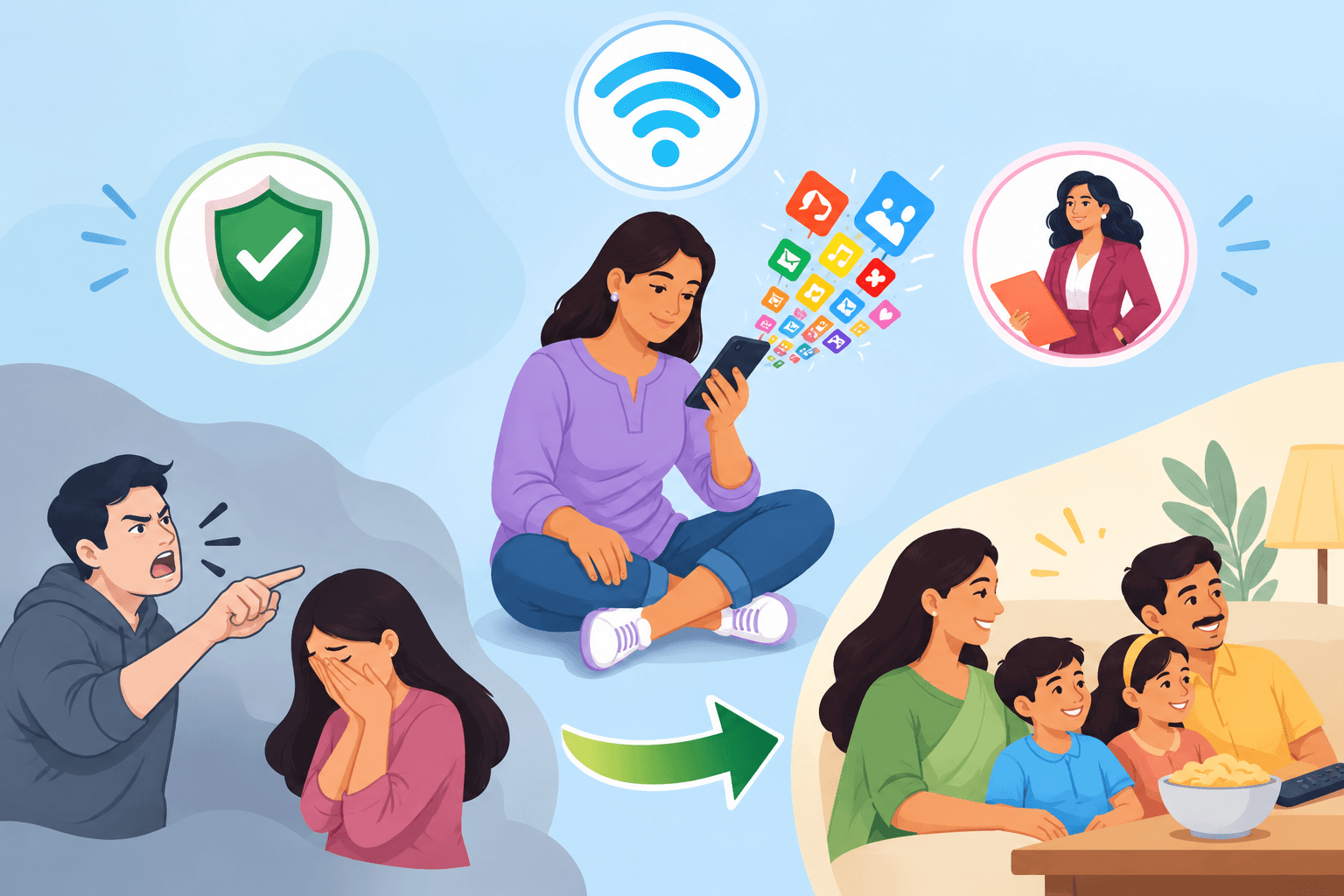
The digital divide does not stop at the front door. For women, who gets connected – and what that connection makes possible – can also matter for power within the home.
Intimate partner violence (IPV) is one of the starkest manifestations of unequal household power, constraining women's choices, economic opportunities and autonomy. Yet India's digital-inclusion agenda is largely assessed through what happens outside the household: network coverage, affordability, subscribers, transactions and access to services and jobs. New evidence suggests that this misses part of what connectivity can change.
The more consequential question is what happens once women get online: whether connectivity expands their freedoms and capabilities, the choices available to them and alters the terms on which power is negotiated within the household.
Connectivity Can Shift Power at Home
One way connectivity may matter is by changing what is considered acceptable within a relationship. NFHS-5 data covering 61,262 ever-married women show that women exposed to the internet are 21 percentage points less likely to justify IPV. Among their husbands, this difference is 14 percentage points.
The finding among husbands is particularly important. It suggests that the relationship between digital connectivity and gendered attitudes may extend beyond the woman’s own attitudes about IPV to such attitudes within the household more broadly. When both partners are less accepting of violence, the boundaries of what can be demanded or tolerated within a relationship may also change.
Connectivity can matter in another way: by widening women's economic options. Access to job information, employment opportunities and wider networks can make dependence on the household less absolute. Women exposed to the internet are 12 percentage points more likely to be employed in the study. Employment does not automatically mean economic independence, but it can make alternatives more credible.
The Effects Extend to Violence
These shifts matter if they ultimately translate into greater safety. The evidence suggests they can. Internet exposure reduces the likelihood of IPV by 17 percentage points, with declines across physical, emotional and sexual violence.
That is a substantial effect. But it does not mean that providing internet access will produce the same outcome for every woman.
Access Is Not the Same as Agency
Connectivity appears to matter most when women are better positioned to act on what it makes possible. Among more educated women, internet exposure reduces IPV by an estimated 22 percentage points; among women with less education, the evidence is less conclusive. The effect is also clearer among women from non-poor households than among poorer households.
But this is not simply a story of more advantaged women benefiting more. The estimated reduction is larger among women from SC, ST and OBC groups combined than among women from other social groups. Nor is the effect confined to urban India: reductions are observed in both rural and urban areas.
These differences point to a larger lesson. A connection can create possibilities, but whether those possibilities become agency depends on the circumstances in which women can use them.
Make Connectivity Consequential
Digital inclusion cannot end at the point of connection. Its success should ultimately depend on what connectivity allows women to do once they are online.
That means looking beyond network expansion to whether women can use connectivity to reach information about rights and public services, build networks beyond the household, and access economic and financial opportunities.
Digital programmes should therefore connect more deliberately with skills, employment and livelihood opportunities rather than operate as standalone access interventions. Linking connectivity to credible economic opportunities can make access more consequential.
It also means bringing together policy domains that are usually treated separately. Digital inclusion, women's economic empowerment and systems addressing gender-based violence all shape the environment in which women exercise agency. Connectivity cannot substitute for institutions that prevent violence, protect women or provide legal and social support. But it may alter the informational, social and economic conditions in which household power is negotiated.
The next phase of India's digital-inclusion agenda should therefore move beyond counting how many women are connected to asking what that connectivity enables them to do, and what it allows them to change within their households.