



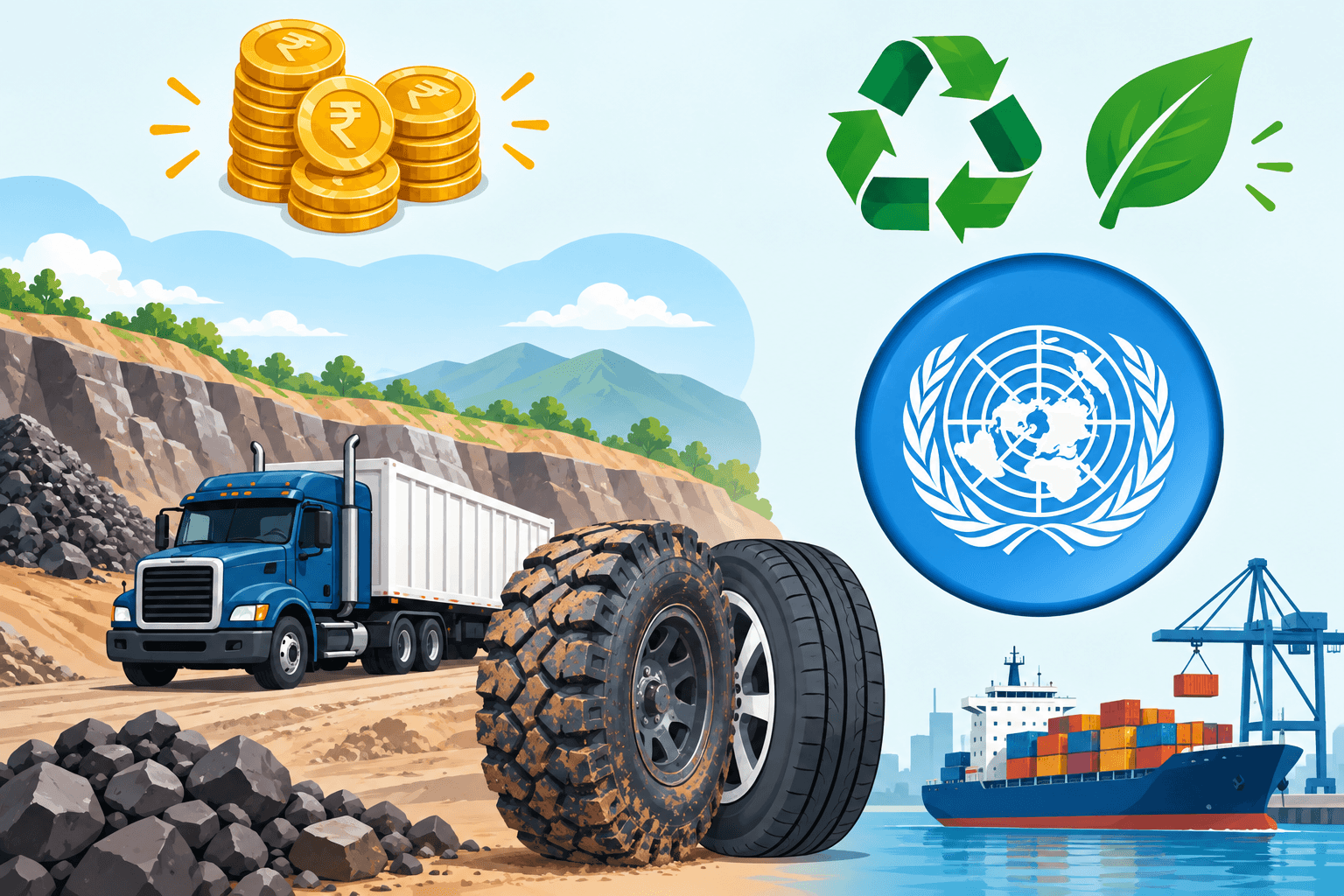
Global standards can improve safety, reduce environmental harm and make it easier for firms to operate across markets. For India, seeking deeper integration with global manufacturing and trade, aligning domestic regulations with international standards can therefore seem like an obvious step forward.
But harmonisation raises a less comfortable question: when does a common global standard become a poor fit for the conditions in which it is being applied? India's ongoing move towards the latest UN regulations for tyres offers a useful case. The question is whether requirements developed around a very different mix of tyres, roads and vehicle use should apply uniformly when those differences continue to matter in India.
The Market Is Not the Same Everywhere
India does not have a single commercial-vehicle tyre market. Radial tyres, with their lower rolling resistance and advantages for highway and long-distance use, have become progressively important. But bias tyres remain widely used because they are cheaper, robust, easier to repair and better suited to rough terrain and mixed-service operations. In 2023–24, bias tyres accounted for 57.7 percent of India's commercial-vehicle tyre segment. Replacement tyres also accounted for 62 percent of domestic production, meaning regulation affects a large aftermarket serving an existing commercial fleet.
These differences reflect the conditions under which vehicles operate. India's rural road network accounts for 66 percent of the country's road network, while national highways account for just 2.09 percent. Commercial vehicles operating on poorer roads, mixed surfaces and demanding service conditions have different requirements from vehicles spending most of their working lives on well-maintained highways.
This does not make bias tyres inherently better or higher standards undesirable. The question is whether regulation should accelerate the shift from one technology to another without first establishing that the benefits outweigh the costs under Indian conditions.
When a Common Standard Meets Different Conditions
India's own regulatory history suggests that this is not a choice between global and domestic standards. The Automotive Industry Standard (AIS) 142 sets performance requirements for tyres sold in the country and was developed with the United Nations’ Regulation No. 117 (UN R117) as an important reference. India has already moved substantially towards R117 requirements on rolling noise and wet grip.
The important divergence is over rolling resistance – the energy a tyre consumes as it rolls. AIS 142 retains distinctions based on tyre construction and rim size, while the latest UN R117.04 requirements use common limits rather than making the same distinction between radial and bias tyres.
This is where a seemingly technical regulatory change becomes a larger policy question.
The Difference Is in the Details
Under AIS 142, the permitted rolling resistance for bias tyres is roughly 50 percent higher than under the proposed UN R117.04 requirements. For C2 tyres, broadly covering light commercial vehicles, the limit is 13.5 N/kN under AIS 142 against 8.5–9.0 N/kN under R117.04. For C3 tyres, used by heavier commercial vehicles such as trucks and buses, it is 9.5 N/kN against 6.0–6.5 N/kN. AIS 142 therefore recognises differences between tyre constructions that the proposed R117.04 limits do not.
A common threshold may look technologically neutral because it does not explicitly favour radial or bias construction. But the same requirement can have very different consequences in a market where both constructions remain commercially relevant. Technology-neutral wording does not necessarily produce technology-neutral effects.
This is not an argument for preserving the existing product mix. Regulation can legitimately accelerate technological change. But where a common threshold effectively disadvantages one technology, the case should rest on evidence that the resulting benefits justify the transition under Indian conditions.
The Costs Do Not Stop at the Factory Gate
If tighter rolling-resistance requirements make significant parts of bias-tyre production commercially unviable, the effects would extend beyond manufacturers to suppliers, workers, repair and retreading businesses and transport operators. The tyre industry directly employs about 1.3 lakh people, while linked activities are estimated to support livelihoods for around 3.7 million people.
There is also an industrial-policy consequence. A shift towards radial tyres would increase demand for specialised steel wire with alloy coatings used in their production. If domestic capacity for these inputs does not expand alongside the transition, a regulation intended to upgrade domestic manufacturing could also increase dependence on imported inputs.
Exports add another consideration. India exported more than ₹25,000 crore worth of tyres in FY25 to over 170 countries and has developed markets for bias tyres in economies where cost, durability and difficult road conditions sustain demand. A rapid contraction of domestic bias-tyre capacity could therefore have consequences beyond the domestic market.
A Better Way to Raise the Bar
India need not choose between adopting R117 wholesale and regulatory isolation. China and Brazil retain national provisions that recognise bias tyres, while other major automotive markets maintain their own national regulatory frameworks. Even countries applying R117 do not necessarily introduce every requirement for every tyre class at the same time. International alignment does not require identical regulatory pathways.
India should continue raising safety and environmental performance and aligning AIS 142 with the beneficial elements of R117. But where evidence shows that tyre construction and Indian operating conditions materially affect performance, differentiated requirements can be retained until there is a demonstrated case for replacing them. Any transition to tighter requirements should also give manufacturers, testing institutions and suppliers reasonable time to adapt.
Before tightening the requirements further, India should undertake a transparent cost-benefit assessment covering safety and efficiency gains, performance under Indian operating conditions, transition costs, supply-chain dependence and export exposure. The objective is not to protect an existing technology from change, but to establish whether the proposed transition produces a net regulatory benefit.
The Lesson Is Bigger Than Tyres
As India integrates more deeply with global markets, it will encounter many standards developed for economies with different technologies, infrastructure and patterns of consumption. Regulatory maturity should not be measured simply by how quickly India adopts a global rule. It should also be measured by its ability to identify where that rule needs to be adapted.
Global standards can provide the benchmark. But the final test of a good Indian regulation should be whether it delivers better outcomes on Indian roads, for Indian users and within an Indian production ecosystem.