



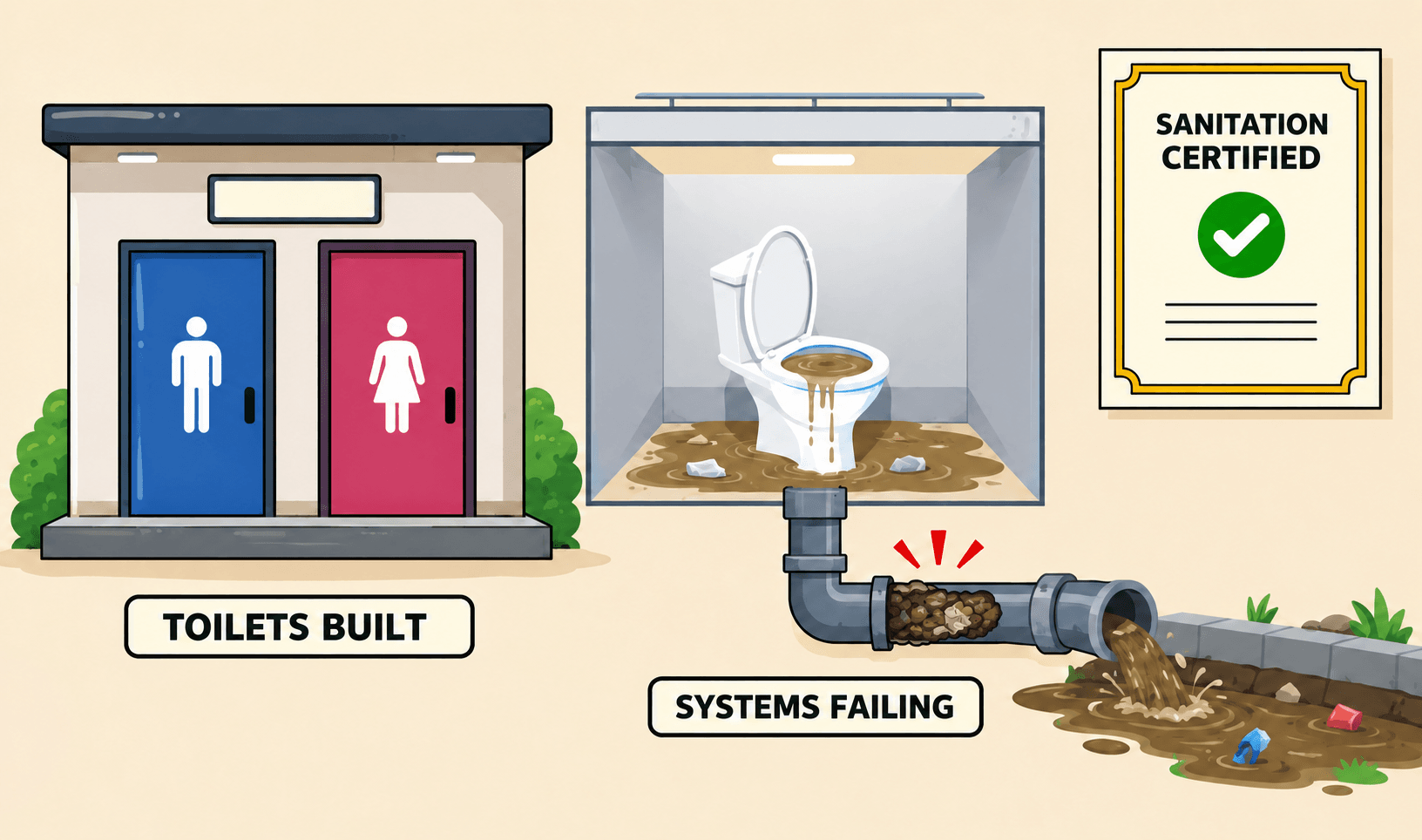
India's sanitation progress is increasingly judged by visible gains: toilets constructed, open defecation reduced and cities receiving progressively higher sanitation certifications. Nanded, Maharashtra, illustrates why these measures are no longer enough. Evidence from the city over a ten year period shows why these measures are no longer enough. The city was certified Open Defecation Free Plus (ODF+) and Open Defecation Free Plus Plus (ODF++) in 2021, yet only 45 percent of excreta was safely managed. Blocked toilets, poorly functioning sewer networks and wastewater accumulating in residential areas underscore the gap.
As access to toilets improves, the policy question must shift from whether infrastructure has been created to whether it delivers a functioning sanitation system that serves marginalised and precarious people.
The Sanitation Chain Starts Beyond Toilets
Safe sanitation depends on what happens beyond the toilet. Excreta must be safely contained and then conveyed through sewerage or collected from on-site systems for treatment, disposal or reuse. India’s Swachh Bharat Mission (SBM) represents one of the world’s largest public sanitation programmes with ODF achieved in 2019. Phase II (Sampoorn Swachhata) as well as the ATAL Mission for Rejuvenation and Urban Transformation (AMRUT) have expanded this ambition to include solid and liquid waste management, circular economy and zero waste principles, and ODF‑Plus outcomes by 2030. Despite these achievements, sanitation access remains deeply unequal.
In Nanded, toilets remain poorly connected to sewerage networks, while blocked chambers and inadequate drainage leave wastewater accumulating around homes. Eighty-six percent of the 42 communities studied, where Urban Community-Led Total Sanitation (CLTS) had been implemented in 2011, reported poorly managed sewer networks and blocked toilets or sewers.
India's sanitation monitoring needs to move beyond "How many toilets were built?" and ask a more consequential question: "Where does the sanitation chain break?"
The first generation of sanitation policy focused on expanding toilet access and reducing open defecation. Those gains remain important, but as coverage expands, the marginal policy problem changes. Connectivity and functionality become more important, alongside the safe containment, collection, treatment, disposal and reuse of faecal sludge and wastewater.
This is particularly true for localities in cities occupied by migrants, Dalits and other socially marginalised groups. In Nanded, they routinely encounter poorly managed sewer networks, blocked toilets and open drains full of excreta, often leaving them with little option but to resort to open defecation.
Beyond Infrastructure: Whose Rights Are Being Served?
Extending policy attention across the sanitation chain is not enough. Infrastructure and services must recognise the needs and rights of those most marginalised.
The experience shows how elite priorities and assumptions about adequate services can leave marginalised groups, particularly Dalit communities, neglected. Inequality is reflected not only in infrastructure provision, but also in whose neighbourhoods receive attention, whose concerns are heard, and who bears the costs when systems fail.
Sanitation must therefore be understood not simply as infrastructure, but as a question of rights, dignity, voice and equitable access. Policy must confront these biases and ensure sanitation works for those historically least well served.
There Is No Single Sanitation Model
Urban sanitation cannot be addressed through a single infrastructure model. Urban sanitation challenges vary across settlements, with differences in density, tenure, geography, drainage and access to conventional sewerage.
Nanded also illustrates the potential for decentralised wastewater treatment, including a system where treated water can be used to maintain a public garden. Such systems can serve difficult-to-reach settlements and areas where topography makes conventional network expansion difficult.
The policy response therefore needs to combine centralised and decentralised approaches according to local conditions, rather than treating network expansion as the universal endpoint.
Community Action Needs State Capacity
Community mobilisation can generate local action. During the CLTS programme, residents identified sanitation problems, organised cleaning activities, monitored waste collection and created local groups to engage with municipal authorities. In some communities, these activities generated a stronger sense of agency and strengthened demands for better services.
But the role of community action changes when sanitation failures arise from networked infrastructure and treatment systems. Communities can monitor services, identify failures and press for action, but they cannot build city-wide sewerage systems, provide treatment capacity or establish the institutional arrangements required for safe faecal-sludge management.
Community participation is best designed as a component of service delivery, rather than a substitute for it.
Governing Sanitation as a System
A system-based approach requires cities to measure sanitation differently. Monitoring should track the functioning of the entire chain: functional toilet connections, sewer functionality, wastewater containment, faecal-sludge collection and treatment, treatment outcomes, service failures, and safe disposal or reuse. The principle is simple: measure the sanitation chain, not the toilet stock.
The real question is not only who will operate the system five years after it is built, but who will have equitable access to it. Financing must address persistent inequalities by ensuring that sanitation investments reach and respond to the needs of marginalised communities historically underserved by public infrastructure.
Local information also needs a route into municipal decision-making. Where community groups monitor waste collection, identify failures or raise demands, municipalities need formal mechanisms to receive and act on that information. Embedding participation within municipal systems can ensure that local monitoring and knowledge survive changes in individual officials.
Addressing inequalities in sanitation access requires moving beyond coverage to identify and respond to disparities faced by marginalised communities. Policy must prioritise equitable access, dignity, and the specific needs of those historically underserved.