


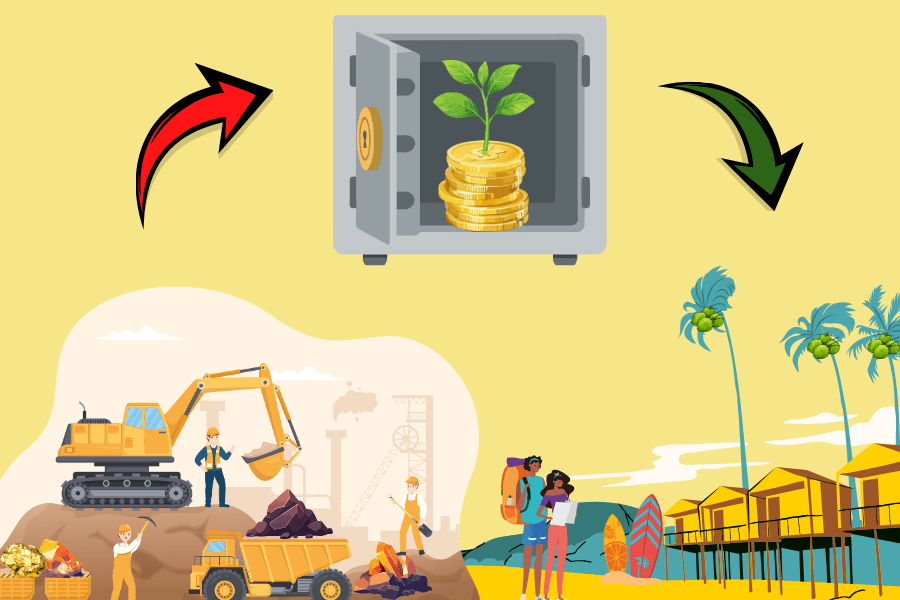
Goa's mining sector was suspended in 2012 following findings of illegal extraction, environmental degradation and mining beyond leased boundaries. The subsequent intervention by the Supreme Court, which cited losses of approximately Rs. 35,000 crore, led to the creation of the Goa Iron Ore Permanent Fund (GIOPF) in 2014. The objective was to convert a finite mineral asset into a lasting public one. The Court directed that 10 percent of the proceeds from existing ore sales and a further 10 percent of future ore sales be transferred to the fund.
As mining activity resumes, an old question has returned with new urgency: what should happen to the wealth generated from a resource that will eventually be exhausted? The question extends well beyond Goa. Why do some resource-rich jurisdictions convert temporary mineral wealth into lasting public assets while others do not?
Institutions, Not Windfalls
The funds that have endured for decades tend to have one thing in common. They function not merely as savings vehicles, but as institutions designed to protect wealth across generations.
Alaska's Permanent Fund, with assets of approximately $81.9 billion, is governed by a Percent of Market Value rule that limits annual withdrawals to 5 percent of the fund's average market value. Norway's Government Pension Fund Global, valued at roughly $1.4 trillion, follows a similarly disciplined approach, combining professional management, extensive public disclosure and a fiscal rule that limits annual spending from the fund to 3 percent of its value.
Despite their differences in scale and context, both funds are designed to address the same challenge: preventing temporary resource revenues from being treated as ordinary income. Clear investment mandates help preserve purchasing power. Disclosure requirements strengthen accountability. Withdrawal rules reduce the risk that short-term fiscal pressures undermine assets intended to benefit future generations.
The Governance Gap
Several of the features that distinguish enduring public endowments from passive savings vehicles remain underdeveloped in GIOPF.
The most immediate concern relates to how the fund preserves value over time. The current framework permits investment in one-year fixed deposits but provides limited guidance on long-term return objectives, inflation protection, performance benchmarks or asset allocation. Reported returns of around 3-4 percent have remained below inflation levels of roughly 5-6 percent. While such an approach prioritises capital preservation, it may struggle to maintain purchasing power over longer horizons.
Public accountability presents a second challenge. Information on the fund's corpus, investment performance and operating costs remains limited. Reports indicate that as of 2019 the corpus of approximately Rs. 471 crore remains in fixed deposits, but it is difficult to determine whether this reflects prudence, administrative delays or broader governance constraints without regular public disclosures.
The most consequential uncertainty concerns access to the fund itself. Unlike established permanent funds that clearly distinguish between principal and spendable returns, GIOPF lacks equally well-defined rules governing withdrawals. As a result, there is limited clarity about how the fund would respond to future fiscal pressures or whether its long-term purpose would remain protected.
Taken together, these gaps suggest that GIOPF currently functions more as a repository of mineral sale proceeds than as a fully developed intergenerational endowment.
Intergenerational Equity Requires Constraints
The challenge confronting GIOPF is not unique. Resource funds everywhere must balance present-day fiscal demands against obligations to future beneficiaries.
Nigeria's Excess Crude Account offers a cautionary example. Created to save surplus oil revenues, the fund reportedly declined from around $20 billion in 2008 to just $376,655 by 2022 following repeated withdrawals and weak institutional safeguards. The experience highlights how incentives can gradually erode long-term objectives when institutional constraints remain weak.
For Goa, the implication is clear. Limited transparency, ambiguous withdrawal provisions and the absence of clearly defined investment objectives increase the risk that the fund's original purpose could gradually weaken.
From Saving Revenues to Governing Wealth
If GIOPF is to convert finite mineral wealth into enduring public wealth, the next phase of reform should focus less on the size of the corpus and more on the rules that govern it.
A permanent fund cannot rely on ad hoc investment decisions. It requires a clear mandate covering long-term return objectives, purchasing-power protection, asset-allocation principles and performance benchmarks. Such a framework would help ensure that investment decisions remain aligned with the fund's long-term purpose.
Regular public disclosures on contributions, corpus value, investment performance, realised and unrealised gains, and administrative costs would strengthen accountability. Without such information, neither citizens nor policymakers can assess whether the fund is preserving value or simply accumulating balances.
Equally important is clarity on withdrawals. Distinguishing between corpus and spendable returns, establishing statutory limits on access and preventing the routine use of fund assets for fiscal management would reinforce the fund's long-term mandate.
Governance arrangements also matter. Greater involvement of the Department of Finance, independent custodial oversight and periodic external review could help ensure that investment decisions and withdrawals remain aligned with the fund's intergenerational purpose rather than short-term administrative priorities.
Beyond the Mining Cycle
Goa's iron ore reserves are finite, but the choices made about their proceeds will have consequences long after extraction ends. The creation of GIOPF recognised a simple reality: non-renewable resources create a one-time opportunity to convert natural wealth into assets that can serve future generations.
The significance of GIOPF ultimately extends beyond the size of its corpus. It lies in the precedent it can establish for managing finite resource wealth. If governed well, it can demonstrate how temporary mineral revenues can be transformed into lasting public assets. If not, it may become another reminder of a familiar lesson: natural resources create opportunities, but only effective stewardship allows those opportunities to endure.