


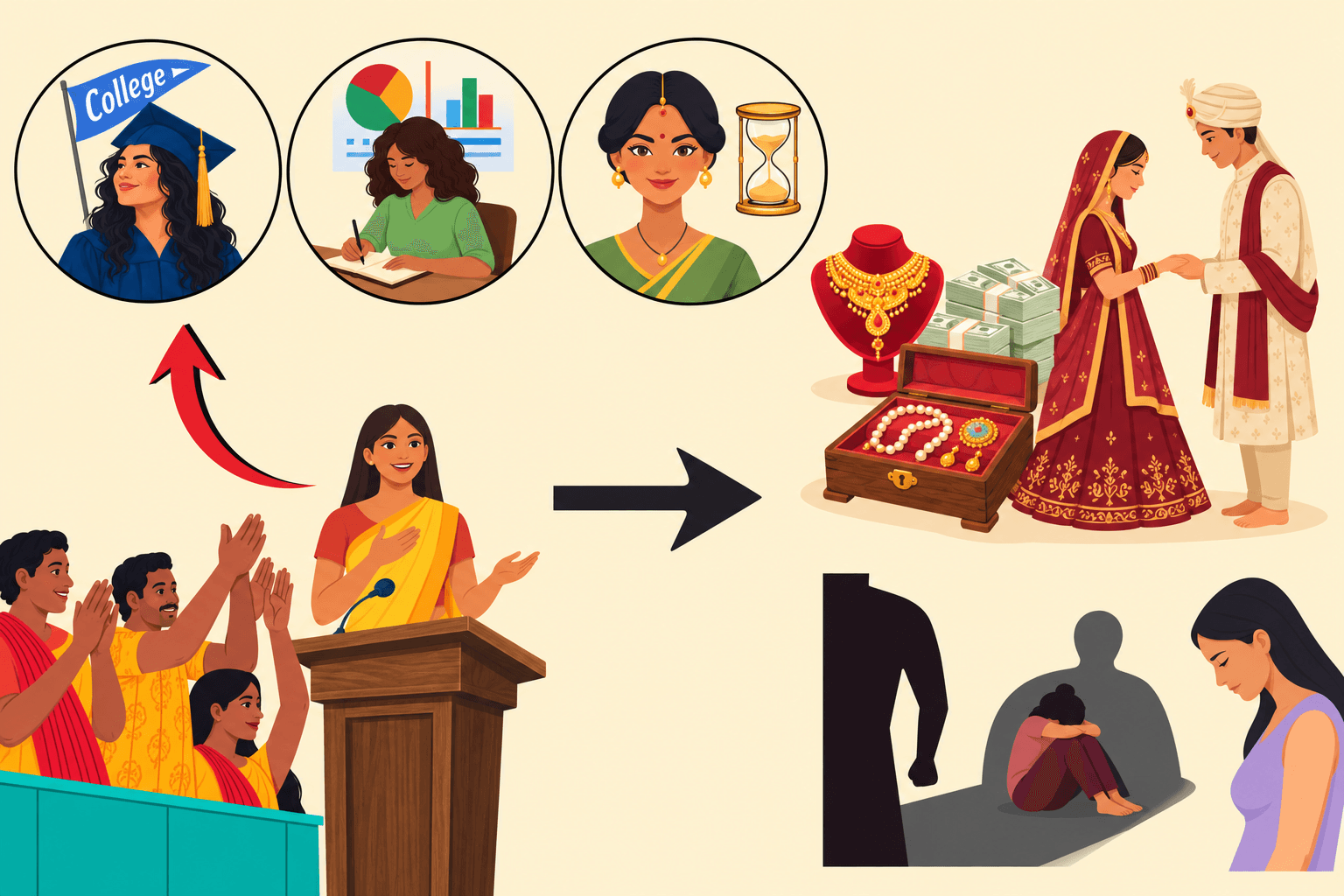
A rise in women’s marriage age is often counted as progress. It can mean more time in school, greater access to work and more choice. Yet a change in when women marry does not necessarily change the expectations surrounding marriage. Evidence from rural India presents a striking contrast: exposure to female village leadership delayed women’s marriages, but in the most patriarchal states it was also associated with higher dowry and less say for women at home.
India’s 73rd Constitutional Amendment reserved one-third of village council head positions for women. Its significance extends beyond who holds the office of pradhan. Female leadership can change the opportunities available within a village during the years when families are making decisions about their daughters’ schooling, work and marriage.
Opportunity Can Change the Timing
Using data from the 2006 Rural Economic and Demographic Survey (REDS), the analysis finds that exposure to a female pradhan increased employment among unmarried women within their villages by 11.6 percentage points, about 29 percent above the sample baseline. Unmarried girls were also 4.7 percentage points more likely to be enrolled in school during the pradhan’s election cycle.
Work gives families a concrete reason to defer marriage. A daughter who can earn within the village has an alternative to marrying immediately, even if marriage remains the expected next stage of her life. The economic calculation can change before that expectation does.
Women exposed to female leadership married about 1.22 years later on average. The largest delay occurred among those aged 15 to 18 when their village first reserved the pradhan position for a woman, at an age when decisions about education, work and marriage often converge. The employment and marriage records cannot be linked for the same individuals, so the analysis does not establish that the women who entered work were themselves the women who married later. It nevertheless shows that opportunities for unmarried women expanded in villages where marriage was delayed.
The Same Delay, Different Outcomes
What did those additional years mean for women’s position after marriage? Across the full sample, exposure to female leadership was associated with a 5.7 percentage point decline in women reporting any say in household decisions. That average hides opposing patterns: reported say rose by about 8.1 points in the least patriarchal states and fell by about 8.1 points in the most patriarchal states.
The result does not mean that later marriage caused the loss of authority. It means that a later marriage cannot be assumed to bring greater authority with it. In the least patriarchal states, exposure to female leadership coincided with more say at home; in the most patriarchal states, it coincided with less. The social setting shaped what accompanied the change in marriage timing.
Dowry makes this difference harder to dismiss. Across the full sample, exposure to female leadership was associated with a 68 percent increase in real dowry. The rise was concentrated in the most patriarchal states, where women married about 1.43 years later and dowry rose by roughly 78 percent. In the least and moderately patriarchal states, marriage was also delayed, but there was no clear increase in dowry.
If postponement alone explained higher dowry, similar delays would be expected to produce similar results across states. They did not. Where remaining unmarried carries a greater social cost for women, families may have reason to postpone a daughter’s marriage as her opportunities expand while still facing pressure to secure a match. Higher dowry is consistent with that pressure shaping the terms of marriage. The analysis cannot observe each family’s motives, but the contrast across states shows why the timing of marriage cannot be separated from the norms governing it.
Count More Than the Years Gained
Legal measures and programmes that keep girls in school remain important, but the additional years before marriage need to bring meaningful alternatives. Local employment can give young women a reason and an opportunity to defer marriage, rather than simply extending the wait for it.
Expanding opportunities before marriage is only part of the task. Where pressure to marry remains strong, policy must also address the terms on which marriage takes place, including dowry, and women’s authority within the household. Marriage-age statistics do not capture either.
Female political leadership can create space for young women to make different choices. Whether that space changes the expectations governing marriage is a further test of its impact. The next test of empowerment is whether the additional years before marriage translate into greater choice over the life that follows.