


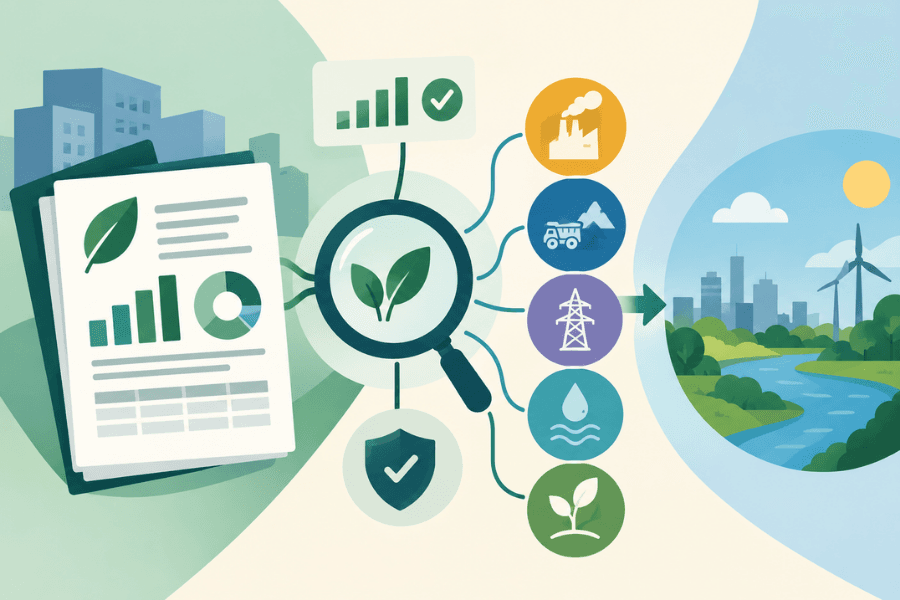
India’s corporate sustainability reporting regime has shifted from largely voluntary disclosure towards mandatory reporting. The Securities and Exchange Board of India’s (SEBI) Business Responsibility and Sustainability Reporting (BRSR) framework marks a significant step in that transition. The critical policy question is under what conditions mandatory disclosure translates into better corporate environmental performance. Greater visibility can support accountability, but its influence depends on how disclosed information is verified, interpreted and used.
India’s sustainability reporting regime has evolved from the Ministry of Corporate Affairs’ National Voluntary Guidelines (2011) and SEBI’s Business Responsibility Reporting (BRR) to BRSR, which became mandatory for the top 1,000 listed companies by market capitalisation from FY 2022–23. BRSR Core, introduced in 2023, added phased verification requirements for selected environmental, social and governance (ESG) indicators. Subsequent changes allowed assessment or assurance and made value-chain disclosures voluntary for the top 250 listed entities from FY 2025–26, with voluntary assessment or assurance from FY 2026–27. The evolution has therefore combined stronger reporting requirements with measures to ease compliance.
What Mandatory Disclosure Can Change
BRSR brings corporate environmental information into the mainstream governance framework. Public disclosure can reduce information asymmetries and give investors, consumers and regulators greater visibility into firms’ resource use, emissions and environmental risks.
Mandatory reporting can also influence internal decisions. Requiring firms to measure and disclose their environmental impacts can bring these considerations into board discussions, operational monitoring, investment decisions and longer-term business strategy. Whether this happens depends on how closely reporting processes connect with the decisions that shape environmental performance.
Early evidence points to improvements in disclosure. A 2026 CFA Institute and CFA Society India study of 300 listed companies finds improved BRSR disclosure quality and coverage over the first three years of mandatory reporting. It also identifies continuing concerns around data quality, consistency, comparability, methodologies and clarity. These findings indicate progress in reporting; they do not, by themselves, establish that BRSR has caused improvements in environmental performance.
The Disclosure-Performance Gap
Two distinct gaps can limit the environmental value of disclosure. The first concerns credibility: whether reported information accurately represents corporate activity. Incomplete data, inconsistent methods or selective presentation can create an impression of environmental responsibility that the underlying evidence does not support.
The second concerns performance. A company may report accurately while making little progress in reducing its environmental impacts. Assessment or assurance can strengthen confidence in the figures without establishing that the company’s environmental trajectory is adequate.
Closing this gap requires more than reliable reporting. Investors, boards and relevant regulators must be able to use the information to assess progress, question inadequate performance and examine the corporate decisions behind it. Disclosure becomes consequential when it informs scrutiny of targets, investments and operational choices.
One Disclosure Framework, Different Performance Benchmarks
A common reporting framework can improve consistency, but environmental performance must be interpreted in relation to each sector’s material impacts. The risks of a chemical or steel producer differ substantially from those of a bank or an information technology firm.
For resource-intensive industries, emissions, energy efficiency, water use and pollution control may be central to assessment. A bank’s smaller operational footprint, however, does not necessarily imply limited environmental exposure: its lending and investment decisions also matter. For other firms, supply-chain impacts may be more significant than those arising from their own operations.
Sectoral benchmarks should therefore reflect where environmental impacts arise within each business model. Common metrics can provide a shared reporting base, while sector-specific assessment helps determine whether a firm is making meaningful progress. Environmental R&D and capital expenditure can help explain that progress, but spending alone cannot substitute for evidence of improved outcomes.
Making Disclosure Matter
The next phase of BRSR should strengthen the connection between credible information, performance assessment and corporate accountability.
First, assessment and assurance processes should make clear what has been verified, which methods were used and where limitations remain. Consistent measurement protocols and transparent treatment of conversions and estimates would improve comparability and help users distinguish changes in performance from changes in reporting practice.
Second, boards should explain how material environmental risks and disclosed targets inform capital allocation and operational decisions. Investors can use this information to examine whether commitments are supported by investment and whether reported progress matches the company’s stated objectives.
Third, sectoral benchmarks should support assessment against material environmental risks and impacts. Clearer guidance on materiality could also reduce generic or “not applicable” responses where an indicator is relevant to the business. Relevant environmental regulators could draw on comparable disclosures within their existing mandates, while SEBI maintains oversight of reporting requirements.
The practical test of BRSR is whether credible disclosures enable stakeholders to assess environmental progress and scrutinise the decisions behind it. That connection would give mandatory reporting a more substantive role in environmental governance.