



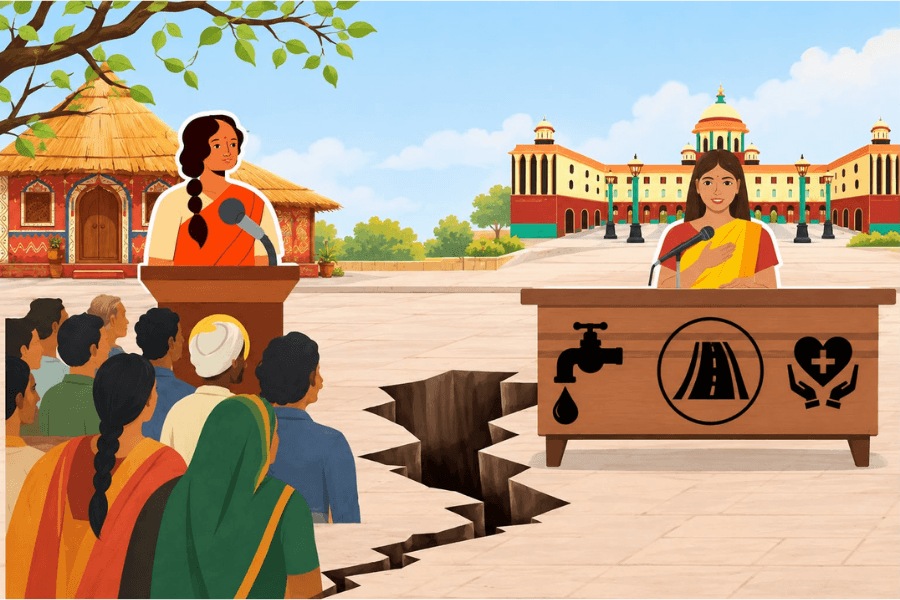
India has built one of the world's most extensive systems of hyperlocal political representation. Across gram panchayats, elected ward members bring political representation closer to citizens, while population-based rules determine the density of representation and reservation policies shape its composition, including through representation for historically marginalised groups.
The policy rationale is straightforward: representatives who are closer to citizens should know more about local needs, be easier to approach and face stronger pressure to respond. The expectation is that denser representation should improve access to government programmes, make public spending more responsive to local priorities and strengthen accountability.
But what happens when representation increases? Does adding elected representatives change what local governments deliver, whom they serve or how they are held accountable?
When More Seats Change Little
Evidence from 13 states, covering roughly 1.2 million ward members across about 150,000 gram panchayats, examines two dimensions of representation: whether increasing the number of ward members changes governance, and whether increasing Scheduled Caste (SC) representation changes the distribution of benefits towards SC communities.
State population thresholds determine the number of ward members, with crossing these thresholds adding an average of 1.39 ward members to a gram panchayat. SC reservation thresholds similarly increase the share of SC representatives by an average of 4.49 percentage points. Because representation changes when gram panchayats cross these thresholds, the rules allow otherwise similar panchayats with different levels, densities or compositions of representation to be compared.
The National Rural Employment Guarantee Scheme (NREGS) offers a direct test of whether greater representation improves the delivery of a major public programme. Adding ward members has no statistically significant effect on NREGS workfare. The same pattern appears in access to government benefits across eight major welfare programmes, covering financial access, food, LPG, pensions, electricity, maternity benefits, housing and piped water.
Representation also does not appear to make local spending more responsive to what citizens say they want. A comparison of priorities recorded through Gram Panchayat Development Plan (GPDP) meetings with the categories of NREGS projects subsequently completed suggests that, on average, about 45 percent of projects fall within categories identified as priorities. Yet increasing representation has no significant effect on the alignment between stated priorities and completed projects.
Across service delivery, welfare access and responsiveness to stated priorities, more representation produces no measurable improvement. This leaves another possibility: representation may affect how existing benefits are distributed across villages and communities.
Representation Does Not Redirect Benefits
More representatives do not significantly change the geographic distribution of NREGS projects within gram panchayats or inequality in per-capita benefits across villages.
Nor does greater SC representation systematically redirect benefits towards SC communities within gram panchayats. If increasing the share of SC representatives gives marginalised communities greater political voice, one might expect benefits to shift towards villages with larger SC populations. The evidence shows no significant shift.
The pattern extends to measures of accountability and corruption: neither professional financial audits nor NREGS social audits show significant effects from increased representation. Greater representation therefore changes neither the overall provision of benefits nor their distribution in measurable ways.
If representation changes neither what the government delivers nor how resources are distributed, it would be tempting to conclude that ward members simply do not matter. The evidence points to a more interesting explanation.
Voice Without Authority
The effects of greater representation are concentrated in participation, transparency and the procedures through which a gram panchayat conducts its business. More ward members increase attendance at GPDP meetings by about 6.4 people. They also make gram panchayats more likely to publicly post beneficiary lists, have those lists approved in meetings and publicly post lists of public works. The number of standing committees also increases.
But these procedural changes do not extend to the substantive outcomes examined in the study.
The standing-committee finding captures this gap particularly clearly. More representatives lead to more standing committees, but not to more committee meetings. Representation can therefore change institutional form without making the institutional machinery more active.
Making Representation Count
The findings weaken the case that gram panchayats simply need more or fewer representatives. Across gram panchayats ranging from roughly one ward member for every 104 residents to one for every 421 residents, there is no systematic evidence of stronger effects at lower or higher levels of representation.
The findings instead point towards four institutional areas that deserve greater attention if representation is to become more consequential.
First, ward members need clearer institutional authority. Their role could be strengthened with formal powers for scrutinising local works, beneficiary lists and implementation priorities, accessing relevant records and escalating unresolved grievances to force others to take them seriously. Some states have begun greater empowerment of ward members, and it will be important to understand the consequences of these reforms.
Second, authority needs to be matched with capability. Many ward members have limited formal education: 41.2 percent are illiterate or have less than primary schooling, while only 2.2 percent have a college degree or higher. Educational attainment is not a measure of representative effectiveness. But expecting representatives to scrutinise budgets, scheme rules, administrative procedures and audit findings without practical institutional support places substantial demands on the office. Training on these functions and GPDP processes could help representatives exercise their responsibilities more effectively.
Third, representation requires usable information. A representative cannot scrutinise a public work, question a beneficiary list or follow up on an audit finding without timely access to the underlying information. Administrative data on works, expenditure, beneficiaries and audit observations therefore need to be accessible in forms that local representatives can understand and act upon.
Finally, participation needs institutional follow-through. Greater attendance, more committees or greater transparency will have limited consequences unless representatives' questions and objections trigger administrative responses. Defined procedures for scrutiny, follow-up and escalation could connect participation to implementation.
The next phase of decentralisation should therefore shift the policy question from how many representatives there are to what they are empowered – and institutionally equipped – to change.