


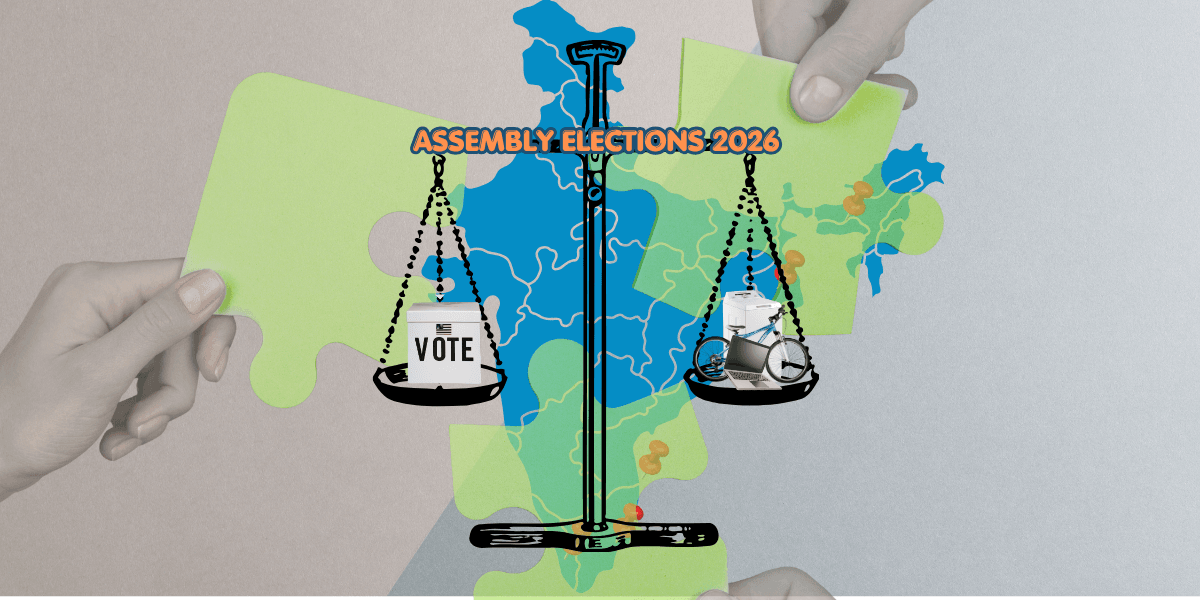
Few issues dominate state elections today as much as the debate over “freebies.” From cash transfers to subsidised services, welfare promises are increasingly framed as fiscally irresponsible and electorally distortive. But this framing clarifies less than it claims.
The real question is not whether states are spending on welfare, but how they are doing so. Not all welfare is distortionary. In fact, much of India’s most effective public policy has emerged from state-level experimentation that would, in today’s discourse, be labelled populist.
The sharper distinction is between welfare that complements development and welfare that substitutes for it. This distinction, rather than the language of “freebies,” better explains both fiscal sustainability and electoral outcomes in across states.
States as Laboratories of Welfare Innovation
Historically, Indian states have been the primary sites of policy innovation. Several programmes that later scaled nationally – from school feeding schemes to employment guarantees and public distribution systems – originated as state-level initiatives.
This is not incidental to India’s federal design. States are closer to citizens, more responsive to local needs, and better positioned to experiment with policy design. Electoral competition has often reinforced, rather than weakened, these incentives to innovate.
Seen in this light, dismissing all welfare spending as “freebies” ignores its role in building the country’s social and institutional architecture. What matters is whether welfare is designed as part of a broader development strategy, or deployed in isolation from it.
Two Types of Welfare Politics
A more useful way to read welfare politics is to distinguish between two types of welfare interventions.
“Complementary Welfare” supports and amplifies existing economic and social systems. It works in conjunction with investments in education, health, infrastructure, and employment.
For instance, subsidised public transport can improve women’s mobility, but its impact depends on the availability of jobs, functioning education systems, and safe urban infrastructure. In such contexts, welfare acts as an enabler, expanding access to work and opportunity.
Similarly, targeted transfers can stabilise incomes and reduce vulnerability when embedded within a broader framework of productive growth and human capital formation.
States such as Tamil Nadu illustrate this dynamic. Long-standing investments in public distribution, school feeding, and social support have operated alongside relatively strong outcomes in health, education, and industrialisation, suggesting that welfare can reinforce, rather than substitute for, broader development strategies.
In contrast, substitution welfare tends to arise where states lack either the capacity or the political incentives to build durable institutions. Here, direct transfers or short-term benefits compensate for deeper structural weaknesses, such as low job creation, poor public services, or weak administrative systems.
While such measures may provide immediate relief, they rarely alter underlying constraints. Over time, they entrench fiscal stress without corresponding gains in productivity or development.
This distinction helps explain why similar welfare measures produce very different outcomes across states.
Fiscal Capacity and the Limits of Redistribution
The sustainability of welfare politics is closely tied to state finances. Concerns about rising state debt and fiscal deficits – highlighted by institutions such as the RBI – are valid, but incomplete without context.
States differ significantly in their ability to generate their own revenues. Those with stronger economic bases and administrative systems can finance welfare alongside investments in infrastructure and human capital. Others rely heavily on central transfers, limiting their fiscal autonomy.
In such contexts, expansive welfare commitments without corresponding revenue capacity can create structural imbalances. The underlying issue is not welfare itself,, but the absence of a growth and revenue strategy capable of sustaining it.
As a result, fiscally stronger states are better able to align welfare with development, while weaker states face sharper and more binding trade-offs.
Why Freebies Alone Do Not Win Elections
A common assumption is that competitive populism drives electoral outcomes. Yet evidence across states suggests that welfare promises alone are insufficient.
Voters assess not just what is promised, but who is promising it and whether delivery is credible. Political parties that combine welfare commitments with a broader narrative of governance and demonstrated capacity are more likely to succeed.
This credibility is built over time: through consistent policy implementation, institutional reliability, and visible improvements in everyday life. In its absence, even generous promises may fail to translate into electoral support.
Welfare is politically effective when it reinforces a credible development trajectory, not when it substitutes for one.
The Federal Dimension of Welfare Politics
The debate on freebies is also, implicitly, a debate about federalism. Increasing centralisation in fiscal and policy domains has narrowed the space for states to design context-specific interventions.
A one-size-fits-all approach to welfare or industrial policy risks undermining the very experimentation that has driven policy innovation in India. At the same time, overlapping incentives – where both the Union and states subsidise the same activities – can lead to inefficiencies and duplication.
A more effective framework would recognise states as primary agents of welfare design, with the Union playing a supportive and coordinating role. This includes aligning fiscal incentives, enabling policy flexibility, and rewarding outcomes rather than prescribing uniform solutions.
From Redistribution to Capability Building
Looking ahead, the central challenge is not whether to spend on welfare, but how to ensure that such spending builds long-term capabilities rather than short-term dependence.
India’s development trajectory remains constrained by gaps in human capital, particularly in education quality, skills, and public health. Addressing these requires sustained, state-led investments that go beyond direct transfers. Welfare can play a critical role here, but only when it reduces barriers to participation, enhances mobility, and complements access to jobs, education, and services.
This, in turn, requires rethinking the federal balance. States must retain the flexibility to design context-specific interventions, while the Union aligns incentives and supports outcomes rather than prescribing uniform approaches. Without this, both fiscal efficiency and policy innovation will remain limited.
The “freebies” debate reduces a structural policy question to a rhetorical one. The real question is not how much states spend, but whether that spending builds capability, productivity, and institutional trust. Ultimately, the future of India’s welfare politics will be decided not by the scale of redistribution, but by whether it expands capability – and with it, opportunity.