


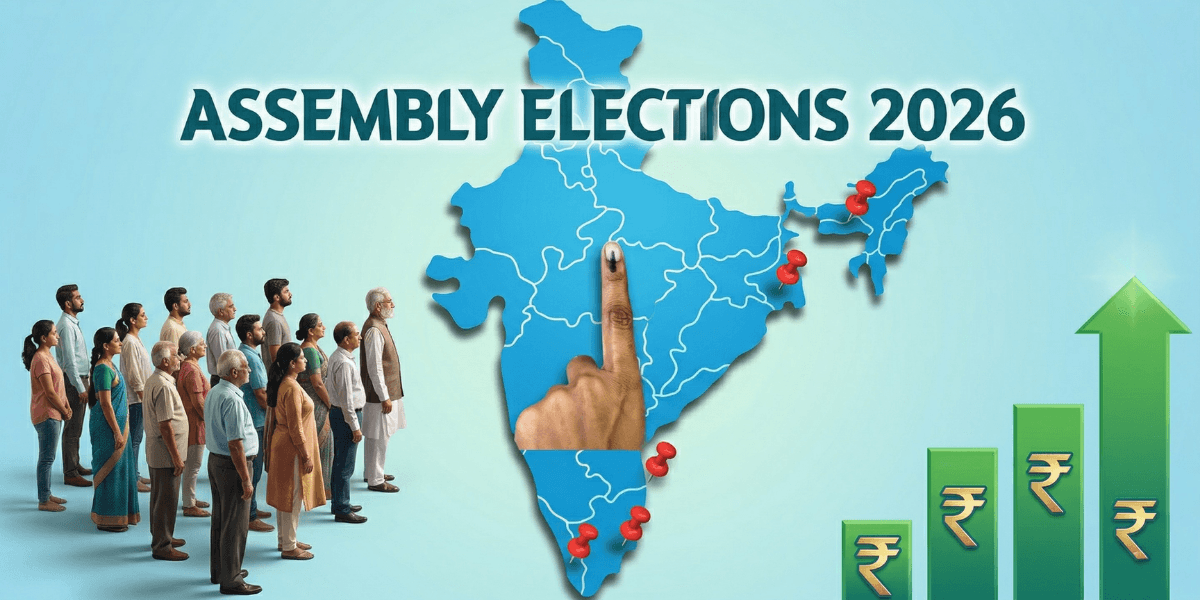
India’s upcoming Assembly elections are often read through the lens of alliances, caste arithmetic, or campaign narratives. But this misses a deeper shift underway. State elections are no longer merely contests of promises; they are increasingly referendums on distinct political-economic models that states have built over the past three decades.
Since the 1991 reforms, India’s states have acquired greater autonomy over industrial policy, welfare design, and investment strategies. This has transformed them from administrative units into competing development regimes. The result is a widening divergence in outcomes: across growth, human development, fiscal capacity, and governance. These differences are now shaping not just economic trajectories, but also how voters evaluate governments.
Why Post-Liberalisation Trajectories Matter Now
Before liberalisation, India’s development model was centrally driven. Industrial licensing, investment decisions, and macroeconomic levers were concentrated at the Union level. States had limited room to differentiate beyond sectors like health and education.
The post-1991 shift changed this equilibrium. As private capital became the primary driver of growth, states gained new importance as sites of policy innovation and investment attraction. Investor summits, industrial corridors, and state-specific incentives emerged as key instruments of competition.
But this new policy space did not produce convergence; instead, it deepened divergence across states. Some states built more dynamic and diversified growth trajectories, while others lagged behind.
These differences are now central to how state-level political economies are structured and evaluated.
Difference Between Growth and Development Matters
A central fault line across state models lies in the relationship between growth and development. High growth rates – often driven by specific sectors or capital-intensive industries – do not automatically translate into broad-based improvements in employment, health, or education. This tension was crystallised in the Bhagwati-Panagariya vs. Drèze-Sen debate in the run-up to the 2014 general election. Jagdish Bhagwati and Arvind Panagariya framed economic reform as a two-track process: Track I policies aimed at accelerating growth, followed by Track II welfare interventions enabled by the fiscal gains from that growth. In contrast, Jean Drèze and Amartya Sen argued that growth does not automatically translate into development, and that early and sustained public investment in health, education, and social protection is necessary for inclusive outcomes.
This distinction has been visible in states such as Gujarat, and to a lesser extent Maharashtra, where rising per capita incomes has not accompanied sufficient job creation or social outcomes. The pattern reflects a structural feature of India’s growth process: integration into global value chains has favoured technology-intensive sectors with low employment elasticity. As a result, growth has often been exclusionary in its impact.
Where this translation from growth to development fails, it reshapes the state-citizen relationship. Governments promise that growth will deliver opportunity, but when that promise remains unfulfilled, voters begin to evaluate not just growth levels, but the distribution and accessibility of its benefits.
By contrast, states such as Tamil Nadu, Kerala, and to an extent Karnataka, which have combined economic expansion with sustained investments in human capital, particularly health and education, have been more successful in generating broad-based gains. This has important electoral consequences, as it builds credibility and trust in state institutions.
State Capacity as the Decisive Factor
What explains these divergent outcomes is not policy choice alone, but differences in state capacity: the ability of governments to design, finance, and implement policy effectively.
This includes fiscal capacity, administrative capability, and political coordination. States that generate higher own revenues, maintain stronger bureaucratic systems, and align political incentives with policy goals are better positioned to translate growth into sustained development outcomes.
This helps explain why similar policy opportunities yield sharply different results across states. While all states operate within the same broad macroeconomic framework, their ability to attract investment, deliver public services, and sustain institutional performance varies significantly.
The contrast between West Bengal and southern states such as Kerala and Tamil Nadu illustrates this clearly. West Bengal’s early success in land reforms improved rural outcomes but was not followed by complementary investments in human capital or industrial transition. Over time, this limited its ability to sustain growth and build institutional depth, with fiscal dependence on central transfers further constraining policy autonomy.
Kerala, by contrast, invested consistently in health and education, building a strong foundation of human development alongside active citizen engagement. Tamil Nadu combined welfare expansion with industrial policy, creating a more balanced model that integrates social and economic objectives.
These trajectories underline a key point: development outcomes are not simply the product of policy choices in isolation, but of the institutional ecosystems within which those policies operate.
But capacity alone does not explain why some state models endure politically while others fragment over time.
Identity and the Politics of Coalition-Building
Another critical dimension shaping state models is how political systems organise social identities. Identity politics is often seen as inherently divisive, but its effects depend on how it is deployed.
In some contexts, identity is used to construct broad-based coalitions that cut across caste, class, and regional divides. These coalitions can support programmatic policies – universal or near-universal interventions in health, education, and welfare – that benefit large sections of the population.
In other contexts, identity becomes a tool of polarisation, fragmenting the electorate into competing groups. This weakens the possibility of sustaining stable, programmatic policy frameworks over time, pushing politics toward short-term redistribution targeted at specific constituencies.
States such as Kerala and Tamil Nadu have, to varying degrees, been able to build inclusive political coalitions that support institutionalised welfare and development policies. In contrast, where coalition-building remains fragmented or clientelist, policy outcomes tend to be narrower and less durable.
The key distinction, therefore, is not whether identity politics exists, but whether it is organised in a way that enables or constrains collective action for development.
What This Means For 2026 Elections
These structural differences are increasingly visible in electoral behaviour. Voters are not simply responding to campaign promises or short-term incentives, but assessing credibility, delivery, and the effectiveness of the state model itself.
States with stronger institutional foundations and more consistent policy delivery are better able to convert governance into electoral support. Conversely, where growth has been uneven or institutions weak, electoral outcomes are more volatile and contingent.
This also explains why similar campaign strategies yield different results across states. The same promise, whether of welfare benefits or economic growth, carries different weight depending on the institutional context in which it is made.
From Electoral Cycles to Institutional Competition
India’s federal structure is increasingly producing a form of competitive institutionalism, where states experiment with different combinations of growth strategies, welfare systems, and political coalitions. Elections, in this context, serve as mechanisms of validation for these models.
This has important implications for policy. It suggests that one-size-fits-all approaches are unlikely to succeed, and that state-level variation is not a problem to be eliminated but a feature to be leveraged.
The real contest in India’s state elections is less about ideology alone, and more about competing institutional models – each offering a different pathway to growth, development, and political legitimacy.