



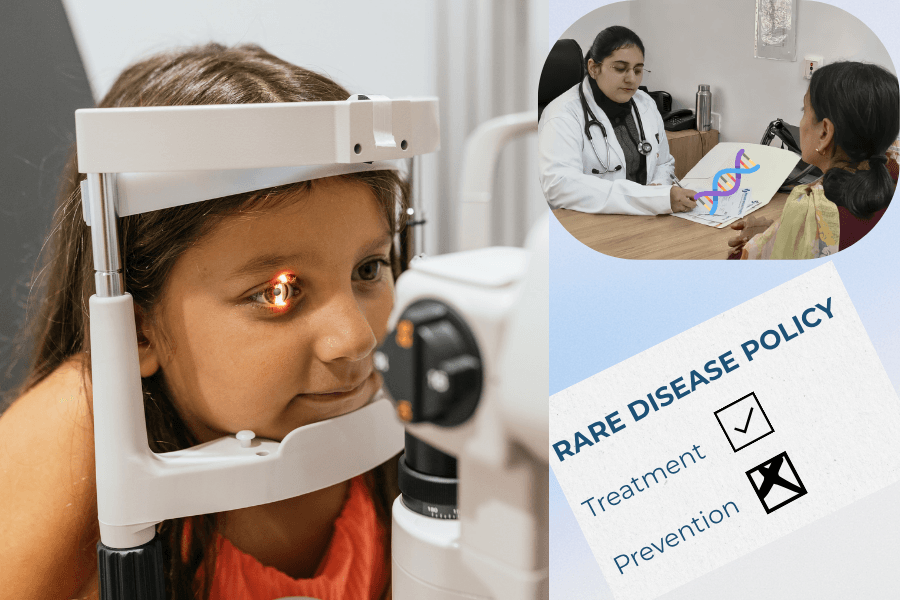
India’s rare disease policy is designed to act when treatment becomes expensive, not when risk becomes predictable. The result is a system that responds after disease manifests, even in conditions where early intervention can prevent irreversible disability.
A child losing vision from familial glaucoma illustrates this gap. The genetic mutation is often detectable years in advance, and the benefits of early intervention are well established. Yet the health system typically intervenes only after damage has occurred.
In 2021, India formalised its approach through the National Policy for Rare Diseases, creating centres of excellence and financial support for high-cost therapies. This was necessary. But its organising logic remains narrow: policy attention is triggered by treatment cost. Prevention, predictive monitoring, and risk-based surveillance remain largely outside its design.
This excludes genetically predictable conditions, where the challenge is not cost, but timely identification. Familial glaucoma sits squarely in that gap.
A System Triggered by Cost
India’s rare disease framework is fiscally intuitive. Many rare diseases require therapies costing several crores annually and are available only in specialised centres. But it narrows urgency to financial catastrophe, not preventable disability.
Familial glaucoma exposes this limitation. It is genetically predictable and clinically identifiable, and vision loss is preventable if detected early. Yet it does not typically require ultra-expensive therapies that trigger rare disease funding pathways. The critical interventions such as genetic confirmation, structured family screening, and longitudinal monitoring occur before symptoms appear.
As a result, conditions where prevention is feasible and cost-effective remain outside formal policy attention. This bias is reflected in the current list of 67 conditions eligible for financial support, where no eye diseases are included.
The consequences are economic as much as clinical. In such conditions, the costs of inaction accumulate early through lost education, reduced productivity, and long-term dependency. In India, avoidable vision loss is estimated to cost up to 0.7 percent of GDP, while global evidence suggests that every dollar invested in preventing blindness can yield returns exceeding 30 dollars. The exclusion of genetic eye diseases from policy frameworks therefore represents a missed opportunity on both fronts.
Capacity Without Risk Integration
This limitation becomes clearer when viewed against existing preventive systems. India already has large-scale preventive infrastructure. The Rashtriya Bal Swasthya Karyakram (RBSK), under the National Health Mission, screens millions of children each year for the “4 Ds”: defects at birth, diseases, deficiencies, and developmental delays. Childhood visual impairment and congenital eye disorders fall within its mandate, with referrals routed to District Early Intervention Centres.
However, the programme remains largely symptom-driven. Genetic risk is rarely incorporated into screening protocols. Family history is inconsistently captured, and cascade screening of relatives is not institutionalised. For such conditions, the outcome is predictable: children often enter the system after irreversible vision loss has progressed.
Expanding screening to the general population raises concerns around cost, overdiagnosis, and system capacity. But genetically predictable conditions allow for a more efficient approach: targeted, family-based screening of high-risk individuals, where yield is higher and intervention timelines are clearer.
The constraint is not infrastructure; it is design. Existing programmes are not structured to act on inherited risk before symptoms emerge.
States Show Implementation is Feasible
Several states have begun expanding access to eye care in ways that move beyond episodic interventions toward systematised delivery.
Odisha’s Universal Eye Health Programme, Kerala’s structured screening for chronic eye diseases such as diabetic retinopathy, and Telangana’s shift toward permanent, facility-based eye care clinics reflect a growing emphasis on continuous screening and referral pathways.
These initiatives are not designed around genetic disease. But they demonstrate that states are willing to build scalable systems when the burden of avoidable blindness is recognised.
This creates a clear implementation pathway for familial glaucoma: it can be integrated into these emerging state-level platforms through targeted screening protocols, family history capture, and referral linkages.
The remaining constraint is policy direction: aligning genetic risk with preventive care.
The Missing Link Between Risk and Care
What remains absent is the institutional bridge between genomic capability and public health delivery.
India’s genomic ecosystem has expanded rapidly, with growing capacity to identify disease-causing mutations. Yet this capability remains concentrated in research settings and tertiary care institutions, with limited integration into routine public health systems.
In practice, genomic diagnosis rarely translates into population-level prevention. The system lacks structured pathways to convert individual identification into family-level surveillance. The gap is compounded by a shortage of trained genetic counsellors and clinical geneticists, limiting the translation of genomic knowledge into preventive care. The absence of national registries further constrains estimation of disease burden, weakening policy visibility and resource allocation.
Detection continues to follow disease, rather than precede it.
Building a Risk-Responsive System
Moving from reactive to risk-responsive care requires alignment across existing systems.
First, rare disease policy must expand its scope to include conditions where surveillance, not just treatment, is the primary intervention. This would allow genetically predictable diseases to enter formal policy visibility.
Second, programmes such as the Rashtriya Bal Swasthya Karyakram should incorporate structured family history capture and referral protocols for hereditary conditions. This would convert individual diagnosis into systematic cascade screening.
Third, state-level eye health programmes can serve as implementation platforms for integrating genetic counselling and family-based screening into routine care.
These are not high-cost reforms. They involve connecting existing capabilities in genomic science, child health programmes, and ophthalmic services into a coherent pathway.
Expanding access to genetic counselling within public health systems will be critical to translating early detection into effective prevention.
From Treatment Financing to Risk Prevention
India’s rare disease policy has rightly focused on the affordability of life-saving therapies. But a mature health system must also invest where foresight can prevent lifelong disability.
Familial glaucoma offers a contained and actionable opportunity. It demonstrates that predictive genomics is no longer theoretical; it can identify risk years before irreversible damage occurs.
The question is no longer whether disease can be predicted, but whether systems will act before damage occurs.
When risk is known, inaction is no longer neutral; it is a policy choice.