



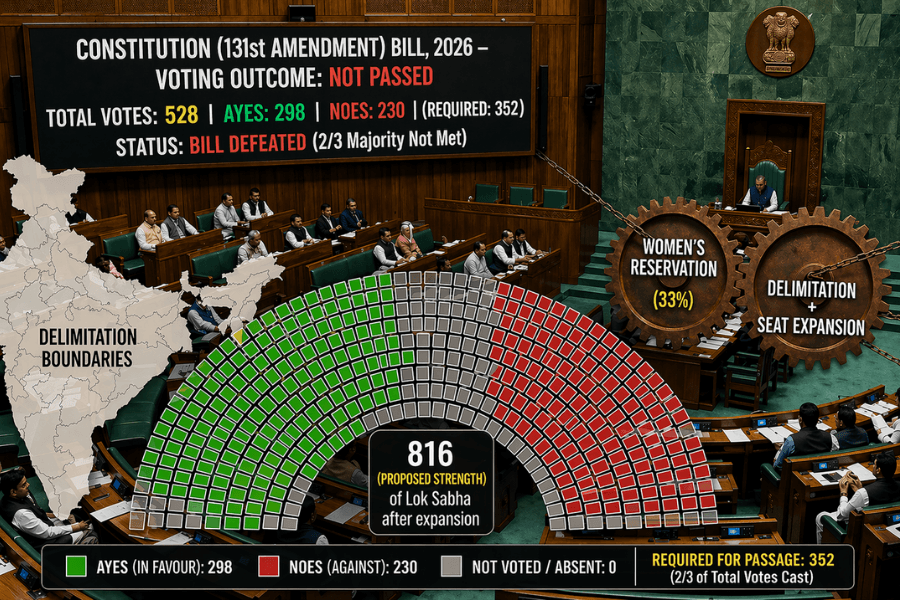
Women’s reservation commands broad support, yet the Constitution (131st Amendment) Bill, 2026 did not secure the required majority in Parliament. A central reason lies in its structure: the reform was tied to delimitation and the proposed expansion of the Lok Sabha from 543 to 816 seats, with 273 seats reserved for women under the Nari Shakti Vandan Adhiniyam. By bundling a widely supported reform with politically contested provisions, the design altered the coalition required for passage.
When a reform with broad legitimacy fails at adoption, the constraint lies in institutional design, particularly in how it structures political incentives and operating conditions. This failure is therefore not incidental. It reflects how the design interacts with the conditions under which the reform must be adopted. Crucially, the same design choices that shape coalition formation at adoption also determine how political authority will be exercised after implementation. The current pause provides an opportunity to examine those conditions before scale.
When Design Shapes Representation
The design issues at play are not confined to implementation. They operate across stages of the reform. The linkage with delimitation shapes political incentives at adoption, while features such as candidate selection, rotation, and capacity constraints shape how power is exercised after implementation.
India has already observed how political reservation operates under similar institutional conditions at the local level. The experience following the 73rd and 74th Constitutional Amendment Acts provides an empirical baseline for evaluating these outcomes. Reservation at the panchayat and urban local bodies level expanded the presence of women across local governance institutions. Field research across Rajasthan, Uttar Pradesh, Bihar, and Madhya Pradesh documented a recurring pattern: elected women representatives held office, while decision-making authority was frequently exercised by male relatives. This pattern came to be described as the “Sarpanch-Pati” or “Pradhan-Pati” phenomenon.
Its persistence across regions establishes that it is structural, reflecting how institutional design interacts with existing political and social structures. The distinction between holding office and exercising authority becomes central to evaluating outcomes, particularly where authority is mediated through informal networks.
Conditions That Enable Proxy Rule
The structural patterns observed in local governance can be traced to three conditions embedded in institutional design. These conditions shape how political entry is controlled and how authority is exercised.
Candidate selection remains tightly controlled by political actors who already hold power within parties and local networks. Where entry is controlled by these structures, candidates are often drawn from households with existing political influence. This pattern extends to higher levels of politics. According to the Association for Democratic Reforms, 47 percent of women legislators have dynastic backgrounds, compared to 18 percent of men. In some states, the concentration is higher, reaching 73 percent in Jharkhand and 69 percent in Maharashtra. These figures establish family-based political capital as a primary mechanism of entry. Entry dependence shapes the degree of autonomy that follows.
Rotation of reserved constituencies across electoral cycles constrains the accumulation of incumbency. A representative elected from a reserved seat in one cycle may find that the same constituency is no longer reserved in the next. For instance, a woman elected in 2029 could face a fundamentally altered electoral landscape by 2034. Rotation disrupts incumbency. Incumbency enables continuity. Continuity enables the accumulation of political capital. When constituencies are periodically reassigned, these processes are interrupted, limiting the development of independent political authority.
Capacity asymmetries further shape outcomes. First-generation entrants often operate within complex and information-intensive administrative systems. In the absence of structured institutional support, intermediaries emerge to bridge access and navigation gaps. Male relatives frequently occupy this role. Assistance can institutionalise into sustained control, particularly where access to decision-making channels remains uneven. Dependence enables the informal transfer of decision-making authority to unelected actors.
Taken together, these conditions generate and stabilise proxy political control, incentivising structures that reproduce such outcomes across electoral cycles.
Scaling Under Current Design
Because these conditions shape how political entry, continuity, and authority operate, their effects are likely to scale with the expansion of women’s representation in Parliament. The Nari Shakti Vandan Adhiniyam retains the same structural features observed at the local level. Candidate selection remains under the control of party leadership without mandated transparency. Reservation is linked to rotation across constituencies. There is no accompanying institutional framework to build a pipeline of candidates with political and administrative experience at scale.
This creates a 273-seat problem. Filling 273 reserved seats requires a rapid increase in the number of candidates who can contest and sustain political careers. The scale and speed of expansion compress the time available to build independent political pipelines. As expansion outpaces mechanisms that generate independent entrants, systems rely on existing networks to fill positions.
This produces what political science describes as dynastic substitution. Candidates are drawn from established political families because they already possess the networks, resources, and recognition required to contest elections. This outcome follows from how political systems respond when expansion outpaces institutional preparation. This is not an aberration. It is a predictable system response.
Design Conditions for Effectiveness
The effectiveness of reservation depends on whether institutional design addresses the conditions that shape political entry, continuity, and authority. Each of these corresponds directly to the constraints identified earlier.
Where candidate selection remains opaque and centrally controlled, entry is likely to continue through existing networks. Introducing transparent and verifiable selection processes alters how candidates are chosen and expands access beyond established political structures.
Continuity is equally central to the accumulation of political authority. When reservation operates through rotating constituencies without mechanisms that preserve electoral bases, incumbency cannot develop into durable political capital. Design features that allow representatives to sustain constituency linkages across cycles enable the consolidation of independent political authority.
Capacity constraints further determine how authority is exercised in practice. In the absence of structured pathways for political and administrative familiarisation, first-generation entrants remain dependent on intermediaries. Institutionalised capacity-building mechanisms reduce this dependence by enabling direct engagement with governance processes.
Accountability mechanisms also shape whether formal authority is exercised by elected representatives. Where institutional frameworks do not address the informal delegation of decision-making to unelected actors, proxy control can persist despite formal representation. Strengthening these mechanisms reinforces the alignment between elected office and exercised authority.
These are enabling conditions. Their presence determines whether reservation translates into independent political power for women representatives or remains mediated through existing networks.
Representation and Control
The expansion of women’s representation raises a structural question about how political authority is exercised. Formal inclusion in legislative bodies does not, by itself, determine who controls decision-making within those institutions. That outcome depends on whether institutional design enables independent political entry, continuity, and direct engagement with governance systems.
Where these conditions are not addressed, representation can remain formally visible while authority is mediated through existing networks. The patterns observed in local governance illustrate how this divergence can persist when design constraints remain unchanged. Scaling representation without altering these conditions extends the same structural outcomes to higher levels of governance.
The question, therefore, is not only whether representation expands, but whether control over political decision-making shifts with it. The current design of women’s reservation will determine which of these outcomes emerges.