



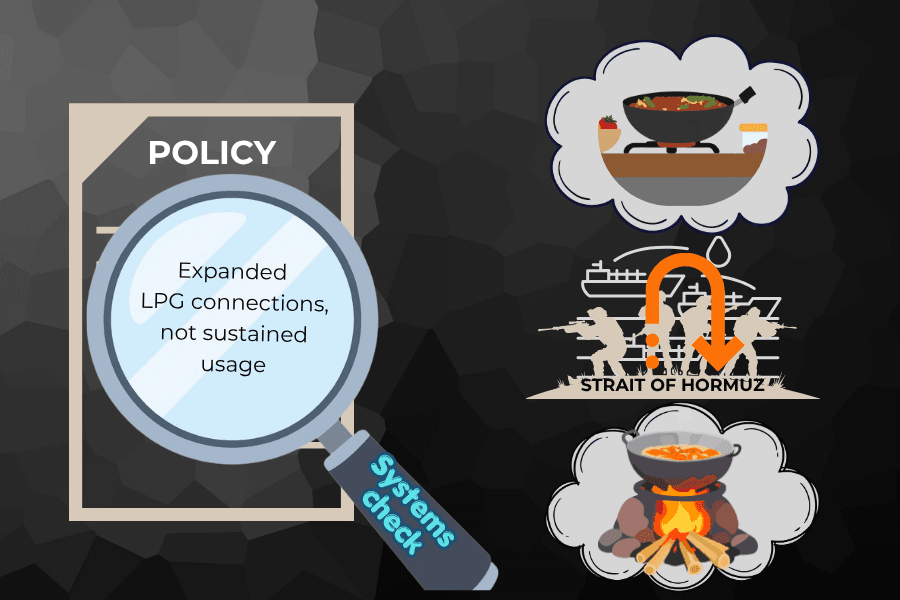
India remains heavily dependent on imported LPG, leaving its clean cooking strategy exposed to external supply shocks. Recent disruptions in West Asia, particularly in the Strait of Hormuz, have brought this vulnerability into focus. Refill delays now run into weeks in several areas, and small eateries are already cutting back menus as LPG availability becomes uncertain. The government’s response is immediate and necessary: refineries have been asked to maximise LPG output, redirect hydrocarbon streams, and seek additional overseas supplies.
India’s clean cooking policy has largely been built around expanding LPG connections rather than ensuring sustained usage, leaving it vulnerable to reversion when conditions weaken.
The larger risk lies in how households respond when supply becomes uncertain. Such disruptions reveal whether the system can sustain clean cooking or promote a shift back to older fuel-use patterns.
Access Expanded, Transition Incomplete
Through the Pradhan Mantri Ujjwala Yojana, India expanded access to LPG on an unprecedented scale, distributing more than 100 million subsidised connections and bringing clean cooking within reach of millions.
But access is not the same as transition or affordability. A household with an LPG connection is not necessarily one that uses LPG regularly as its primary cooking fuel. The real test lies in sustained use, whether households move away from firewood, dung cakes, and crop residue in everyday practice.
On that front, progress remains incomplete. Average refill consumption among beneficiary households is roughly 3-4 cylinders annually, far below levels consistent with primary LPG use.
Fuel Stacking and the Latent Fallback System
For many low-income households, LPG adoption did not replace traditional fuels. Instead, it led to fuel stacking: LPG entered the kitchen, but biomass fuels remained in reserve, used when refill costs rise, delivery becomes uncertain, or cash flow tightens.
This creates a latent fallback system. Traditional fuels remain locally available and socially embedded. When disruptions occur, households do not need to adapt; they revert.
Why Reversion Happens and Persists
Sustained LPG use depends on three conditions: affordability, reliable refill supply, and enough consistency for new cooking routines to become embedded. When these conditions hold, LPG functions as the default fuel.
When they weaken, households conserve LPG for limited uses, while routine cooking shifts back toward biomass. This shift is often frictionless, particularly in rural settings where traditional fuels remain readily accessible and embedded in long-lasting cultural practices.
The asymmetry is central. Adopting LPG requires system reliability; reverting does not. More importantly, recovery is not automatic. Once older routines are restored, they can persist even after supply conditions normalise. Household confidence in LPG weakens, and regular use may not return to previous levels.
This makes the energy transition path dependent and difficult to reverse once triggered.
From Supply Disruption to Energy Poverty
When this shift occurs at scale, supply disruption can translate into energy poverty, in which households are unable to access affordable, reliable, and clean energy for basic needs.
This carries immediate welfare consequences: higher indoor air pollution, increased drudgery in fuel collection, and renewed health risks that disproportionately affect women and children.
Crucially, this can occur without any visible change in official statistics. Households may retain LPG connections while shifting everyday use back to traditional fuels.
The Limits of Connection-Based Metrics
This reveals a core limitation in how progress is measured. Connection-based metrics capture access, but not outcomes. They do not reflect whether LPG is used regularly, whether it functions as the primary cooking fuel, or whether biomass dependence has meaningfully declined.
The issue, therefore, is not the occurrence of shocks, but whether the system can sustain usage when such shocks arise and prevent reversals in everyday fuel use.
Designing for Continuity Under Stress
If India’s clean cooking transition is to hold, policy must shift from expanding access to protecting sustained use, with the explicit objective of limiting the risk of reversion.
First, sustained use must be anchored through affordability. This requires shock-responsive support mechanisms in which subsidy levels or refill entitlements adjust to price movements or supply disruptions, ensuring that households do not reduce usage when costs rise or access becomes uncertain. At the same time, success must be measured through usage-based indicators rather than connection counts. These include refill frequency and the extent to which biomass dependence declines, ensuring that policy reflects actual consumption patterns rather than nominal access.
Second, reliability must be ensured at the point of delivery. While expanding storage and diversifying import sources remain important, household behaviour is shaped by whether cylinders are available when needed. Strengthening last-mile distribution and reducing refill delays are therefore central to sustaining LPG as a primary cooking fuel.
The Real Test of Clean Cooking
India’s clean cooking transition has now entered its most demanding phase. The question is whether households can continue to rely on LPG when disruptions occur. If they trigger a shift back to traditional fuels, the challenge becomes structural.
The objective is not to eliminate shocks, but to ensure they do not reverse welfare gains. Clean cooking must be governed as a continuity-dependent welfare system, where affordability, reliability, and behavioural persistence are treated as core design objectives. That requires building institutions capable of sustaining clean energy use even under disruption.