


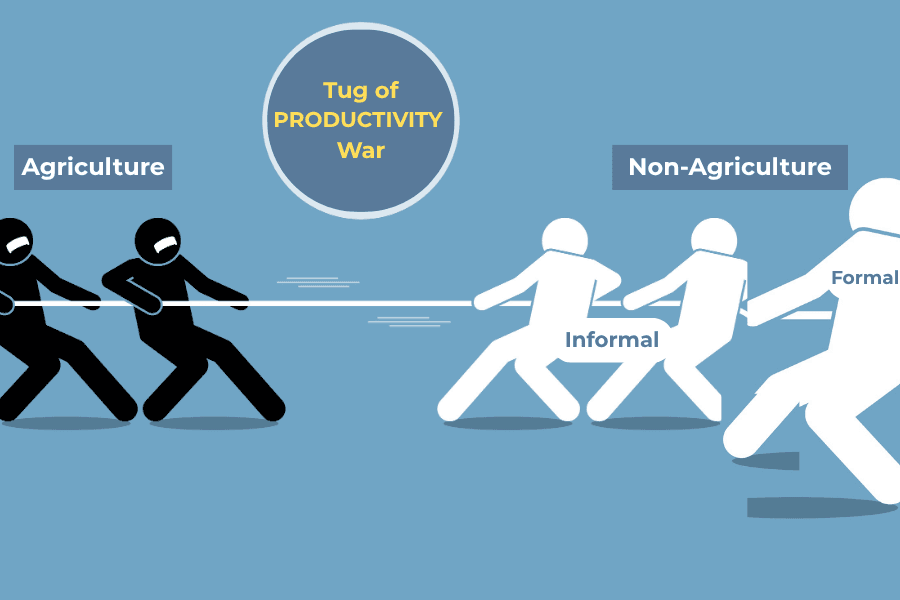
One statistic dominates India’s development debate: agriculture employs far more workers than its share in GDP. The resulting “agricultural productivity gap (APG)” has long been read as evidence that India’s growth problem lies in too many workers remaining in low-productivity farming. Structural transformation, in this view, requires more labour exit from agriculture and expanding non-farm employment.
This interpretation has shaped decades of policy thinking – from migration policy to rural employment schemes to industrialisation strategy. But it rests on a comparison that is rarely interrogated: agriculture is measured against the entire non-farm economy, as if the latter were a single productivity benchmark.
In reality, the non-farm economy itself is sharply divided: a small high-productivity formal sector raises the average far above the productivity of the much larger informal work most workers actually enter.
The Productivity Puzzle
Using sectoral data from the India KLEMS database – based on India’s national accounts – non-farm output per worker, on average, appears roughly four times higher than agricultural output per worker.
Part of this difference reflects differences in working time and education rather than productivity alone. Non-farm workers typically work longer hours over the year and have higher levels of schooling. Once these differences in labour input are accounted for, the gap falls sharply to roughly 1.4. More than half of the raw disparity disappears.
Yet even after adjusting for labour input, the gap remains. This persistence is often interpreted as evidence of labour market frictions: if workers could move freely, productivity differences should equalise. The policy implication has therefore been to accelerate movement out of agriculture.
But this interpretation rests on another assumption – that the non-farm economy itself forms a single productivity benchmark. It assumes that a large, capital-intensive formal firm and a tiny informal enterprise can be grouped together in a single “non-farm” category.
The structure of the non-farm economy makes this comparison misleading.
The Missing Informality Layer
The non-farm economy is deeply segmented.
Across the past two decades, roughly two-thirds to three-quarters of non-farm employment has been informal – concentrated in small, often unregistered enterprises with limited access to credit, minimal use of intermediate inputs, and little or no social security coverage. These enterprises coexist with a much smaller (employing less workers) formal segment composed of larger, capital-intensive firms.
Despite employing the majority of non-farm workers, informal enterprises generate only about 43 percent of non-farm GDP. The remainder is produced by the smaller formal sector. Using the same KLEMS data, the raw productivity gap between formal and informal non-farm segments is itself large – comparable to the conventional farm–non-farm gap.
The non-farm economy is therefore not a single ladder out of low productivity. It is internally divided between two very different productivity regimes.
Agriculture Versus Informal Work
Once agriculture is compared specifically with industries dominated by informal employment, the picture shifts.
In raw terms, value added per worker in predominantly informal non-farm industries appears several times higher than in agriculture. But much of this difference reflects observable factors. Informal non-farm workers work longer hours over the year than agricultural workers, whose employment is often seasonal. They also have somewhat higher levels of schooling.
After adjusting for working time, education, and labour’s share of value added, the gap narrows sharply. Corrected productivity in predominantly informal non-farm industries is only 8 to 38 percent higher than in agriculture. In several years, agriculture and informal non-farm work operate at broadly similar productivity levels.
Wage data reinforce this conclusion. Once differences in education are accounted for, earnings in predominantly informal non-farm activities are close to those in agriculture.
If agriculture and informal non-farm work sit on roughly the same productivity tier, the large aggregate agricultural productivity gap must be coming from elsewhere. Yet the aggregate farm–non-farm productivity gap remains large because the non-farm average is pulled up by a relatively small formal segment with much higher productivity.
The Formal Sector Drives the Gap
The divergence lies in the formal segment.
When agriculture is compared with industries dominated by formal employment, the raw productivity differences are stark. In some years, value added per worker in predominantly formal industries is six to fourteen times that of agriculture. Adjusting for hours worked, education, and labour shares reduces this gap substantially – but it does not eliminate it. Even after full correction, productivity in the formal non-farm sector remains roughly 1.4 to 2.5 times higher than in agriculture.
Formal firms are also more capital-intensive: higher output per worker partly reflects greater use of machinery, technology, and capital rather than labour alone.
The aggregate agricultural productivity gap is therefore driven by a relatively small formal segment whose productivity remains persistently higher.
This becomes decisive when looking across industries. Across 24 industry divisions, the agricultural productivity gap declines systematically as the share of informal employment rises. For industries where informal workers account for more than 76 percent of employment, productivity is statistically indistinguishable from agriculture.
The divide therefore lies within the non-farm economy itself – not between agriculture and the rest of the economy.
Rethinking Structural Transformation
If the principal divide is between formal and informal activity, the policy question shifts.
Industries with higher informal employment use fewer intermediate inputs per worker and are less integrated into production networks. They rely more heavily on labour relative to capital. These technological differences limit productivity growth and restrict spillovers.
Spatial evidence points in the same direction. Informal employment is lower in districts with higher levels of urbanisation, schooling, and banking access, and higher where landless agricultural labour – a proxy for low-skilled labour supply – is more prevalent. State-level labour regulation, by contrast, shows little systematic association with informality.
Informality therefore reflects structural conditions – scale, capital intensity, human capital, financial access, and network integration – rather than simply regulatory evasion.
If agriculture and informal non-farm activities operate at similar productivity levels, reallocating workers between them will not unlock large gains. This does not diminish the role of informal activity: seasonal non-farm work often supplements agricultural income and stabilises household earnings.
Structural transformation is less about farm exit and more about expanding the conditions under which formal, high-productivity firms can grow and absorb labour.
A Different Policy Question
Policy must shift from accelerating farm exit to expanding the formal sector at scale. Productivity gains will not come from moving workers between agriculture and informal employment, but from enlarging the segment of the economy where capital intensity, network integration, and scale sustain higher output per worker.
That requires strengthening the foundations of formal growth – access to finance, urban infrastructure, skills, and production linkages – rather than relying on administrative formalisation alone.
India’s productivity challenge, therefore, is not primarily about too many workers remaining in agriculture. It is about too few workers employed in the formal economy.