



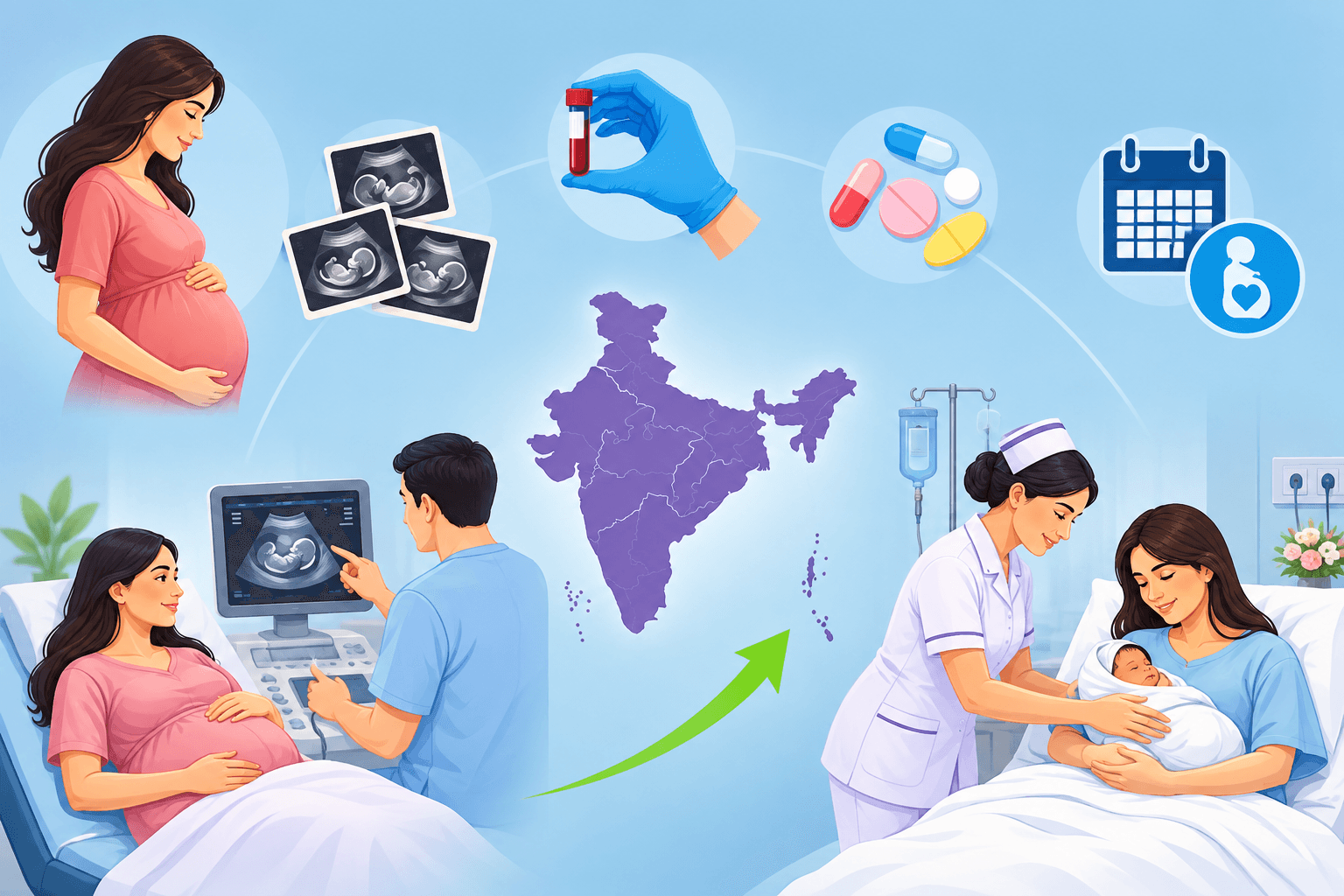
Birth weight is an important marker of maternal health and a child’s early development Low birth weight (LBW), defined as a birth weight below 2,500 grams, is associated with neonatal mortality, impaired physical and cognitive development, poorer educational outcomes, and chronic disease later in life. Its estimated economic cost in India is US$30 billion, or 0.9 percent of gross national income. Reducing LBW is therefore both a maternal-health priority and an investment in human capital.
Maternal-health coverage has improved substantially, including gains in first-trimester registration, antenatal care (ANC), and institutional delivery. Yet these improvements in maternal-health coverage have not been matched by comparable progress in birth outcomes. Approximately 18 percent of newborns are low birth weight, with little national improvement between 2015–16 and 2019–21. Uttar Pradesh, Bihar, Maharashtra, and West Bengal accounted for nearly 47 percent of low-birth-weight infants.
This divergence raises a deeper policy question. India has been more successful in bringing women into contact with the health system than in ensuring that those contacts deliver complete and continuous care. The next reform must therefore move from counting contacts to completing care pathways.
What Counts as Adequate Antenatal Care
ANC provides an opportunity to identify and manage conditions that increase the risk of low birth weight. Properly delivered, it identifies and manages anaemia, inadequate weight gain, hypertension, infections, gestational diabetes, and other causes of fetal-growth restriction or premature delivery. Evidence associates each additional visit with a 30–90 gram increase in birth weight. Although the World Health Organization recommends eight contacts, many Indian women do not complete even four, the earlier benchmark.
Four visits remain a useful access benchmark where many women receive little or no care, but they are not a quality standard. Nor would mechanically replacing four visits with eight resolve the problem. If examinations, treatment, and follow-up remain incomplete, a higher target could reproduce the same weakness across more contacts. India must therefore distinguish access from effective care: the number of contacts shows whether women reached the system; their content and continuity determine what care they received.
Coverage Gaps Are Not the Same Everywhere
NFHS-6 finds that 35 percent of Indian women do not complete four ANC visits. National coverage is 65.2 percent, but ranges from 85.5 percent in Andhra Pradesh and 77.5 percent in Maharashtra to 51.8 percent in Uttar Pradesh and 37.6 percent in Bihar. In Bihar, only 9 percent of women receive sufficient high-quality ANC. Long journeys, transportation costs, poorly equipped facilities, staffing shortages, and limited information constrain both access and quality. National averages therefore conceal sharply different state-level problems.
The policy response must differ accordingly. Bihar and Uttar Pradesh need to reduce financial and geographic barriers while improving service quality. In Andhra Pradesh and Maharashtra, where most women already complete four visits, greater returns may come from strengthening the content and continuity of existing contacts rather than adding more recorded visits.
The Missing Link Between Detection and Follow-Through
India does not lack programmes. Janani Suraksha Yojana has improved institutional delivery rate, Pradhan Mantri Surakshit Matritva Abhiyan provides opportunities for comprehensive examinations, and ASHAs connect women with health facilities. But health monitoring systems capture registrations, visits, and service utilisation more readily than treatment completion, referral closure, or the management of identified risks. Coverage can therefore improve without showing whether care initiated during those contacts was completed.
Responsibility can also become fragmented once a risk is identified. ANC may involve ASHAs, Anganwadi workers, auxiliary nurse midwives, primary health centres, and referral facilities, with responsibility dispersed as a woman moves between them. Detecting anaemia, inadequate weight gain, or hypertension matters only if it leads to treatment, reassessment, and escalation when necessary.
The accountability problem is therefore twofold: completed care is not consistently visible, and responsibility for follow-through can become unclear.
From Counting Visits to Guaranteeing Care
Existing programmes provide the platform. The task is to realign how they measure success, deliver services, and assign accountability.
First, India should adopt a quality-adjusted ANC indicator combining the timing and number of contacts with essential examinations, treatment completion, and referral follow-through. Conditional cash transfers remain valuable where costs restrict access, but financial support should primarily reduce the costs of reaching and continuing care rather than make benefits contingent on services women may not be able to obtain. Frontline and facility performance should reflect whether identified risks were followed up and referrals completed.
Second, each ANC contact should deliver the services appropriate to that stage of pregnancy under a defined care protocol. This requires trained staff, functioning diagnostics, essential supplies, and referral capacity. Increasing the number of contacts has limited value if facilities cannot deliver the care those contacts are meant to provide.
Third, every high-risk pregnancy should have a clearly identified point of responsibility for follow-up, reassessment, and referral. Responsibility may shift as a woman moves through the system, but it should never become unclear who is expected to act. Digital systems can flag missed appointments and unresolved risks, but cannot substitute for institutional ownership. ASHAs should be compensated for follow-up and referral closure; facilities should be assessed on whether identified risks were appropriately managed, not merely recorded.
Together, these reforms would make completed care visible, give every contact clinical value, and establish responsibility for identified risks.
India’s next maternal-health transition will not come from counting more visits alone. The relevant question is not merely whether a woman attended ANC, but whether identified risks were treated and followed through. Persistent LBW does not show that ANC has failed; it shows why contact with health personnel cannot be treated as a proxy for effective care. India must now move from coverage to content, and from attendance to outcomes.