



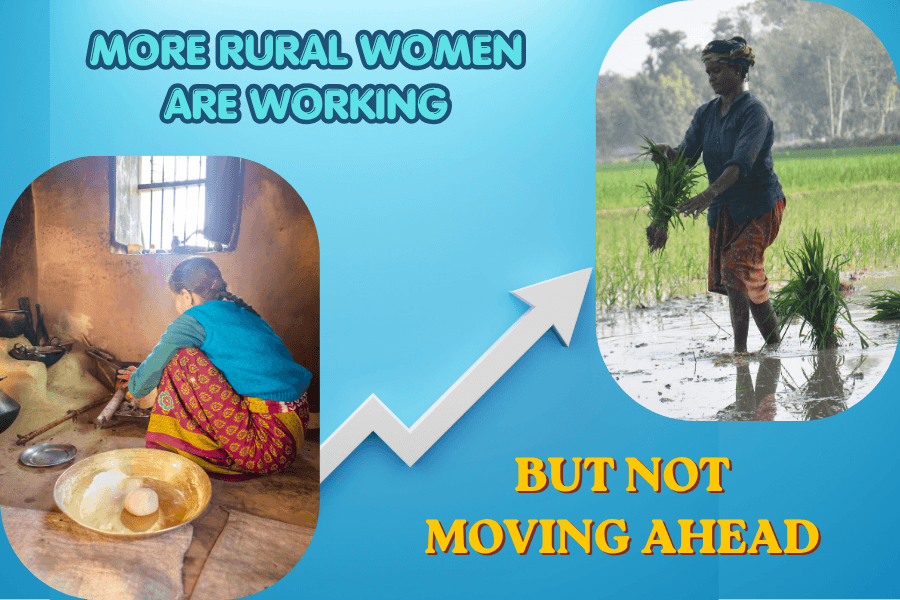
Rural India appears to be undergoing a long-awaited shift. Women’s labour force participation has risen sharply – from around 25 percent in 2017–18 to nearly 48 percent in 2023–24, suggesting a significant expansion in economic inclusion.
The rise is real but not a move into better or more productive work. Instead, it reflects a reallocation of women’s labour into low-productivity, agriculture-based activities, while the constraints that shape their choices – especially unpaid care responsibilities – remain unchanged.
The result is a deeper paradox at the heart of India’s labour market: more women are working, but they are not moving ahead.
Why Participation Data Misleads
Labour force participation answers a narrow question: is someone working or not. It says little about how much they work, what kind of work they do, or whether that work generates income or builds skills.
That distinction becomes clear once time is brought into the picture. Time-use data shows that much of women’s work remains undercounted or misclassified, especially when it is unpaid, home-based, or tied to subsistence production. Tasks like livestock care or assisting on family farms often do not register as “work,” despite sustaining rural economies.
More importantly, participation hides differences in intensity. A woman counted as employed may spend far fewer hours in paid work while also carrying the bulk of unpaid domestic work. Without accounting for time, rising participation can give the illusion of progress.
The Real Shift is Back to Agriculture
Once this fuller picture is brought into view, the pattern of change looks different.
The increase in women’s work is drawing them further into agriculture. Between 2019 and 2024, women’s participation in farm activities rose from about 32 percent to 35.9 percent, alongside a sharp increase – nearly 38 percent – in time spent in paid agricultural work.
This reflects reallocation, not structural transformation. Labour is moving not to where it is most productive, but to where it is most feasible under constraint. Agriculture functions as a low-entry sector that absorbs labour with limited pathways out, without requiring mobility, formal hiring, or skill certification.
The contrast with nonagricultural work is stark. Only about 17 percent of rural women participate in nonfarm activities, compared to more than half of men, and the time spent remains minimal. The pathway to diversified, higher productivity work remains largely closed.
The Unchanged Core: Five Hours of Unpaid Work
But sectoral patterns alone do not explain this distribution. The deeper constraint lies in how time is structured within households.
Women continue to spend close to five hours a day on unpaid domestic chores and caregiving – a burden that has barely shifted even as their participation in the workforce has risen. Men, by contrast, spend only a fraction of this time. What appears as a labour market outcome is rooted in household time poverty.
These hours are binding. They reduce time for paid work, limit mobility, and pre-select the jobs women can take up – pushing them toward work that is local, flexible, and often low-paying.
As a result, even when more women enter the workforce, they remain concentrated in low-productivity activities. Without a redistribution of unpaid work, higher participation will not translate into better work.
Why Women are Not Moving to Nonfarm Work
Even where time constraints ease, barriers to nonfarm work remain. The limited movement of women into nonagricultural work reflects how rural labour markets are structured.
Nonfarm employment requires mobility, skills, and access to networks – all unevenly distributed. For many rural women, these constraints reinforce each other: restricted mobility narrows job options, limited skills reduce entry into better-paying roles, and social norms shape what work is considered acceptable.
The gap in actual work patterns makes this visible. Rural men spend close to three hours a day in nonagricultural activities; women spend barely half an hour. This is not just a difference in participation; it is an access constraint.
The result is a gender-skewed pattern of structural change: as men move into higher productivity work, women remain concentrated in agriculture and low-return activities.
The Puzzle: Why Work Increased Despite Better Conditions
Despite these constraints, women’s work has increased. The paradox deepens: this rise has occurred even as living conditions improve. Education levels are rising, consumption has increased, and housing quality has improved – changes that would typically reduce the need for labour-intensive work.
Yet women are working more, not less.
The increase in work is not driven by expanding opportunity alone. It reflects adjustments within households facing economic uncertainty. Women’s labour shifts from being supplementary to stabilising – absorbing income shocks when options are limited. This is closer to distress-driven participation than opportunity-led entry.
Designing Policy for Time, Not Just Jobs
The distinction is not between work and no work, but between more work and better work. Policy has tended to track the former, while meaningful structural change depends on the latter.
Much of current policy assumes that expanding jobs or skills will be sufficient. But when large parts of women’s day are absorbed by unpaid work, access to these opportunities is constrained. Without reducing time poverty, even well-designed job creation and skilling interventions will have limited uptake.
Public investments in childcare, water access, and other time-saving infrastructure are therefore central, not peripheral, to enabling labour market entry. Similarly, improving productivity within agriculture and creating accessible nonfarm opportunities must account for the constraints under which women make choices, rather than assuming they can respond like unconstrained workers.
Equally, the redistribution of unpaid work within households remains critical. Without it, gains in participation will continue to be absorbed within existing constraints rather than translating into structural change.
The Real Test of Inclusion
The current trajectory risks producing a form of feminization without empowerment, where women’s labour increases without a corresponding shift in their economic position.
The test for inclusive growth, then, is not participation alone. It is whether policy can enable women to move into more diversified and higher-return opportunities. Until that shift occurs, rising participation will continue to register activity without altering outcomes – and policy will keep mistaking movement for mobility.