


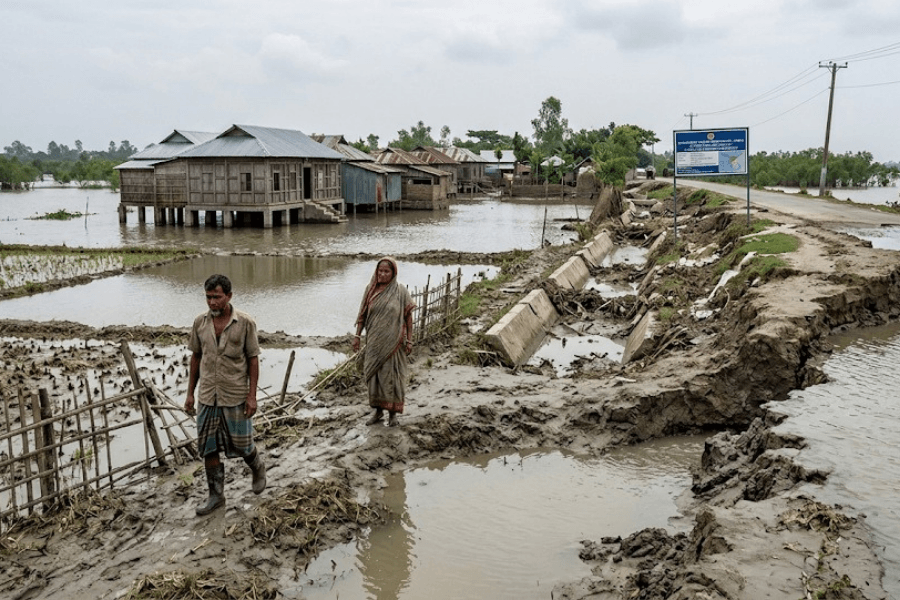
India’s climate policy has long rested on two pillars: mitigation and adaptation. Mitigation seeks to limit future warming, while adaptation focuses on strengthening resilience to climate impacts. As global temperatures approach 2°C above pre-industrial levels, however, a third category of climate risk becomes unavoidable: losses that adaptation cannot prevent.
For India, this is not a distant scenario. A 2°C world would reshape economic and social conditions across multiple sectors. Even with strong adaptation, some climate impacts remain unavoidable. In international climate policy debates, these residual risks are described as “Loss and Damage” – irreversible harms that exceed the limits of conventional resilience strategies.
While often framed internationally around climate finance and compensation, Loss and Damage also raises a domestic policy question: how governments manage these impacts within their own economies.
Climate policy must therefore expand beyond managing risk to governing irreversible climate loss.
When Warming Becomes Non-Linear
The difference between 1.5°C and 2°C of warming is not merely incremental. In several climatic systems relevant to the Indian subcontinent, risks intensify once certain thresholds are crossed.
Higher temperatures increase the atmosphere’s moisture-holding capacity, amplifying extreme rainfall events. As precipitation intensifies, drainage and hydraulic infrastructure designed for historical rainfall patterns faces structural limits. Urban and riverine flooding will increase even where infrastructure investment continues.
Heat risk follows a similar pattern. Wet-bulb temperatures approaching 35°C represent physiological limits for sustained outdoor labour. In parts of the Indo-Gangetic Plain and coastal India, extreme heat events are projected to approach these thresholds more frequently. Such conditions place severe physiological limits on sustained outdoor work, particularly in regions where large segments of the workforce remain exposed to high heat and humidity.
As these climate stresses intensify, their consequences will not be evenly distributed across the country. Instead, impacts will concentrate in specific ecological and economic zones.
Where Climate Impacts Concentrate
The Himalayan region, often described as Asia’s “water tower,” faces accelerating glacier loss as temperatures rise. Reduced ice volume could alter the long-term flow of major rivers such as the Indus, Ganges, and Brahmaputra, reshaping the hydrological stability on which much of North India’s agricultural economy depends.
Coastal regions face a different form of long-term change. In deltaic systems such as the Sundarbans and parts of coastal Odisha, rising sea levels and saltwater intrusion threaten the long-term viability of agriculture and settlement. Once soil salinity crosses certain thresholds, productive land can be lost for generations.
Urban systems present a third geography of risk. In major metropolitan areas, rising temperatures interacting with the urban heat island effect intensify extreme heat conditions across dense built environments.
These patterns show that climate loss is fundamentally spatial. National averages obscure the fact that irreversible climate impacts will concentrate in particular landscapes and communities. Because risks concentrate in particular landscapes, the economic consequences fall unevenly across social groups.
Who Bears the Economic Costs
Climate loss is also economically regressive, with irreversible impacts falling disproportionately on households least able to absorb economic shocks.
Low-income households often hold assets directly exposed to environmental risk: small agricultural plots, informal housing, or natural resources that support livelihoods. When floods, salinity intrusion, or heat stress reduce the value of these assets, families frequently lack access to insurance, savings, or formal credit markets.
Repeated climate shocks can trigger cycles of informal borrowing and asset liquidation, eroding fragile household wealth and deepening structural inequality. Public finances also face pressure as governments divert resources from long-term development investments toward repeated disaster relief.
Climate change therefore does not only create environmental stress; it can reinforce economic disparities by systematically exposing poorer households to uncompensated losses.
Governing Residual Climate Risk
If residual climate risk becomes an enduring feature of the policy landscape, governments will need institutions capable of anticipating and managing its economic and social consequences.
Existing climate governance systems are largely organised around disaster response and adaptation planning. These tools remain essential but are not designed to address permanent economic losses or long-term shifts in habitability and livelihoods.
This requires integrating climate loss considerations into fiscal planning, social protection systems, and spatial development policy. Rather than treating climate impacts as exceptional events, they must be incorporated into routine economic governance.
Governing climate loss therefore requires institutions capable of managing its fiscal, social, and spatial consequences. Three policy arenas are particularly relevant: fiscal transfers that distribute climate risk, social protection systems that stabilise household incomes, and spatial planning frameworks that manage long-term relocation.
Fiscal Architecture for Climate Loss
India’s fiscal federal system offers an institutional platform for managing climate risk. The Finance Commission periodically determines how tax revenues are distributed between the Union and the states and the criteria for inter-state transfers.
Incorporating climate loss projections into this framework could help align fiscal transfers with geographic vulnerability. Regions facing persistent climate risk may require additional resources not only for disaster response but also for long-term economic adjustment.
Finance Commission formulas already incorporate criteria such as forest cover, demographic change, and disaster risk when determining inter-state transfers. Similar metrics could be developed to reflect long-term climate loss exposure across states.
A dedicated “Climate Loss Grant” could complement existing disaster response funds by supporting livelihood transitions, infrastructure redesign, and economic adjustment in high-risk regions. This would shift climate loss from ad hoc relief toward planned fiscal policy.
Climate Safety Nets for Workers
Social protection systems will become central instruments for managing climate-related income volatility.
Rural employment guarantee systems already provide an important buffer for households during economic shocks, expanding public works when rural labour demand weakens. Similar mechanisms could be designed to activate automatically during extreme heat events or rainfall shocks, providing temporary income support for workers in climate-exposed sectors.
Linking programme expansion or cash transfers to environmental indicators could provide rapid liquidity for informal workers whose incomes are disrupted by extreme conditions.
Such mechanisms would transform welfare programmes into stabilisers that protect household assets and prevent climate shocks from pushing vulnerable families into long-term debt cycles.
Planning for Managed Retreat
In some locations, adaptation may reach its limits. Coastal erosion, salinity intrusion, or repeated flooding may render certain settlements increasingly difficult to sustain.
Policy must then move from defending every location toward facilitating orderly transitions. Managed retreat does not imply abandonment but the proactive planning of relocation and economic transition.
Existing spatial planning frameworks already identify high-risk areas through instruments such as Coastal Regulation Zone (CRZ) rules and floodplain zoning guidelines. These mapping exercises provide an institutional basis for identifying locations where long-term relocation planning may become necessary.
Governments can identify high-risk zones, support migration toward economically viable regions, and provide vocational training that enables workers to shift out of climate-vulnerable livelihoods. When integrated into development policy, relocation becomes a pathway to economic opportunity rather than a response to crisis.
From Adaptation to Risk Governance
India’s climate strategy will continue to rely on mitigation and adaptation. But a warming world will also bring losses that cannot be fully prevented.
Planning for such outcomes strengthens economic preparedness. By incorporating climate loss into fiscal policy, social protection, and spatial planning, governments can reduce the long-term disruption associated with irreversible climate impacts.
Climate governance must therefore evolve from managing climate risk to governing climate loss – ensuring that unavoidable impacts do not derail India’s long-term development trajectory.