

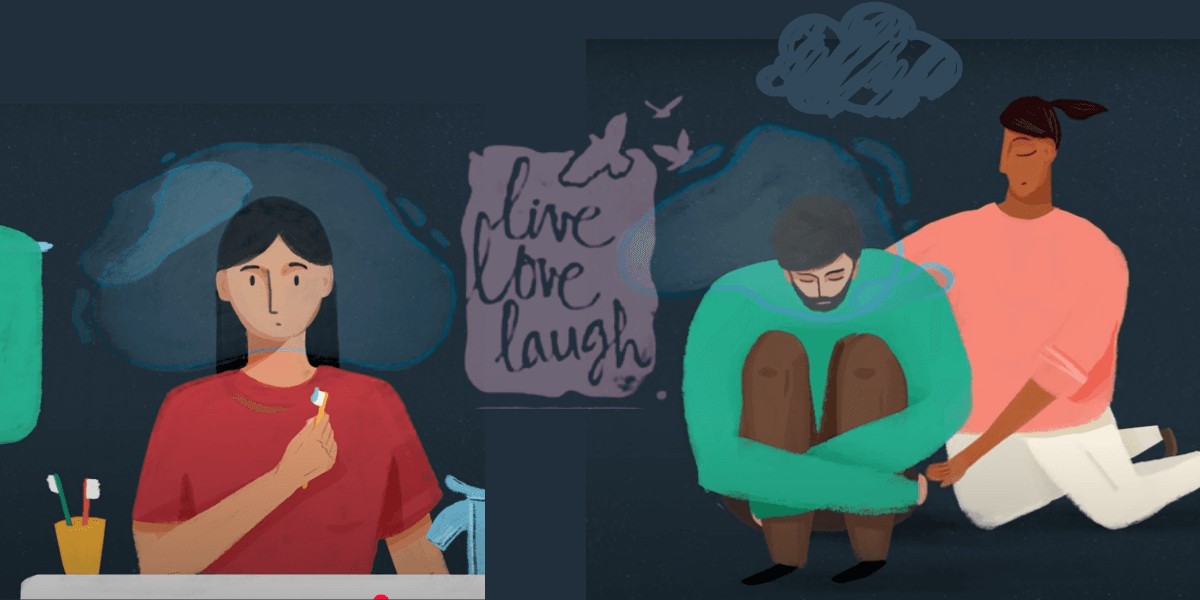
In many households, mental illness is not recognised as illness at all. For instance, it may appear first as a disruption – a son who stops working, a mother who begins speaking incoherently, a father who becomes fearful, aggressive, or withdrawn. Families adapt around these changes for months or years, unsure whether they are witnessing stubbornness, bad behaviour, stress, possession, moral failure, or something that will resolve on its own. Treatment is not delayed so much as undefined.
When the condition worsens – behaviour becoming unmanageable or life-threatening – families often reach a breaking point. What they face is not only a lack of knowledge but also social stigma, the absence of diagnostic language, treatment pathways, and affordable psychiatric care, and psychological support within reachable distance.
It is in this gap between recognition and care that The Live Love Laugh Foundation (LLL) began its work nearly a decade ago. Established in response to the founder’s own experience with anxiety and depression, the organisation emerged from a simple but difficult insight: mental illness often becomes dangerous not only because it is stigmatised, but because families are unaware or are left to navigate it alone.
“The hardest part is often not the illness itself,” says Anisha Padukone, CEO of LLL. “It is not knowing what you are dealing with, or where to turn – for the person who is unwell, as well as for those around them.”
From Sports and Caregiving to Design Choices
Before mental health became Anisha’s professional focus, her life was shaped by competitive sport. She represented India in golf and had pursued badminton, cricket, basketball at competitive levels.
“Sport teaches you to think long-term,” she says. “You don’t train for quick wins. You train knowing results, if at all, may come much later.”
That orientation became relevant in 2014, when her sister experienced anxiety and depression. While the family was fortunate to have access to a professional mental health ecosystem, that experience exposed its systemic flaws: a large number of those affected face significant barriers in accessing reliable information and affordable care. Scaled up, the number runs into millions at the country level..
As recovery unfolded, this experience informed a deliberate focus on common mental disorders – stress, anxiety, and depression – where early recognition and sustained support could meaningfully alter trajectories. LLL took shape as an institutional anchor to address these gaps.
“The problem was vast, and the support system was minimal where it mattered most,” Anisha says.
Community as the First Site of Intervention
As LLL’s work moved from lived experience to field practice, one constraint became unavoidable: professional mental health care was often too distant, fragmented, costly or inaccessible to serve as the first point of response. The community, therefore, became the starting point – not as an ideological choice, but as a practical one.
A pilot programme in Davangere district of Karnataka tested whether locally anchored interventions could reliably alter care trajectories. That test cemented confidence: interventions could be magnified through collaboration with local institutions without eroding quality or continuity. And, expansion followed.
“Even if we reach fewer people, the question is whether the impact holds,” Anish reflects.
By embedding community into its programme model, LLL reframed the mental health challenge from one of service delivery to one of system readiness: one that notices distress, connects families to care, and stays engaged over time. Community programmes thus function as entry points into care – linking awareness and identification with clinical consultation, medication access, caregiver support, and rehabilitation where required.
Partnerships as the Infrastructure
Once community programmes began functioning as entry points into care, the question shifted from outreach to durability: who would carry treatment, follow-up, and support at scale?
For LLL, the answer lay in partnerships with grassroots organisations and community health workers – not as an add-on to delivery, but as the very infrastructure of care.
However, partnerships also impose a second-order challenge: capacity. Many grassroots organisations lack the technical, administrative, financial, and compliance systems required to sustain specialised mental health interventions over time, even though they possess passion, legitimacy and reach.
LLL’s role adjusted to this reality; institutional strengthening became a core focus with investments in partners’ technical training, financial systems, documentation practices, and reporting capabilities – functions often treated as peripheral in community work but essential for durability.
LLL also facilitates annual partner convenings to strengthen cross-learning by surfacing operational problems and refining delivery pipelines.
“If we are part of an ecosystem,” Anisha points out. “We have a responsibility to strengthen it.”
Campaigns as Behavioural Interventions
Even with partnerships in place, care can begin only after people identify and admit mental distress – of their own and those around them. Public awareness campaigns, therefore, play a critical enabling role in LLL’s work. They function as behavioural interventions that shape when and how responsibility is taken, while helping loosen long-standing social taboos around mental health.
The Dobara Poocho campaign, India’s first nationwide public awareness campaign on mental health, launched in 2016, illustrates this logic. Rather than speaking to individuals experiencing anxiety or depression, it targeted those around them – friends, colleagues, family members. The premise was simple: people in mental distress often struggle to articulate what they are experiencing, shifting responsibility outward.
“Can you ask again how they are really doing?” Anisha says, drawing on the central premise of the campaign.
Subsequent campaigns, including #NotAshamed in 2018, reinforced this approach by lowering the social threshold for acknowledging mental illness, helping prepare the ground on which programmes and clinical care depend.
3A’s: Awareness, Access, and Affordability in Practice
Anisha describes the LLL approach to mental health through three interlinked priorities: awareness, access, and affordability. In practice, these shape whether people enter care early or reach it only after a crisis.
Awareness is the first constraint that LLL addresses. In many settings, mental distress remains unnamed – misread as weakness, misbehaviour, or a passing phase. LLL’s programmes focus on making mental health comprehensible to individuals, families, and communities, so that common mental health disorders such as anxiety and depression are recognised early.
Access is often the next bottleneck. For early-stage conditions, this may involve counselling and psychosocial support. LLL now maintains a directory of over 500 mental health professionals and 20 partner helpline numbers, lowering the threshold for reaching qualified care. Yet, in rural settings, field work repeatedly reveals a harder reality: in many cases, due to the lack of awareness, mental distress is undetected and untreated. When detected late, counselling alone may not be sufficient; patients could also need psychiatric assessment, medication, and long-term follow-up.
Affordability becomes critical at this stage. The cost of mental health care adds up: it accumulates through medication costs, repeated trips for treatment – which are often the reasons for drop-offs and sub-optimal outcomes for all, including caregivers.
“If someone seeks help but can’t afford it,” Anisha asks, “what are we really offering them?”
By helping them navigate treatment pathways and sustain follow-up, within their own communities of patients and caregivers, LLL addresses affordability across the full course of illness.
LLL’s Rural Community Mental Health Program currently covers over 22,000 persons with mental illness (PWMIs) and their caregivers across 15 districts in eight states.
Strengthening Mental Health in Diverse Institutional Settings
While rural mental health remains central, LLL adapts its care logic to other institutional contexts as well.
LLL works with organisations in cities to assess workplace mental well-being and design structured responses – helping organisations use tailored interventions rather than relying solely on one-off awareness sessions. The emphasis is on aligning support with organisational systems, where mental distress often appears as burnout, isolation, or performance pressure.
Previously, LLL has also undertaken capacity building within formal institutions, including training over 2,400 doctors to diagnose and treat common mental disorders. These efforts aim to strengthen early recognition and appropriate referral, ensuring that mental health concerns are routed through qualified and timely care pathways.
Policy as the Next Layer
LLL approaches policy as an extension of field practice – using on-ground experience to identify implementation gaps and feed those insights into institutional conversations.
Anisha notes that the Mental Healthcare Act, 2017, marked a significant step by recognising mental health as a right. But, despite policy intent, insurance coverage for mental illness remains uneven.
Another potential area of intervention is professional regulation. The absence of clear national standards defining who qualifies as a counsellor or therapist creates a serious risk for people seeking care.
“As we are observing, anyone can call themselves a counsellor today,” Anisha reflects. “That’s dangerous when people are dealing with mental illness and don’t know where to turn.”
Scaling With Discipline
When Anisha reflects on LLL’s future plans, she is confident about scale, but cautious about its conditions. “What matters is systems, people, and clarity of purpose.”
LLL’s trajectory – from community pilots to multi-state outreach, from awareness campaigns to strategic policy engagement – reflects a sequencing logic shaped by design discipline. Community first, systems next – with policy underpinning efforts as a framework.
“If we can make things better not just for today,” she says, “but for the next two or three generations, then we have done our job.”