



Every February, India’s climate debate centres on the Union Budget, with attention focused on allocations for green hydrogen, carbon capture, clean energy and other climate-related programmes. Yet this national focus can obscure where many climate risks are experienced and managed: through the roads, drains, water systems and housing provided by 2.5 lakh Gram Panchayats (GPs) and roughly 4,700 Urban Local Bodies (ULBs). Heatwaves, floods and water stress are now the problems of local governance as well, not only of the environment ministry. Most local governments cannot readily identify how much of their expenditure reduces climate risk and how much may lock communities into greater vulnerability.
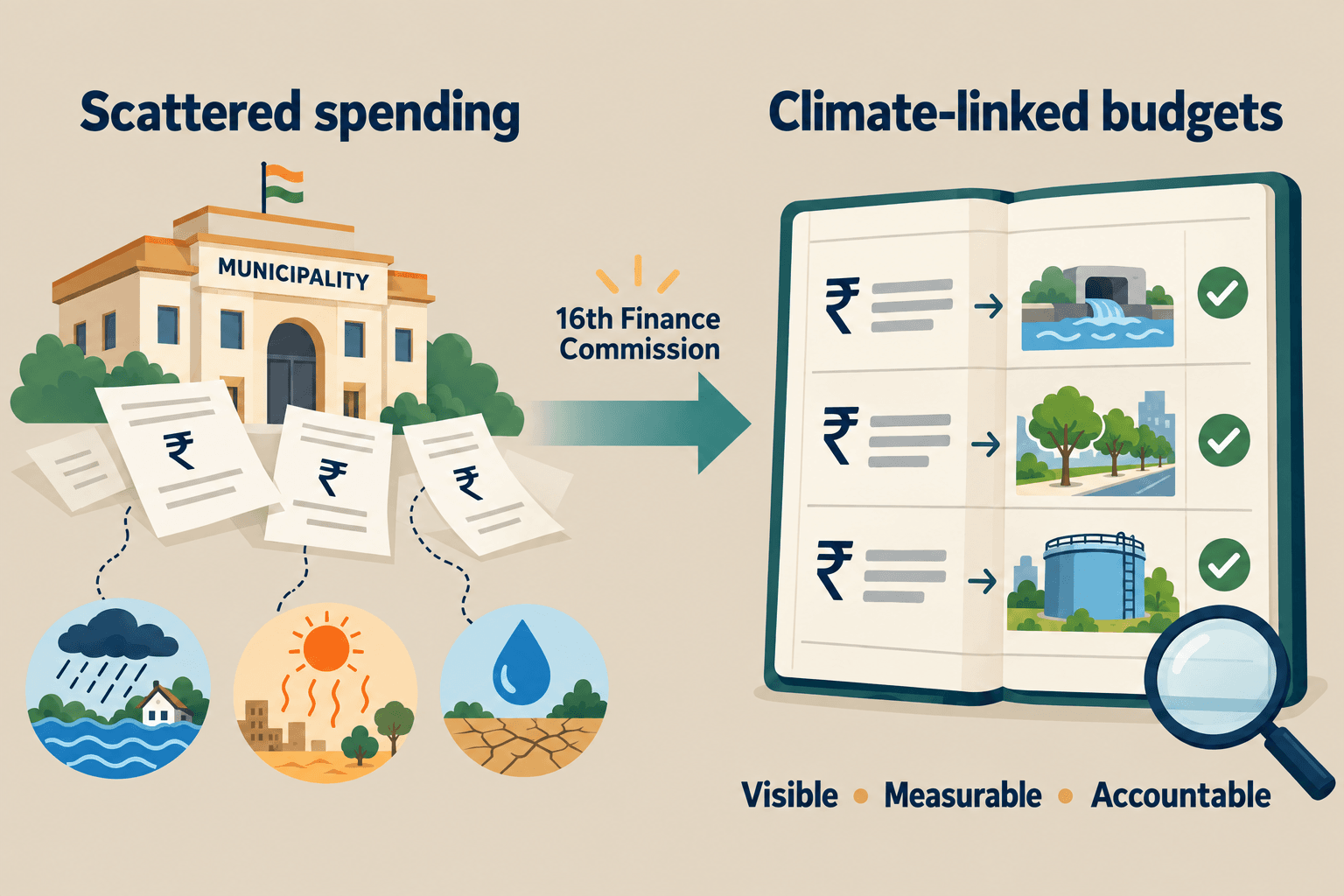
The more immediate question, therefore, is not simply how much more India should spend on climate action, but whether local budgets make existing spending visible -- and show whether that spending is building resilience to climate change.
The Fiscal Gap in Local Climate Governance
India constitutionally devolved local governance in 1993; climate risks, meanwhile, have increasingly become local, without a corresponding adaptation in fiscal arrangements.
The 16th Finance Commission’s data show own-source revenue accounts for 51 percent of municipal income nationally, rising to 61 percent in the largest cities but falling sharply for smaller urban bodies. Panchayats remain still more dependent on transfers. Climate tagging cannot substitute for adequate and flexible local finance, but it can show where existing resources are going and where additional funding may be needed.
The deeper failure is that mitigation and adaptation are treated as sectors rather than as a lens applied to expenditure already being made on roads, water and housing.
From Mumbai to Karnataka: Scaling Local Climate Budgeting
In 2024, the Brihanmumbai Municipal Corporation became the first Indian city to publish a formal climate budget, prepared through the C40 Cities Climate Budgeting Pilot, which supports cities in integrating climate objectives into their existing budgeting processes, with WRI India as knowledge partner. It tagged ₹10,224.24 crore, approximately 32.18 percent of capital expenditure, as climate-relevant, with the largest shares going to urban flooding and water management, followed by waste, greening and air quality. The exercise required neither a new ministry nor a new tax; it required the discipline of examining an existing budget and asking whether each rupee reduces risk, builds resilience, or does neither.
Karnataka is now taking decentralised climate governance a step further. Karnataka's climate agency, Environmental Management and Policy Research Institute (EMPRI), announced plans in 2026 to formulate climate action plans for all 5,994 Gram Panchayats (GPs) and 314 Urban Local Bodies (ULBs).
However, a plan is not a budget: it can specify what should happen without ever showing whether money was actually committed to it. Mumbai's exercise shows that climate expenditure can be identified within an existing municipal budget. The two experiences point to the same missing link: translating local climate plans into visible expenditure.
From Tagging to a Working Budget Framework
Expenditure tagging is a diagnostic step, not a budgeting framework by itself. A working framework must put tagged expenditure to work at four stages of the budget cycle. First, it should establish an explicit climate-expenditure target during formulation. Second, it should inform the prioritisation of competing capital proposals, including their climate relevance. Third, it should provide elected councils with a measure to track quarterly. Finally, it should create a verifiable record for fiscal oversight, audit and public scrutiny. These functions can be built into accounts that local bodies must already publish.
The budget classification needs to be two-tiered to survive scrutiny. Tier one should be climate-primary expenditure, where mitigation, adaptation or resilience is an explicit primary objective and can be demonstrated through project design. Tier two should be climate-significant expenditure, where resilience forms one component of a wider investment and only the attributable share is counted. A road resurfaced to ordinary specification is not climate spending; the same road rebuilt to a prescribed climate-resilient standard can qualify, but not automatically at the full project cost.
A nationally published taxonomy, eligibility criteria and weighting methodology should guide these percentages, while requiring climate relevance to be demonstrated against local risk and prescribed design standards. Otherwise, tagging becomes subjective and incomparable across states and risks becoming a paper compliance exercise. Tier Two expenditure must therefore be verifiable against what was actually built, not merely declared. Major capital proposals should also be screened for potential maladaptation so that spending that increases climate vulnerability is visible too.
The Scaffolding Already Exists
Since 2021, the Ministry of Panchayati Raj has advanced the localisation of Sustainable Development Goals through nine thematic areas. The Panchayat Advancement Index (PAI), rolled out nationally in 2025 and subsequently rationalised through PAI 2.0, provides an outcome-monitoring framework across these themes. But it does not yet systematically connect those outcomes to climate-relevant expenditure. PAI 2.0 reduced the framework from 516 indicators in PAI 1.0 to 150 indicators.
Closing this gap does not need new institutions; rather, it requires connecting existing planning, monitoring and budgeting systems. Every Gram Panchayat prepares an annual Gram Panchayat Development Plan (GPDP), while eGramSwaraj already integrates planning, budgeting, accounting and progress reporting. Climate classification could be incorporated at the activity level in this chain and linked to relevant PAI outcomes.
Urban local bodies need a parallel route through municipal budgets and accounting systems rather than an assumed urban equivalent of the GPDP. A common climate-expenditure taxonomy could be mapped onto existing municipal accounting heads and published financial statements.
The resulting expenditure statement could then connect climate outcomes with spending without creating a separate reporting architecture.
Embedding Climate Spending in the Fiscal Architecture
The 16th Finance Commission’s 2026–31 award already provides a fiscal and disclosure architecture on which climate-expenditure reporting can build. It divides local body grants into 80 percent basic and 20 percent performance components. Half of the basic component is tied to sanitation and solid-waste management and/or water management, while the local-body performance component is linked to own-source revenue growth.
The Commission also specifies that no further conditions beyond those in its local-body chapter should be imposed for release of these grants.
Climate reporting should therefore not become a new grant-release condition during the award period. It can instead be incorporated into ordinary local budgeting and financial disclosure, with relevant tied expenditure cross-referenced against the climate statement. Climate-expenditure share should initially remain a disclosure measure rather than a performance score: what matters is whether spending responds to local risk, is implemented as designed and improves outcomes.
Evidence generated during 2026–31 could inform State Finance Commission recommendations and provide a tested basis for a future Union Finance Commission to consider climate alignment formally within the fiscal-performance architecture.
Administrative circulars alone, however, will not be enough. State and local-government audit systems would need the capacity to verify Tier Two expenditure against prescribed criteria, supported by common standards and the Comptroller and Auditor General’s existing technical guidance and supervision. That verification will determine whether the framework becomes an accountability mechanism or remains a reporting exercise.
The next step in India’s climate-finance architecture is not another funding window, but a system that can see whether ordinary local spending is reducing climate risk or adding to it. Once that becomes visible, expenditure can be prioritised, scrutinised against outcomes and, eventually, rewarded through the fiscal system.