



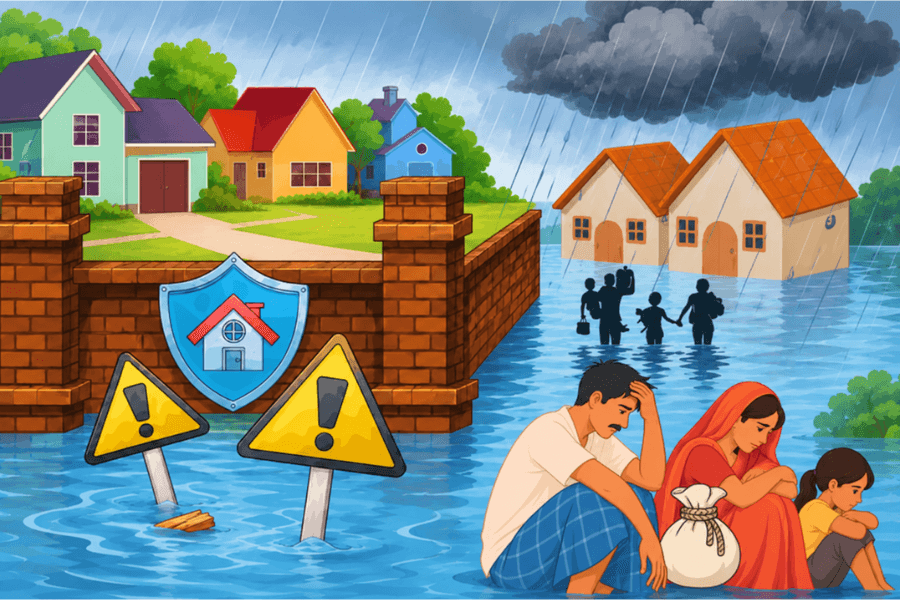
In Bihar, nearly 74 percent of the state's geographical area is flood-prone. In 2024 alone, floods affected approximately 5.64 million people, damaging cropped land and housing. Yet the economic consequences can last longer than the visible damage. Lost working days, depleted savings and borrowing to meet immediate needs can leave households less able to withstand subsequent disruptions.
The geographical distribution of flood exposure does not necessarily match that of poverty vulnerability or public assistance. Some locations with severe inundation have comparatively low relief coverage, while poverty persists even in protected areas. Flood policy must therefore distinguish three tasks: reducing exposure, reaching households in need and enabling economic recovery.
How Flood Exposure and Poverty Intersect
An analysis of 424 households across 26 villages in Bhagalpur and Sitamarhi districts, surveyed between November 2024 and January 2025, illustrates why exposure alone is an incomplete guide to economic risk. Using the Vulnerability as Expected Poverty (VEP) framework to estimate the probability of future household consumption falling below the poverty line, the assessment identified 60.85 percent of households as vulnerable to future poverty, compared with 58.96 percent currently poor. Present poverty rates alone cannot capture this forward-looking risk.
The survey examined four spatial categories: inside embankments, outside embankments, protected areas and unprotected areas. Severe inundation, defined as flood depths exceeding 1.5 metres, affected 73.33 percent of surveyed households inside embankments, 35.45 percent outside and 20.83 percent in unprotected areas. None in protected areas experienced flooding of this depth.
Poverty incidence was highest inside embankments, at 75.56 percent. Yet 57.14 percent of households in protected areas were also poor, despite the absence of severe inundation. Physical protection and economic security are not equivalent: education, productive assets, livelihood opportunities and access to services also influence households' capacity to absorb losses.
Livelihood disruption complicates the picture. Almost all surveyed households inside and outside embankments lost at least one working day to floods; more than half did so in protected areas. While specific to the surveyed locations, these findings illustrate why flood exposure alone cannot adequately capture household poverty risk.
The Uneven Reach of Flood Relief
Assistance was similarly uneven across the surveyed locations. Nearly 90 percent of households reported receiving flood warnings including through government sources, newspapers, social media, village-level communication, or mobile alerts, but only 23.11 percent reported access to relief centres, including community kitchens and designated shelters. A warning provides time to prepare, but without accessible shelters, evacuation support or ways to protect livestock and productive assets, households may have limited means to act.
Access to relief centres and receipt of government relief differed markedly. None of the surveyed households in unprotected areas reported access to relief centres, although 86.46 percent received government relief. In protected areas, 92.06 percent reported receiving relief. By contrast, only 44.44 percent of households inside embankments and 46.82 percent outside received it, despite substantial exposure and livelihood disruption in these locations.
These comparisons cannot establish whether assistance was appropriately distributed; eligibility, the nature of losses and the adequacy of support require separate examination. They nevertheless reveal the limits of aggregate coverage measures. Evaluations should distinguish warning coverage, access to emergency facilities and receipt of government relief, while assessing whether assistance reaches households facing substantial disruption when they need it. Delays in support also warrant attention where households must borrow or deplete assets to meet immediate needs.
Household Coping Has Limits
When floods interrupt earnings, households may draw on savings or borrow from moneylenders, friends and relatives. These measures help meet immediate expenses, but depleted reserves and repayment obligations can weaken their capacity to absorb subsequent shocks.
The survey analysis indicates that coping strategies are associated with lower estimated poverty vulnerability on average, but the pattern varies across locations. The association is strongest in protected areas and considerably weaker outside embankments and in unprotected areas. Where work resumes quickly, savings can be replenished and borrowing repaid. Where floods repeatedly damage assets and interrupt income, similar strategies may provide temporary relief without securing recovery.
Managing an immediate shock should not be mistaken for long-term resilience. Where repeated floods prevent households from restoring their resources, private coping strategies cannot substitute for sustained institutional support.
Disaster Management Beyond Flood Response
The findings argue for differentiated flood management based on physical exposure, household circumstances and access to assistance. This requires action before, during and after floods.
Before floods, risk assessments should combine inundation data with indicators of poverty, livelihood dependence, asset ownership and access to essential services. This would help identify settlements where even moderate flooding creates serious economic disruption. Embankment management and drainage planning should consider their effects across settlements, including persistent waterlogging. Early-warning systems should be assessed for timeliness and their connection to evacuation and asset-protection measures, rather than simply the number of messages delivered.
During floods, relief provision should address gaps revealed by location-specific evidence. The absence of reported relief-centre access among surveyed households in unprotected areas warrants examination of facility locations and accessibility during inundation. The lower receipt of government relief in embankment locations calls for scrutiny of how eligible households are identified and whether assistance reflects their losses. Tracking access to shelters, evacuation support and government relief separately would help identify gaps in disaster response.
After floods, restoring livelihoods should become a central objective. Agricultural rehabilitation, replacement of productive assets and access to employment can limit prolonged income losses. Affordable credit may help, provided repayment does not deepen financial distress. Public employment programmes should be assessed for their ability to provide work when floods interrupt other earning opportunities.
Disaster-management outcomes should also be evaluated through household recovery. Tracking lost working days, consumption disruptions, distress borrowing, depletion of productive assets and time taken to resume employment would help establish whether assistance supports economic recovery. Monitoring these outcomes across locations and over time would help distinguish temporary relief from sustained improvement.
Flood protection, emergency assistance and livelihood recovery are complementary responsibilities, but success in one does not guarantee success in the others. A disaster-management system that identifies economic vulnerability alongside physical exposure, improves access to support and measures recovery would be better equipped to prevent recurrent floods from deepening poverty.