


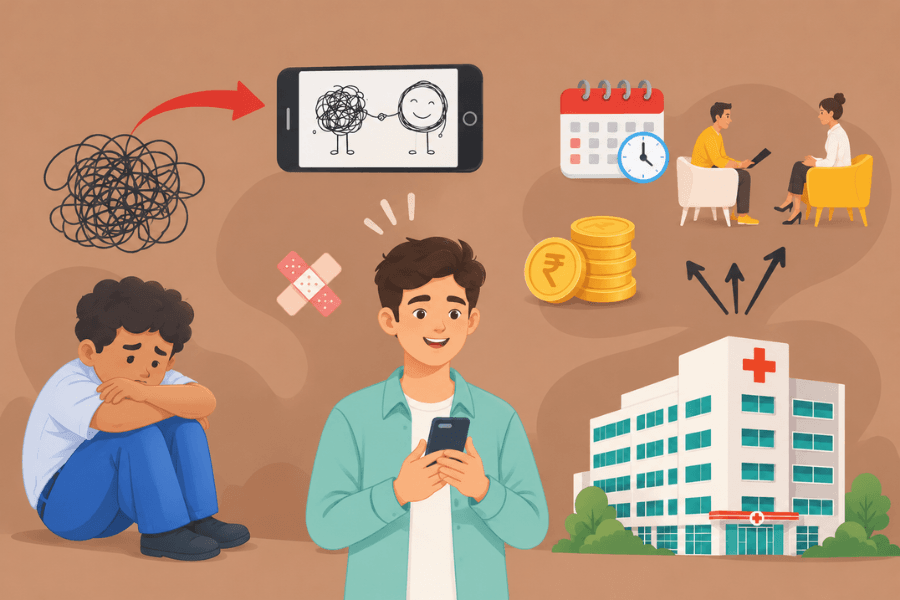
Mental-health systems face a persistent gap between the need for care and the treatment people receive. The World Health Organization estimates that more than one billion people worldwide live with a mental disorder, while access to adequate treatment remains severely limited in many settings. Reducing stigma may encourage people to seek help, but whether that willingness translates into treatment depends on more than communication alone. An experiment in Nepal examines how mental-health messages affect willingness to seek counselling and what the findings imply for connecting awareness campaigns with accessible care.
The Social Costs of Seeking Help
Stigma can discourage help-seeking through both internalised beliefs about mental-health difficulties and expectations of how others will respond. People may regard seeking treatment as a sign of personal weakness while anticipating disapproval from family members, neighbours or colleagues. Communication strategies therefore need to address the social meaning of seeking help, alongside providing information about mental-health conditions and available support.
In an experimental study of 2,485 adults in Nepal, 67 percent regarded seeking mental-health care as a sign of weak willpower, while 47 percent believed others might consider them inferior if they sought treatment. These findings illustrate the social and personal barriers that mental-health communication must contend with.
When Communication Changes Intentions
The experiment tested two messages delivered by telephone. One combined information about the prevalence and treatability of mental-health difficulties with the message that seeking help is a sign of strength. The other described a Nepali public figure’s experience of depression and recovery with professional support. Both interventions produced modest increases in stated willingness to seek counselling relative to a control group. The pooled effect was 0.11 standard deviations, with similar effects for the information-based message (0.12) and personal narrative (0.11). The difference between the two interventions was not statistically significant.
The information-based message challenged beliefs about the prevalence of mental-health difficulties and the meaning of seeking help, while the personal narrative offered a visible example of recovery through professional support. Effects were stronger among respondents reporting greater stigma and relatively mild symptoms, suggesting that targeted communication may be particularly useful where social barriers discourage help-seeking.
The Gap Between Willingness and Care
Willingness to seek counselling is an important precursor to treatment, but it does not establish that care will be received. Moving from willingness to treatment requires people to know where trained providers are available, be able to reach and afford their services, and proceed to attend and continue care. In the Nepal study, only 33 percent of respondents knew a trained mental-health counsellor. Although this does not directly measure awareness of available services, it points to potentially limited familiarity with professional sources of support.
The interventions also produced little evidence of increased willingness to pay for counselling. Respondents reported an average increase of approximately NPR 1 per session on a scale capped at NPR 50, but the overall effect was not statistically significant.
Connecting Awareness to Treatment
For India, the findings raise an important question about the relationship between mental-health awareness and service delivery. Initiatives such as Tele-MANAS have expanded access to initial counselling, while the District Mental Health Programme provides a framework for treatment through public health facilities. The challenge is to ensure that people encouraged to seek help can move from initial contact to appropriate assessment, affordable treatment and continuing care.
This also changes how the success of awareness campaigns is judged. Greater willingness to seek help, higher helpline use and increased demand for counselling are encouraging signals, but they cannot establish whether treatment gaps are narrowing. Evaluating referral completion, treatment continuity and patient outcomes would reveal more about whether communication efforts are producing meaningful improvements in access to care.
The Nepal experiment shows that even brief messages can influence attitudes towards seeking help. The larger policy test for India is whether efforts to encourage people to come forward are matched by the capacity to care for them once they do.